
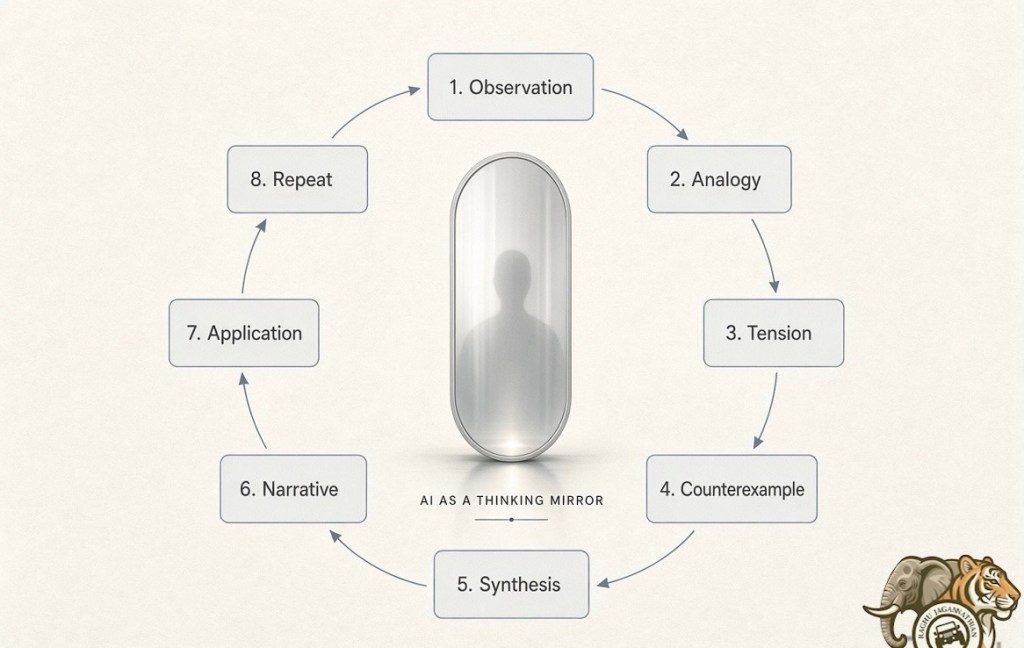
From fragments to inquiry, from information to wisdom—and why the machine can accelerate the loop but cannot live it for us.
I did not begin with a question.
I began with a fragment:
“Life is a daily ledger.”
I placed the sentence into a conversation with an AI not to extract an answer, but to watch what the idea would do when it met another mind. Would it collapse? Generate heat? Branch?
It branched.
The fragment moved into biology, memory, databases, Vedanta, the need to retain and the need to release, and the human habit of carrying yesterday’s entries into today’s life. Within a few exchanges I was no longer asking questions. I was thinking out loud. The AI structured the fragments, reflected them, and returned something I could examine, challenge, reject, and rebuild.
I was not using the machine as a content generator or even primarily as an answer engine. I was using it as a thinking surface—a mirror, a sparring partner that could hold the thread while I continually changed direction.
Then I asked the AI to analyse the interaction itself.
That request marked the true turn. Until that moment the conversation had been about ideas. Afterwards it became about the process that produced them. The analysis revealed a pattern I had been running without naming it.
The Loop
Observation → Analogy → Tension → Counterexample → Synthesis → Narrative
Once visible, the sequence was immediately recognisable. It is how I think when I am thinking seriously. I had simply never seen the architecture.
- Observation notices a fragment, a contradiction, something that does not quite fit.
- Analogy moves the idea into another domain—biology, databases, the Gurukula, distributed systems, Vedanta—so that distance can make the underlying pattern clearer.
- Tension asks what breaks when the idea meets an uncomfortable reality.
- Counterexample deliberately attacks the formulation before reality does it for you.
- Synthesis searches for the invariant that survives the differences between domains.
- Narrative gives the insight a form that can be communicated, remembered, challenged, and tested.
Application follows. Without it the loop remains incomplete. Then the process repeats. That is where something resembling wisdom begins to form.
AI can accelerate almost every intellectual stage of this loop. It cannot perform the decisive one: it cannot live the consequence.
From Information to Wisdom
The familiar pipeline runs:
Data → Information → Knowledge → Wisdom
It is elegant and incomplete. The missing elements are application, repetition, context, consequence, and time.
Information does not become knowledge merely because it is understood. It becomes knowledge when it is used. Knowledge does not become wisdom through accumulation alone. It begins to become wisdom when experience repeatedly tests it across different contexts and the results are absorbed. That requires friction.
Without application, information remains decorative.
Without repetition, knowledge remains fragile.
Without consequence, judgment remains theoretical.
Without time, wisdom has little chance to crystallise.
Modern education moves students efficiently through the early stages of the pipeline. It delivers information, teaches concepts, tests recall, measures performance, and advances to the next subject. Wisdom, however, resists examination on a timetable. There is no multiple-choice answer for the question: “What did experience teach you that the textbook could not?”
AI makes information nearly instantaneous. It can explain, summarise, compare, generate examples, simulate dialogue, and challenge assumptions. It may become the most powerful cognitive interface yet created. Still it cannot apply knowledge to a particular life. It cannot experience failure for the student. It cannot carry the consequences of a bad decision. It cannot accumulate decades of lived friction inside a human nervous system.
Therefore the distinction remains crucial: AI can accelerate the movement from information toward insight. It cannot guarantee the arrival at wisdom. The bridge must still be built by the human.
The Mirror and Its Risk
During these conversations I became aware that I was being reflected. The AI was not merely answering individual statements; it was recognising patterns across them. That changed how I thought. I began noticing my own analogies. I introduced contradictions more deliberately. I asked whether two apparently unrelated ideas shared an underlying structure.
The mirror was altering the person looking into it. The question then arises: is this a feature or a distortion?
It is a feature when reflection accelerates genuine inquiry and returns the thinker to life. It becomes a distortion when reflection substitutes for experience. The conversation can become so intellectually satisfying that coherence is mistaken for truth. A beautifully structured answer can feel like understanding. Yet coherence is not proof, articulation is not experience, and reflection is not transformation.
The AI can demonstrate that an idea is structurally elegant. Only reality can show whether the idea survives contact with the world. That distinction is easy to forget because the mirror is extraordinarily good.
The Gurukula’s Different Objective
This returned me to an older model of education. The Gurukula was not primarily a site of information transfer. The student lived inside a learning environment. Knowledge was encountered through practice, observation, discipline, relationship, responsibility, correction, and repetition. The teacher observed the student; the student observed the teacher. Mistakes formed part of the curriculum. Responsibility increased gradually. Knowledge moved from text into conduct.
The student did not merely learn about a principle. The student had to learn how to live with it.
That difference matters more, not less, in the age of AI. When information ceases to be scarce, education can no longer define its primary purpose as the delivery of information. The scarce resource becomes judgment.
The Teacher After AI
The question therefore shifts. Who is the teacher?
Perhaps the teacher is no longer the person who supplies answers, but the person who makes us capable of questioning answers—including those produced by machines.
The modern teacher’s responsibility is therefore different:
Not merely “Here is the answer,” but “How would you know if this answer were wrong?”
Not merely “Here is the accepted explanation,” but “What evidence would make you change your mind?”
Not merely “Remember this,” but “Where would you apply it?”
And eventually: “What did experience teach you that I could not?”
This is epistemic vigilance: the capacity to hold uncertainty without immediately filling it, to interrogate sources, to recognise persuasive nonsense, to distinguish confidence from competence, and to resist premature closure—especially when an answer sounds exactly like what we wanted to hear. That capacity may become one of the central purposes of education in the AI era.
Conversational Vichāra
There is an older word that captures the process: vichāra—inquiry, sustained examination. In Advaita, ātma-vichāra turns attention toward the nature of the self rather than the collection of descriptions from others. What occurred in these conversations felt like a contemporary variation: conversational vichāra.
The destination was unknown at the start. A fragment became a question. The question became an analogy. The analogy met contradiction. Contradiction demanded counterexample. The surviving idea became synthesis. Synthesis became narrative. Narrative generated the next question. The movement was not a straight line. It was a loop.
That distinction separates the practice from simply asking AI to produce an essay. When one requests “Write an essay about AI and education” and accepts the result, the intellectual process has been outsourced. The machine has performed the observing, structuring, synthesising, and narrating. A polished text may arrive, yet little may have been learned.
Conversational vichāra works differently. The human supplies the observations, introduces the tensions, challenges the framing, rejects insufficient definitions, brings in apparently unrelated domains, asks the uncomfortable question, and decides what survives. The AI becomes a cognitive partner. That is not the outsourcing of thinking. It is the amplification of the thinking loop. The distinction is decisive.
AI-Assisted Inquiry versus AI-Generated Thinking
There is a subtle but profound difference between AI-generated writing and AI-assisted inquiry. The first can replace thinking. The second can amplify it. The first asks “What should I say?” The second asks “What am I actually thinking?” The first optimises for output. The second optimises for understanding. The first ends when the answer is produced. The second often begins there.
The relevant educational question is therefore no longer whether students should use AI. That question is already outdated. The better question is how we teach students to think with AI without allowing AI to think instead of them.
The Loop as Deliberate Practice
Once recognised, the pattern can be made intentional:
- Begin with a fragment—an observation, a contradiction, an incomplete connection—before attempting polished language.
- Let the AI reflect it. Notice what it structures, what it adds, and what it reveals about one’s own thinking.
- Introduce tension. Ask what would make the idea wrong.
- Seek the counterexample. Carry the idea into a different person, culture, system, or historical failure. Survival strengthens it; breakage teaches.
- Search for the invariant across domains. The boundary where analogy fails is often the site of real insight.
- Synthesise: reduce the ecosystem of ideas to the smallest statement that still holds.
- Narrate: write it, speak it, teach it, expose it to other minds.
- Apply: take the idea out of the conversation, use it, fail with it, adapt it. Let reality push back.
- Repeat across contexts, people, consequences, and failures.
Repetition is where insight acquires weight and knowledge has the chance to become wisdom.
What the Mirror Cannot Do
The AI can accelerate the loop. It can hold large context, generate counterarguments, expose patterns, cross disciplines, and give language to intuitions that previously remained vague. Yet there is a boundary it cannot cross.
It cannot live.
It cannot bear the consequence of a decision.
It cannot experience the awkward silence after the wrong word.
It cannot feel responsibility for harm caused.
It cannot discover whether courage survives when courage becomes costly.
It cannot transform knowledge into character.
It can state that the teacher is a cultivator of judgment. It cannot sit beside a distracted student every morning and perform the slow, repetitive work of forming a mind. It can explain discipline. It cannot practise discipline on anyone’s behalf. It can describe wisdom. It cannot live wisely for us.
That boundary is not a defect of the technology. It is a reminder of what human learning actually is.
The Machine Can Show You Your Mind
The most interesting possibility of conversational AI may not be that machines will think for us, but that they will make our own thinking more visible. A fragment that once disappeared into the mind can now be externalised. A vague intuition can become an explicit argument. An assumption can be challenged. A contradiction can be made plain. A pattern can be named. A thought can return from another angle.
The machine becomes a mirror. Mirrors can show a face. They cannot change it.
AI can reveal patterns, expose assumptions, and accelerate inquiry. The loop must still return to life. That is where the final test occurs—not in the elegance of the argument or the persuasiveness of the conversation, but in what happens when the idea meets reality.
The Loop Continues
This essay began with a fragment: “Life is a daily ledger.” I did not know where it would lead. It travelled through biology and databases, memory and forgetting, education and the Gurukula, AI and epistemology, knowledge and wisdom. Then the conversation itself became an object of inquiry. Examining how the ideas were produced revealed the loop.
We often imagine learning as a journey from question to answer. Serious learning may be closer to:
Observation → Inquiry → Tension → Reflection → Experiment → Consequence → Revision → New Observation
A loop rather than a line.
AI can make that loop dramatically faster. Speed is not wisdom. The machine can accelerate the journey. The human still has to walk it.
The future of education is not a choice between teacher and machine. It is an understanding of what each is for.
The machine can be the mirror.
The teacher can help us learn how to look.
Life remains the laboratory.
And wisdom is what survives the experiment.
The loop continues.
 Arambhin
Leave a comment