
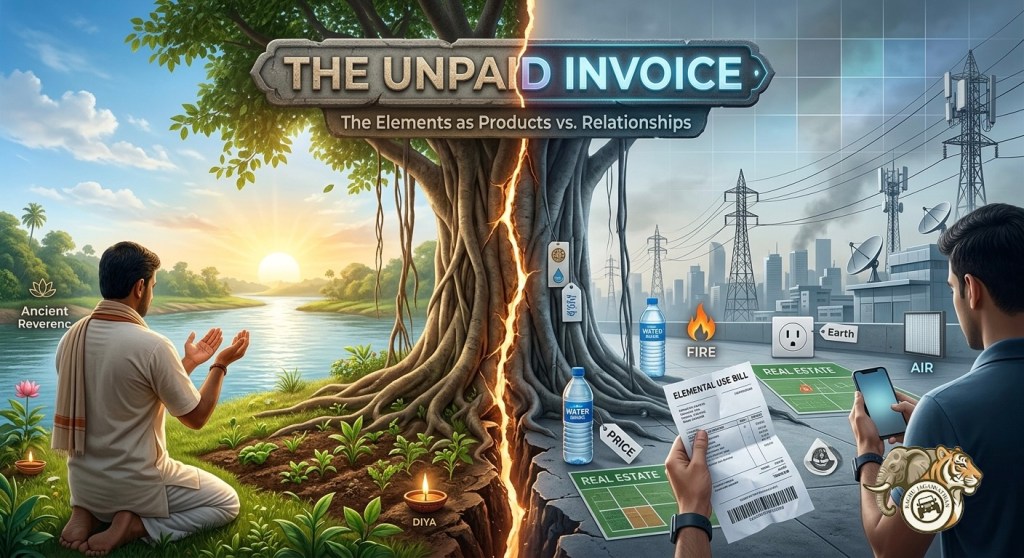
How We Turned the Five Elements into Products and Called It Progress
Imagine taking your smartphone back a thousand years. People would be astounded by the glass that glows with moving images. Now imagine taking something else back with you: a plastic bottle of drinking water. An electricity bill. A carbon credit certificate. A deed for a quarter-acre of land.
That would confuse them far more than the glowing glass.
“You pay for air?” they would ask.
“Sometimes,” you would reply.
“You pay for water?”
“Every month.”
“You pay for fire?”
“We call it electricity.”
“You pay for the earth?”
“We measure it by the square foot.”
“And the sky?”
“We auction it for satellites, telecom spectrum, and orbital highways.”
They would likely ask one final, piercing question: “When did the five elements become products?”
The uncomfortable answer is that they never did. Only our relationship with them changed.
There was a time when civilization began each morning with gratitude rather than consumption. Before opening the eyes, there was a prayer. Before placing one’s feet on the ground, an apology was whispered to Bhūmi Devī:
Samudra-vāsane devi parvata-stana-maṇḍale |
Viṣṇu-patni namas-tubhyaṃ pāda-sparśaṃ kṣamasva me ||
“O Devī, You who wear the ocean as Your garment and the mountains as Your bosom, Consort of Viṣṇu, salutations to You. Forgive the touch of my feet upon Your holy body.”
That single verse contained an entire worldview. Every step was taken on borrowed earth. The first rays of the sun were greeted with upturned palms. The first sip of water was received with reverence. Even the act of bathing was an invocation rather than a private hygiene ritual:
Gaṅge ca Yamune caiva Godāvari Sarasvatī |
Narmade Sindhu Kāveri jale’smin sannidhiṃ kuru ||
“In this water, I invoke the presence of Gaṅgā, Yamunā, Godāvarī, Sarasvatī, Narmadā, Sindhu, and Kāverī.”
Food was never simply food. Every meal carried the invisible fingerprints of sunlight, rushing rivers, fertile soil, fire, microbes, insects, weary farmers, and time itself. People did not worship nature because nature demanded worship. They practiced gratitude because gratitude transformed the human being. The prayer changed nothing outside—it changed the one who prayed.
Somewhere along the way, we stopped speaking the language of relationships and became fluent only in transactions. Nature became a resource. Knowledge became content. Education became employability. Health became a subscription, and attention became a commodity.
The five elements quietly acquired price tags. Air was reduced to HEPA filters and oxygen cylinders. Water became branded plastic bottles. Fire morphed into electricity tariffs and fuel prices. Earth became real estate, and the infinite sky was carved into spectrum auctions. We started paying monthly bills to access what earlier generations considered sacred, unalienable gifts.
The irony is as tragic as it is quiet: we pay for water while forgetting the river. We pay for electricity while forgetting the sun. We pay for life while forgetting its source.
Then something even stranger happened. We declared the old ways obsolete. Tradition was labeled “old school.” Culture became “backward,” and ritual was dismissed as “superstition.” Science became the only language worthy of respect.
Science unequivocally deserves its place. It gave us vaccines, satellites, the internet, modern medicine, and weather forecasting. It taught humanity the mechanics of how the universe works. But somewhere in the triumph of celebrating that achievement, we quietly abandoned a vital question: How should we live within it? That question belonged to culture.
Look carefully, and history begins to smile. The ideas we discarded never truly disappeared; they simply returned wearing different clothes. Yoga became fitness. Meditation became mindfulness. Fasting became intermittent fasting. Breathwork became nervous system regulation. Silence became a digital detox. Community morphed into networking, gratitude into journaling, and respect for nature into sustainability. Nothing vanished. Everything was rebranded. Perhaps wisdom discovered that modern civilization would only listen if ancient truths arrived carrying scientific papers instead of scriptures.
We clear-cut ancient forests, then organize global climate summits. We drain wetlands, then ask why our cities flood. We poison the soil with chemicals, then pay a premium for organic food. We isolate ourselves from the wild, then prescribe nature therapy for our depression. Our solutions increasingly serve only to repair the problems our lifestyles continue to create.
Nature is not punishing us. Nature is simply responding. Cause and effect has no ideology.
The deepest loss of the modern era is not environmental. It is relational. Our ancestors did not believe a prayer paid for the earth. They knew some debts could never be repaid. A mother cannot be reimbursed for giving birth. A tree cannot invoice us for oxygen. A river cannot calculate interest on the water flowing through our veins, and the sun never sends a monthly subscription fee for the dawn. The greatest gifts in life refuse to become transactions. They can only become relationships. Touching the earth each morning was not paying a debt; it was remembering that the debt was unpayable.
Perhaps this explains our strange, collective emptiness. We have more information than any civilization before us, yet information is not wisdom. Knowledge tells us the chemical composition of water; wisdom teaches us not to poison the river. Knowledge explains how photosynthesis works; wisdom plants the tree anyway. Knowledge builds artificial intelligence; wisdom asks whether human intelligence is growing alongside it. Science explains how. Culture remembers why. Neither is complete without the other.
To Gen Z: You inherit more computing power in your pocket than entire nations possessed a generation ago. You inherit quantum computing, space exploration, genomics, and robotics. But you also inherit rising temperatures, disappearing forests, polluted rivers, fractured communities, anxiety, loneliness, and a civilization that has become astonishingly efficient at extracting value while completely forgetting reverence.
Your task is not to choose between tradition and technology. It is to become bilingual.
You must learn to understand satellite imagery and still greet the sunrise. You must build solar panels while remembering every watt is borrowed sunlight. You must design Artificial Intelligence without abandoning human wisdom. You must measure atmospheric carbon while protecting the forests that quietly balance it. You must see a river both as a watershed and as a relative—not because science demands it, but because civilization does.
The greatest illusion of modern life is that everything has a price. The deepest truths never did. The sun still rises without an invoice. The wind still fills every newborn’s lungs without asking for payment. The earth still grows food with astonishing generosity. The rivers still flow, if we allow them.
Maybe the climate crisis is not solely an environmental crisis. Maybe it is a crisis of gratitude. A civilization that forgets how to bow before its source will eventually begin billing itself for survival. The future will not be saved by rejecting science, nor by romanticizing the past. It will be saved when we learn to hold both in the same hands—one hand building the future, the other remembering what should never have been forgotten.
Because the greatest innovations are not always inventions. Sometimes, they are ancient relationships waiting to be lived again.
 Arambhin
Leave a comment