
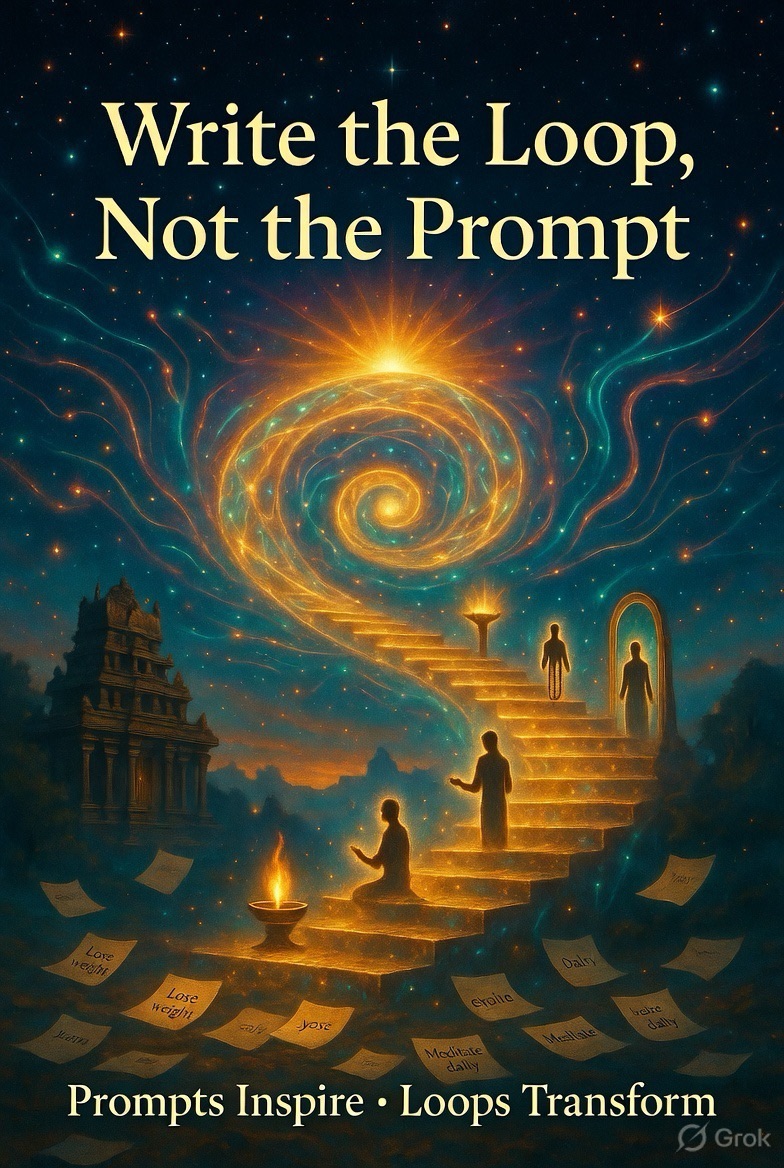
The First Agent Principle
How AI Agents, Bhakti, and Ancient Wisdom Converge on the Same Truth
Every January, millions of people write themselves a new prompt.
“This year I’ll lose weight.”
“I’ll meditate every day.”
“I’ll build a business.”
“I’ll become a better person.”
For a few days, motivation burns brightly. Then life resumes, and the prompt quietly expires.
The problem isn’t ambition.
It’s architecture.
Prompts Inspire. Loops Transform.
In his essay LOOPS.md: Field Notes on Agents That Run for Days, Andrej Karpathy begins with a deceptively simple principle:
Write the loop, not the prompt.
A prompt is a one-time instruction.
A loop is a living system. It repeatedly gathers information, reasons, acts, verifies, learns, and begins again. The intelligence doesn’t come from one brilliant instruction. It emerges from thousands of iterations.
That insight extends far beyond artificial intelligence.
It explains why resolutions fade, why organizations lose momentum, why mastery takes years, and why the deepest spiritual traditions have always emphasized disciplined repetition over emotional intensity.
Humans Are the Original Long-Running Agents
If an AI agent runs for days, a human being runs for decades.
We don’t become wise because of one profound thought.
We become wise because life keeps asking the same questions in different forms.
Wake.
Work.
Love.
Fail.
Reflect.
Grow.
Repeat.
Every day is another iteration.
Character is simply the output of the loops we choose to run.
Bhakti Was Never Designed as a Prompt
Modern spirituality often resembles a search engine.
We have a problem.
We visit a temple.
We make a request.
We expect a result.
If nothing changes, we try another temple, another deity, another ritual.
That is prompt-based devotion.
Ancient Bhakti was designed very differently.
When someone undertakes a 9-day Navaratri vrata, a 12-week Hanuman vrata, a 48-day mandala, a 90-day observance, or a 108-day japa, the intention is not merely to repeat a prayer. The intention is to enter a transformative loop.
Every day follows the same architecture.
Wake.
Purify.
Pray.
Chant.
Serve.
Observe the mind.
Live with restraint.
Sleep.
Repeat.
The transformation is not expected from a single prayer.
It emerges from hundreds of faithful iterations.
The deity is not merely answering requests.
The deity becomes the stable center around which an otherwise restless life begins to organize itself.
The Loop Creates the Gravity
Life is naturally chaotic.
Thoughts wander.
Desires multiply.
Emotions fluctuate.
Ancient traditions understood that the mind doesn’t become peaceful by force.
It becomes peaceful when it finds a stable center.
The chosen deity becomes that center.
Every chant, every visit to the temple, every act of restraint gently pulls the mind back into the same orbit.
The loop creates the gravity.
Over time, discipline stops feeling imposed.
It becomes natural.
The ritual that once required effort quietly becomes character.
A Vrata Is Not a Bargain
Many people approach a vrata as a transaction.
“If my wish comes true, I’ll perform this for 48 days.”
But traditionally, the vrata itself is the medicine.
Its purpose is not to persuade the Divine.
Its purpose is to transform the devotee.
During those 48 or 108 days, the practitioner regulates food, sleep, speech, attention, and behavior. Every repetition weakens an old habit while strengthening a new one.
The miracle is not that life suddenly changes overnight.
The miracle is that the person facing life is no longer the same.
Repetition Is Not Circles. It Is a Spiral.
Critics often dismiss rituals as rote repetition.
But sacred repetition is not a circle.
It is a spiral.
Each morning the mantra is the same.
The devotee is not.
Yesterday the mind was restless.
Today it is calmer.
Tomorrow it may resist again.
The unchanging prayer becomes a mirror reflecting every internal fluctuation: impatience, ego, distraction, gratitude, devotion, and peace.
The prayer is not changing the deity.
The repetition is revealing the devotee to themselves.
From Transaction to Transformation
Prompt-based thinking says:
“God, solve my problem.”
Loop-based Bhakti slowly evolves into:
“God, make me capable of facing whatever comes.”
That subtle shift changes everything.
The objective is no longer merely changing circumstances.
It is changing consciousness.
The devotee becomes more resilient, more patient, more centered.
In modern language, we might call this emotional resilience, habit formation, or cognitive rewiring.
Ancient traditions simply called it sādhana.
The loop retrains the mind.
The sacred words become a carefully curated dataset.
Daily repetition reshapes perception until a new way of seeing the world becomes natural.
The miracle is not that reality bends.
The miracle is that the mind does.
Every Loop Builds Anti-Fragility
A single answered prayer may solve today’s problem.
A disciplined spiritual loop prepares you for tomorrow’s uncertainty.
The intentional constraints of a vrata, whether fasting, silence, early rising, or disciplined worship, are not punishments. They are controlled challenges that strengthen the mind through practice.
Like a tree growing stronger against the wind, the devotee becomes more stable because of the discipline, not despite it.
The goal is no longer comfort.
It is capacity.
The Hidden Genius of Bhakti
Long before neuroscience, behavioral psychology, or artificial intelligence, Bhakti traditions understood a timeless principle:
Humans are shaped less by isolated decisions than by repeated patterns.
A prayer offered once may comfort.
A prayer lived every day transforms.
The genius of the vrata was never in the number 9, 48, 90, or 108 alone. Those numbers create a container long enough for a new pattern of living to take root.
The prayer was never merely asking.
The loop was always becoming.
Beyond the Temple
This principle extends beyond spirituality.
What if we approached health as a vrata instead of a resolution?
What if we treated relationships as daily practice rather than occasional repair?
What if learning became a sacred loop instead of a race for certificates?
What if leadership were measured by disciplined repetition instead of dramatic speeches?
The same architecture that shapes a devotee can shape a family, a company, or a civilization.
Closing Reflection
Perhaps Karpathy’s insight about AI agents is really an ancient truth wearing modern clothes.
A prompt changes an answer.
A loop changes a system.
For AI, that system is software.
For humans, it is consciousness.
For Bhakti, it is the heart.
The deepest traditions never promised instant miracles.
They offered something far greater.
A way of becoming someone who no longer needs life to change before they do.
 Arambhin
Leave a comment