
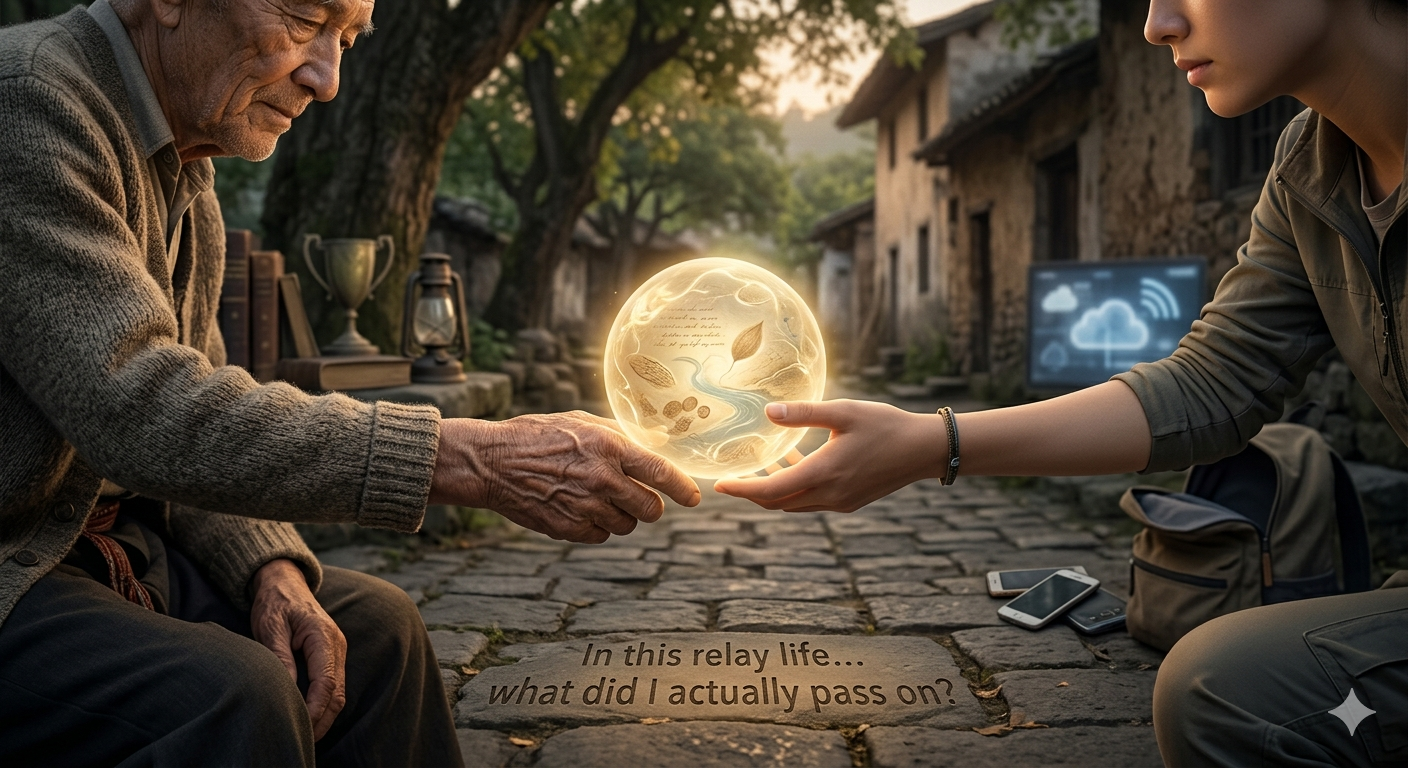
There comes a strange age in life when success no longer feels like ownership. The trophies gather dust on forgotten shelves. Passwords replace memories, contacts replace relationships, and invisible clouds store what our hearts once carried. Somewhere between ambition and exhaustion, a quieter question begins to rise:
In this relay life… what did I actually pass on?
We entered the world holding nothing; everything we touched was inherited. Language came from forgotten tongues. Stories came from fireside elders. Roads were laid by workers we will never know, and seeds were saved by farmers long gone. Even our bodies are ancestral hand-me-downs—stitched together through countless generations that survived storms, droughts, migrations, wars, and silence.
Life was never a solo race. It was always a relay.
For a brief, blinding moment, the baton reaches our hands: a child, an idea, a tradition, a piece of land, a skill, a fragile future. And yet, modern life whispers a dangerous lie: hold tighter. So we clutch wealth beyond need, power beyond purpose, attention beyond meaning, and resources beyond replenishment. We have built systems that reward endless accumulation, but rarely teach graceful transmission.
Perhaps life itself is a vast, living program driven by events. If events arrive—unexpected, urgent, ordinary—and our inner handlers respond. A smile from a stranger triggers warmth. Hunger fires the search for food. Heartbreak queues reflection that may surface years later. Messages pass asynchronously across time: hormones broadcast through the body, ideas spread through cultures, traumas replay in quiet moments. The code is wetware, messy and emergent, refined by billions of years of blind refactoring. Yet we often route the wrong events—endless notifications starving the deeper ones—while outsourcing our processing to glowing rectangles and remote servers.
Last year, I sat with my father in our small home as he struggled to remember the old Tamil story his grandmother taught him. His hands, once strong from years in the workshop, now trembled slightly as he tried to show my daughter how to tie a simple knot he had learned as a boy—the same one used to secure fishing nets in his village decades ago. For a moment, the phone in my pocket buzzed with notifications, pulling me toward emails and digital noise. I almost reached for it. But watching him patiently guide her small fingers, correcting her gently when the rope slipped, something shifted. In that ordinary evening, an ancient event handler fired: the relay activated in real time. Not through grand achievements or accumulated data, but through a simple skill and a quiet story passed like a serialized payload from one generation’s queue to the next. I realized how close I had come to breaking the chain by letting low-value events crowd out the ones that matter.
Nature understands continuity better than our overloaded systems. The farmer once saved seeds for seasons he would never see. The village elder passed on stories before memory disappeared. The craftsman trained apprentices, knowing his own hands would one day tremble. Even elephants guide their young toward hidden water during droughts. A river does not drink its own water. A tree does not eat its own fruit. The sun does not invoice the earth for light.
But humans, standing several abstraction layers above nature, slowly forgot the rhythm of passing things forward. We externalize not just tasks but the inner life that makes transmission possible. Ancient stories warned us symbolically. Demons hid their life force in distant birds across seven seas. Today, our lives too live elsewhere—in servers, databases, profiles, and digital shadows.
And still, children arrive. Animals migrate. Birds remember the skies. Forests communicate underground. Life continues, trying desperately to teach us the original pattern.
Perhaps that is why a child changes an adult so deeply. Not because the child needs to become us, but because they remind us of what we forgot while becoming modern: to wonder. To observe. To belong. To pass on without possessing.
One day, whether gently or suddenly, every runner reaches the edge of their lap. Status disappears. Ownership dissolves. The applause fades. And in that profound silence—something either remains in the world, or it doesn’t
Leave a Reply