
Technology, Ego, and the Longing for Bhakti
Human civilization began with wonder, but as desire evolved, comparison, ownership, and conflict followed. From the first light described in the Rigveda’s Nasadiya Sukta to modern technology, humanity has continuously tried to imitate and control nature through its creations. Yet every tool, from the glass to AI and biotechnology, silently reshapes human consciousness and relationships. Ancient dharmic traditions and bhakti teachings warned that power without humility leads to imbalance, ego, and destruction. The real challenge of our age is not choosing between technology and nature, but rediscovering how to create without losing reverence, balance, and belonging.
The bird flew, so we built airplanes. Night fell, so we manufactured daylight. Nature wove memory through consciousness; we answered with servers and the internet. Technology became our long declaration to the universe: “You create. I can too.”
That impulse was never wrong. The wheel eased burdens. Medicine extended life. Language preserved wisdom across generations. But somewhere, creation quietly mutated into an obsession with dominance. Instead of dancing with nature’s design, we began overriding it.
From Greenhouse to Gas House
Ancient homes listened to the land. Courtyards welcomed breezes. Mud walls cooled naturally. Villages aligned with monsoons and sunlight. Architecture was negotiation, not conquest.
Today’s cities trap heat with concrete, glass, and asphalt—then burn energy to cool what we overheated. Air-conditioned rooms chill our bodies while warming the planet outside. Cars promise freedom but deliver congestion. Industrial farms force yields while depleting soil. We behave like a sailor drilling holes in his boat to install a fancier pump.
The deeper wound is psychological. Nature taught rhythm: seasonal harvests, the boundaries of dawn and dusk, the grace of patience and rest. Modernity swapped rhythm for relentless optimization. Mangoes on demand. Midnight emails. Infinite scrolls. Our ancient bodies now inhabit synthetic worlds.
The Day the Bottle Fell from the Sky
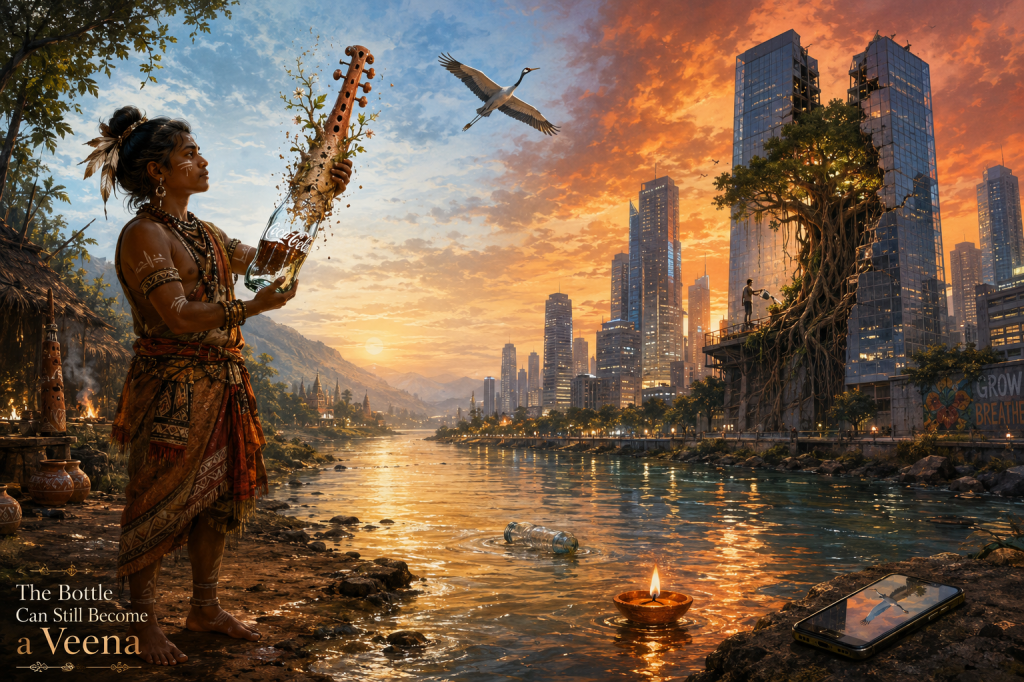
In The Gods Must Be Crazy, a Coca-Cola bottle drops from an airplane into a balanced indigenous tribe. The bottle itself is harmless. Yet it carries an entire civilization’s logic—comparison, ownership, desire, conflict. The tribe’s harmony fractures.
This is how many modern tools arrive: disguised as convenience. The smartphone promises connection and fragments attention. Social media offers community but turns identity into performance. Plastic promises preservation but litters oceans. Every tool carries a hidden philosophy. A tool is never just a tool.
Wars: When Tools Outpace Wisdom
From industrialized killing in World War I to nuclear weapons, algorithmic manipulation, and editable biology, humanity keeps extending its reach—muscles to machines, machines to minds, minds to genes. Each leap brings chest-puffing declarations of power.
Yet history whispers: capability evolves faster than consciousness. We built reactors before emotional maturity. We coded global platforms before ethical clarity. We summoned AI before philosophical grounding. The true risk emerges when these god-like tools amplify our unresolved impulses—greed, fear, domination, ego.
Nature does not negotiate with arrogance. A virus pauses economies. An earthquake redraws maps. An ocean reshapes coasts. The tiger needs no visa. Birds migrate without passports. Only humans invented borders after forgetting how to belong.
Why Avatars Appear: The Call of Bhakti
Modern life has made us globally linked yet emotionally homeless. We surround ourselves with algorithms, metrics, and digital masks, yet crave silence, forests, shared meals, temple bells, and rain on old rooftops. Something ancient stirs when we walk barefoot on wet soil.
This is where Bhakti enters—not as fear-based ritual, but as pure love and alignment. In the Narada Bhakti Sutra, bhakti softens the ego into relationship. Existence is not territory to conquer. It is a dance to join with reverence.
Dharmic traditions repeatedly send avatars not merely to punish villains, but to restore balance when power outruns humility. Ravana, Hiranyakashipu, Duryodhana—brilliant, disciplined, immensely capable. Their flaw was the same: ego eclipsing dharma. The asura is not always an external demon. It arises in institutions, corporations, technologies, and hearts—wherever greed, arrogance, or delusion takes root.
Bhakti is civilization’s essential counterweight. It insists intelligence must bow to wisdom, capability to compassion. In an age of god-tools, this humility is our surest safeguard.
The Real Question
Every advanced civilization eventually produces two forces: those preserving harmony and those seeking to dominate reality. The friction between them writes history. Many now rebel—not against progress itself, but against a mechanical, dehumanized existence that starves the soul.
The future hinges on one choice: Will our technology deepen our humanity, or quietly replace it?
The ancients were not anti-innovation. The plough, the veena, temple architecture, and Ayurveda were all technologies—rooted in dharma, rhythm, restraint, and responsibility. We do not need to abandon creation. We need to remember the river was never the enemy.
Perhaps the bottle that fell from the sky can still become a musical instrument for the tribe. The return to Bhakti is not retreat. It is the mature way forward: reverent creation that participates in existence instead of overriding it.
We built the machine. Now we must ensure the machine serves the heart.
The bottle is already in the village. The question is whether we recognise what it carries?.
 Arambhin
Leave a comment