
Dawn: The Question
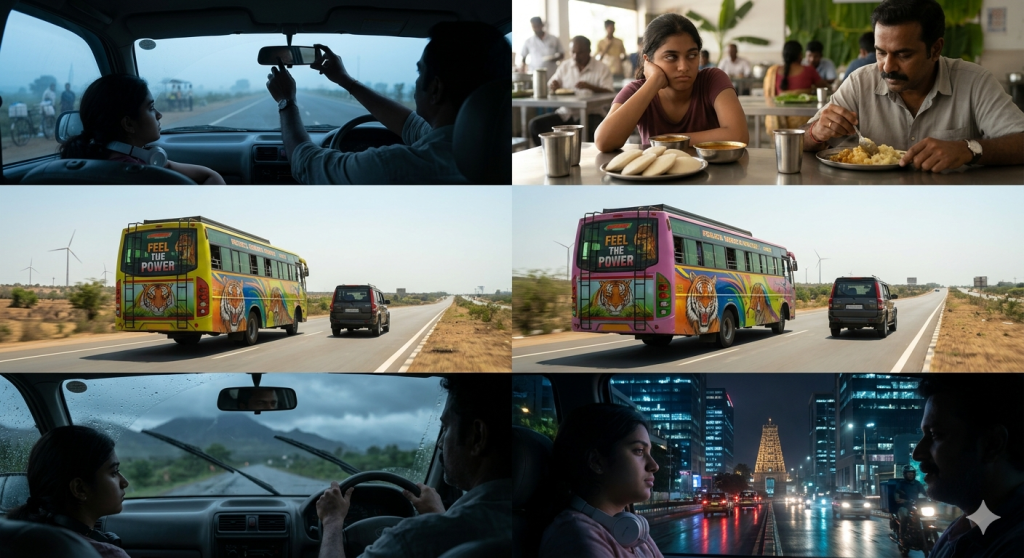
The highway out of Chennai was still rubbing sleep from its eyes. Tea stalls steamed like miniature volcanoes, and milk packets hung from bicycles like ceremonial flags under the pale blue hesitation of dawn.
A father and daughter drove toward Bengaluru in an aging SUV that smelled faintly of jasmine, coffee, old books, and dashboard heat. Ilaiyaraaja floated softly from the speakers as trucks thundered past, heavy with onions and steel rods.
The daughter sat curled near the window, headphones draped around her neck, untouched.
“Appa,” she asked suddenly. “What’s the difference between spirituality and bhakti?”
The father smiled—not because he had a ready answer, but because some questions only arrive when life begins opening its deeper rooms. He adjusted the rearview mirror.
“Spirituality,” he said, “can still be your profile picture.”
She laughed. “And bhakti cannot?”
“Bhakti slowly removes the photographer.”
The daughter turned toward him fully. Outside, the city thinned into toll booths and long stretches of sunburnt earth.
“Then why do so many spiritual people still seem angry?” she asked.
“Because information can decorate the ego,” he replied. “But devotion threatens it.”
A silence settled in the car. It wasn’t awkward. It was temple silence—the kind where even thoughts remove their slippers.
Morning: The Danger of Knowing
Near Vellore, they stopped for breakfast. Steel tumblers collided over the din of the highway as idlis arrived like soft moons. At the next table, two men argued loudly about politics, civilization, and the stock market.
The daughter rolled her eyes. “Everyone sounds so certain these days.”
Her father dipped his pongal into sambar thoughtfully. “That is why Narada is dangerous.”
“Dangerous?”
“He says love matters more than being right.”
She leaned forward. “That sounds weak.”
“No,” he said gently. “It sounds impossible. In the Narada Bhakti Sutra, bhakti is not an emotional dependency. It is total alignment.”
“With God?”
“With truth.”
Afternoon: The Antidote to Taxidermy
Back on the highway, the daughter watched windmills turning lazily against the afternoon sky.
“Appa… is bhakti anti-knowledge?”
He laughed immediately. “That’s like asking if roots are anti-tree.” He began to recite softly: “Bhaja Govindam, Bhaja Govindam… Nahi nahi rakshati dukrinkarane.”
She recognized the Adi Shankaracharya verse.
“When Shankara says grammar cannot save you,” her father continued, “he isn’t insulting intelligence. He is warning against becoming spiritually taxidermied.”
“Taxidermied?”
“Yes. Looking alive, but internally preserved.”
She burst into laughter just as a bus overtook them aggressively. Painted across its back alongside giant tigers was the phrase: FEEL THE POWER.
Her father pointed at it. “Exactly.”
Dusk: The Architecture of Devotion
By the time they reached Krishnagiri, dark clouds had gathered. The hills loomed like ancient rishis in deep meditation before the rain began—slow at first, then dense enough to erase the horizon.
The daughter watched the droplets race across the glass. “What actually is bhakti then?”
He took a slow breath. “It is when God stops being a concept and becomes your interior climate.”
She stayed quiet, letting him continue.
“You know how people say, ‘I believe in fitness,’ or ‘I believe in music’?” he asked. She nodded. “Belief changes nothing. Practice changes structure. Spirituality is sometimes just a belief. Bhakti is repetition until remembrance becomes your default setting.”
The windshield wipers moved rhythmically. Like a mantra.
Night: What Remains
After Hosur, the traffic thickened. Glass buildings began rising from the earth like giant, illuminated hard drives. The daughter looked out at the endless tech parks.
“Funny, isn’t it?” she noted. “Everyone here is building AI.”
Her father smiled knowingly. “Ancient India built intelligence systems, too. The Sapta Rishis were natural intelligence architects. Narada understood emotional bandwidth long before psychologists did. Bhakti is just one of the oldest operating systems for stabilizing human consciousness.”
“That sounds very Appa.”
“It is very Appa.”
Night fell fully as they entered Bengaluru. The wet roads glowed with neon boards, impatient headlights, and delivery bikes ferrying midnight hunger across the city. The daughter looked tired, but softer somehow.
“Appa?”
“Hmmm?”
“You once told me spirituality is my name, but bhakti is my soul.”
“Yes.”
“I think I understand now.” She watched a traditional temple spire flash briefly between two towering corporate buildings. “Spirituality is what I say I am. But bhakti…”
She paused, answering her own question quietly in the dark.
“Bhakti is what remains when life removes the introductions.”
For a moment, neither spoke. Only the engine hummed. Somewhere in the distance, a temple bell rang out through the traffic and the rain.
Ancient sound. Modern city. Same longing
 Arambhin
Leave a comment