
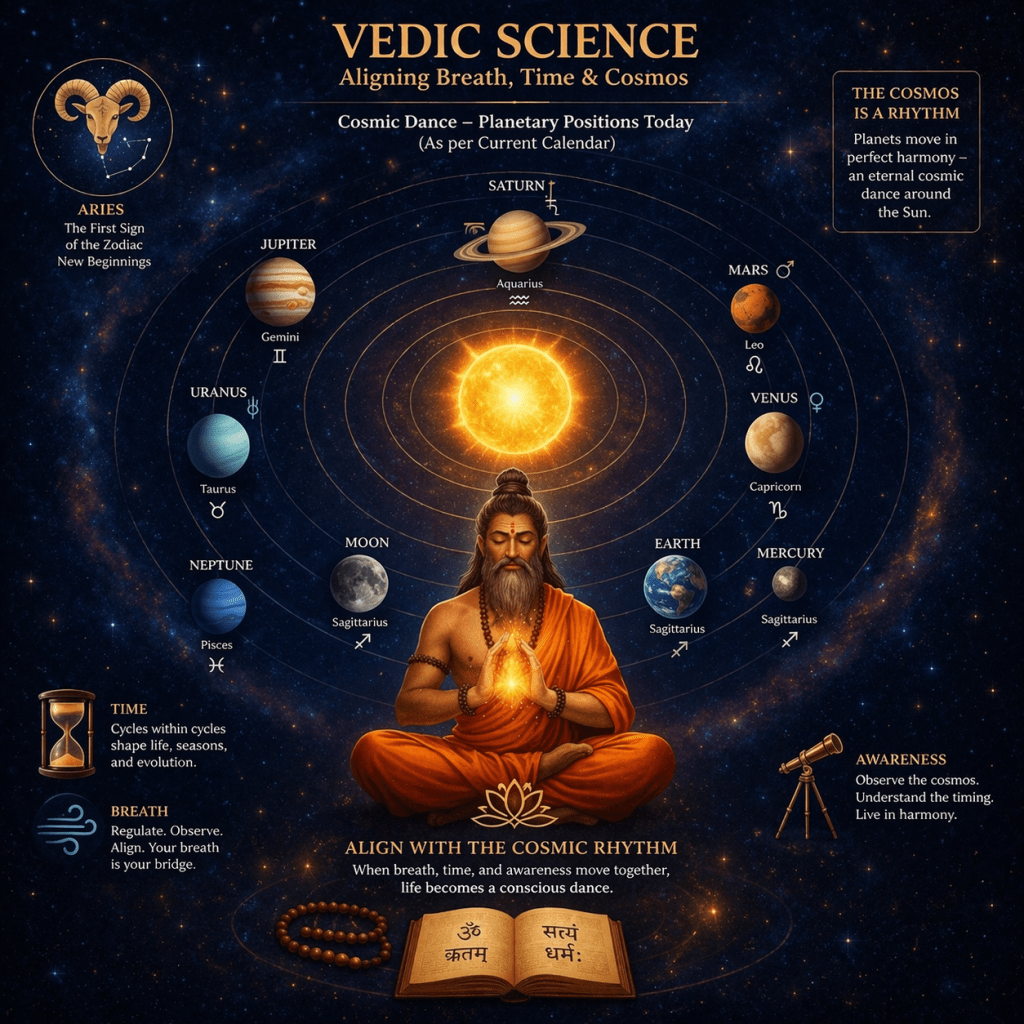
Tamil Puthandu · April 14
Aligning Breath, Time, and the Stars
Mesha Rasi · Sun enters Aries
Imagine the Solar System as a vast, synchronized dance. The Sun is the DJ, holding the center, while the planets whirl around at their own unique tempos—Mercury zipping by on a scooter, and Saturn gliding with the steady weight of an elephant.
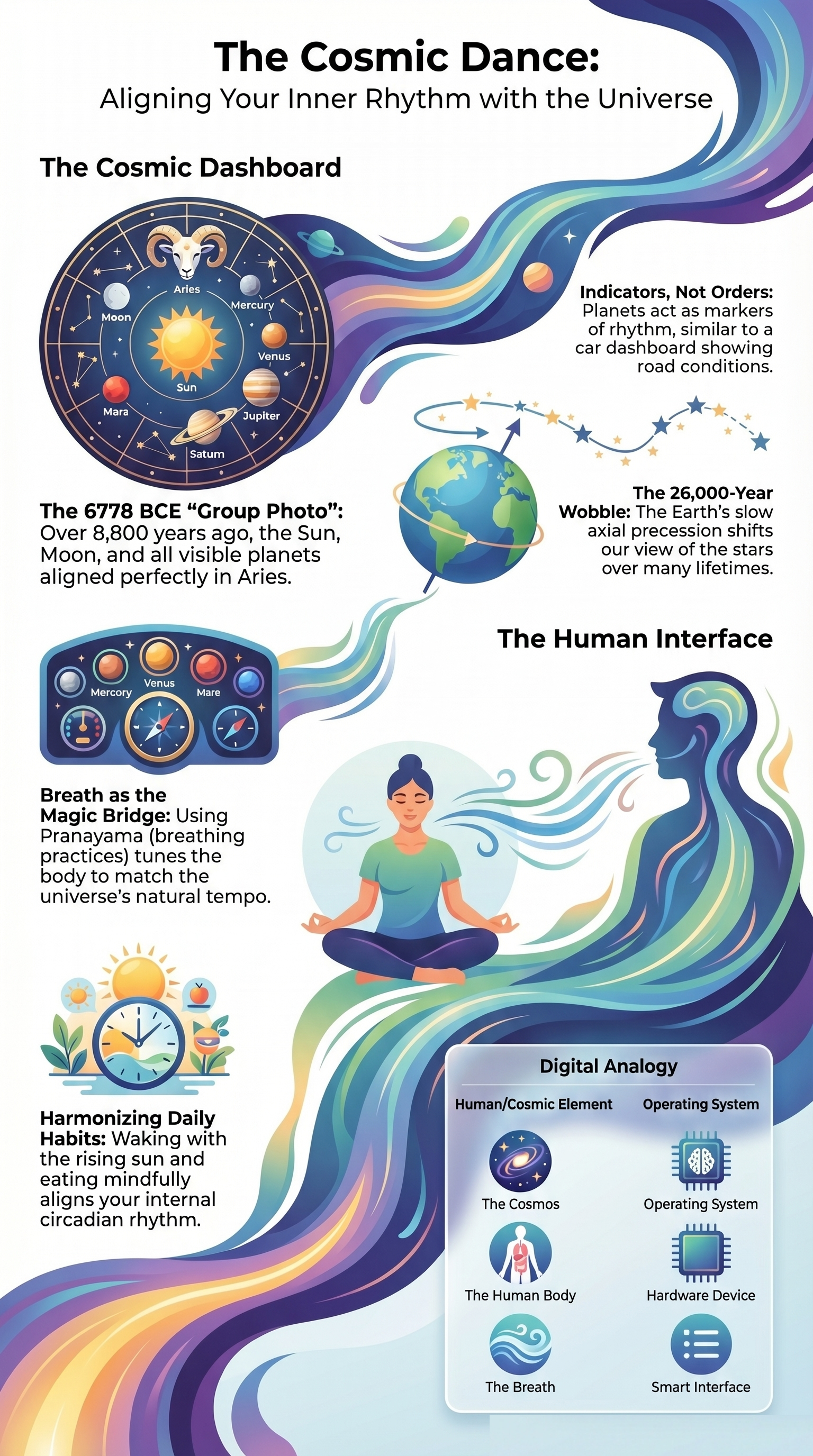
Nearly 9,000 years ago—on February 22, 6778 BCE—this dance hit a rare crescendo. The Sun, Moon, and every visible planet squeezed into a single “group photo” in the constellation of Aries (Mesha). Ancient astronomers captured this beat, using it as the foundational “zero hour” for their calendars. Today, NASA data confirms this alignment actually happened.
This celestial milestone is the heartbeat of Tamil Puthandu (Tamil New Year). As the Sun enters Aries around April 14, we don’t just celebrate a date on a calendar; we celebrate a fresh start in the cosmic rhythm.
Beyond Fortune-Telling: A System of Alignment
Many people view astrology as a cosmic lottery—hoping for a “lucky” swipe on a planet. But original Vedic science wasn’t built for fortune-telling; it was built for participation.
The planets aren’t pulling your strings; they are markers of rhythm, much like the beat in your favorite song.
- The Sun sets your daily biological pace.
- The Moon stirs the tides of your emotions.
- Planetary Cycles create the long-term “weather” of our lives.
The goal isn’t to ask, “What will happen to me?” It is to ask, “How can I move in harmony with what is already happening?”
“The sky does not predict your future.
It reveals your timing.
What you do with that timing… is your dharma.”
The Body is a Clock
You already have an internal clock: the circadian rhythm. It dictates when you’re hungry, tired, or sharp. Scientists know that ignoring this clock leads to burnout.
Vedic systems simply expanded this “clock” to include the cosmos. They saw the sky as a helpful dashboard. Just as a pilot uses instruments to navigate wind and weather, we can use planetary motions to navigate our inner world.
Breath: The Hidden Bridge
The most powerful tool for alignment isn’t a telescope—it’s your breath.
Your breath is the interface between your mind and the universe. When you are stressed, your breath is shallow and jagged. When you are calm, it is deep and rhythmic. Through Pranayama (breathwork), you “tune” your body like a musical instrument, preparing it to play in sync with the larger cosmic orchestra.
Vedic science is not a “blind date with fortune.” It is an invitation to stop chasing predictions and start noticing patterns.
This Tamil Puthandu, as you look at the sky, remember that you are part of a dance that has been spinning for millennia. The planets may only line up once in an epoch, but you have the opportunity to find your rhythm with every single breath.
The Modern Comparison:
The Cosmos is the Operating System.
The Body is the Hardware.
The Breath is the Interface.
Awareness is the Processor.
Practical Harmony: How to Align
Alignment doesn’t require blind belief. It requires gentle attention to these daily habits:
Rise with the Sun: Sync your energy levels with natural light.
Eat with the Clock: Fuel your body when your digestive “fire” is strongest.
Track the Moon: Notice how your energy waxes (grows) and wanes (rests) with the lunar cycle.
Breathe Consciously: Use slow, deep breaths to anchor yourself when the “road ahead” feels bumpy.
A New Lens on Ancient Wisdom
Don’t ask what the stars will do to you;
Ask how you can dance with them.
இனிய ஸ்ரீ பராபவ வருஷத்திய புத்தாண்டு நல்வாழ்த்துக்கள்
 Arambhin
Leave a comment