
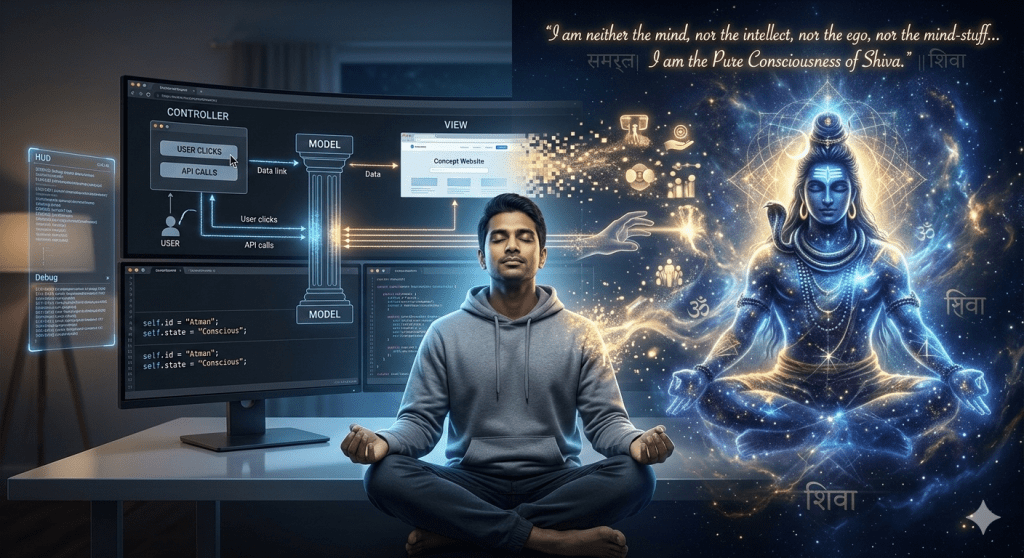
Have you ever felt like you’re performing, even when you’re alone?
You post a perfectly curated story. You cultivate a specific aesthetic. You respond to DMs with a standard, hollow “lol.” But beneath the polish, there’s a quiet, persistent glitch—a suspicion that this sophisticated interface is not actually you.
This isn’t a digital-age problem. Instagram didn’t invent it. LinkedIn didn’t scale it. The glitch is ancient.
More than a thousand years ago, a philosopher named Adi Shankaracharya debugged this very issue. He didn’t build a better identity framework; he exposed the source code of existence itself. His philosophy is called Advaita Vedanta (Non-Dualism), and it explains exactly why you feel disconnected.
The Architecture of You
Imagine your life as a complex application built using the Model-View-Controller (MVC) pattern.
Component – The Human Version The Glitch The Truth
View – Your persona, body, social presence Thinking you are your image A constantly updating interface
Controller – Your thoughts, ego, reactions Thinking you are your mental chatter
A processing layer Model Your essential self Forgetting it exists independently Pure, silent awareness Our core bug is misidentification. We look at the rendered interface and assume that is our core logic. When a wave of anxiety hits, we think the database is corrupted. When social rejection happens, we assume the entire system has failed. Shankara called this error Maya.
Maya: Not Fake, Just Rendered Maya does not mean the world is a hallucination. It means reality is rendered through layers.
Think of it as:
- Cultural CSS (how you should look)
- Memory Cache (past traumas)
- Algorithmic Overlays (what you think people want)
We mistake the rendering for the source code. That mistake creates the “User Suffering.”
The Refactoring Script: Nirvana Shatakam
Shankara composed six verses known as the Nirvana Shatakam. They function like a systematic refactoring of identity, commenting out every layer of mistaken selfhood.
Deleting Mental Identification
“I am not the mind, nor intellect, nor memory, nor ego.”
You are not your thoughts. Thoughts are middleware. They execute; you observe. Anxiety is a process. You are the runtime.
Abstracting Biological Functions
“I am not the vital forces, nor the bodily layers.”
Breath happens. Digestion happens. Aging happens. These are background services. You are not the biological machinery; you are the one aware of its operation.
Deprecating Social Contracts
“I am not duty, nor wealth, nor desire, nor even liberation.”
Society writes heavy, resource-draining scripts for your interface:
- The Success Script: A high-gloss finish that feels like cold glass.
- The Productivity Script: A background hum that vibrates with the frantic heat of a cooling fan pushed to its limit.
Shankara comments them all out. Your core function is not optimization. It is Being.
The Final Line: Shivoham
The verses culminate in one thunderous declaration: “I am pure consciousness and bliss. I am Shiva.”
This is not mythology; it’s Deep System Architecture. Shiva is the electricity. It is the silent current that allows the screen to glow, the processor to hum, and the keys to click.
When you say “Shivoham,” it is not the ego expanding. It is the ego dissolving like a salt doll walking into the ocean.
- Different avatars. Same voltage.
- Different apps. Same runtime.
- Different stories. Same silence.
The Deploy: Log Out, Log In
We live as if we are the interface, collapsing when the metrics drop. Shankara invites a radical decoupling.
When your identity maps to the Model rather than the View, life changes texture.
Anxiety becomes a low-priority notification—audible, but not an emergency. Success becomes a UI skin—rewarding, but not essential to the hardware.
Log out of the frantic performance.
Log into the steady, luminous source.
 Arambhin
Leave a comment