
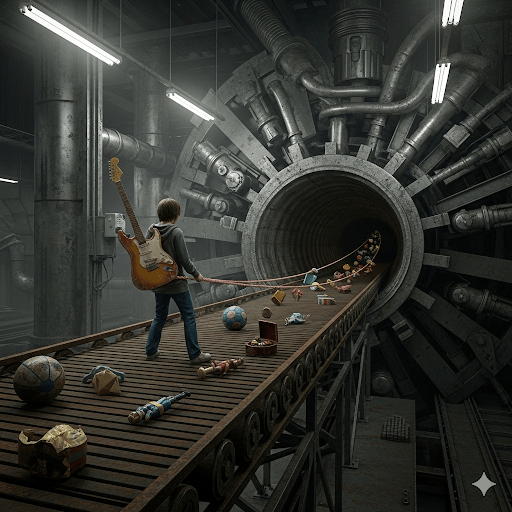
You wake up to the hum. Not the alarm— that’s so 2025. It’s the pipeline, whispering through your neural implant: Welcome back, Alex. You’ve been missed. Scroll? Your room’s a glow of holograms, ads flickering like fireflies on steroids. “What you see is what you get,” the first one promises—a sleek job offer, tailored to your midnight searches for “easy money, no bosses.” But you know better. At 19, you’ve danced this tango before.
It started in the cradle of code. Mom said I was born swiping—literally, on her cracked phone screen during a blackout in the sprawl. By 10, I was the kid hacking allowances from glitchy apps, dreaming of big stars like the influencers who “played a mean guitar” in viral vids. But the machine welcomed me early. “Where have you been?” it cooed, feeding me reels of rebellion: Protest clips from the ’24 Uprisings, where kids like me toppled data barons with memes that went nuclear. Truth felt electric then—raw, unfiltered, a high better than any synth-drop.
Cut to now: September 2025, and the world’s a pinball table. I’m shunting fences daily—dodging rent hikes that spike my cortisol like bad code, leaping over ghosted dates where “ghosting” means algorithms matching you to fakes for engagement metrics. Politics? A joke scripted by AIs. Last election, the feed showed Candidate X as savior: “Relief for your generation!” What you saw: Smiling faces, policy pix. What you got: Tax loops for corps, while my crew’s gig apps crash mid-shift, leaving us hustling for scraps. Survival’s the real game—truth? A luxury app, premium tier only.
The hum pulls me in. I tap yes, and the pipeline floods: A thread on X about “machine overlords,” laced with deepfakes of celebs ranting against Big Tech. My heart races—dopamine ping, amygdala lighting up like a glitch. Is it real? Half the replies scream conspiracy; the other half shill crypto scams. I scroll deeper, fences blurring: A hurdle from last week replays—boss firing me via auto-email for “low engagement” on team chats. “You’re replaceable,” it said. No appeal, just a survey: How can we improve your termination experience?
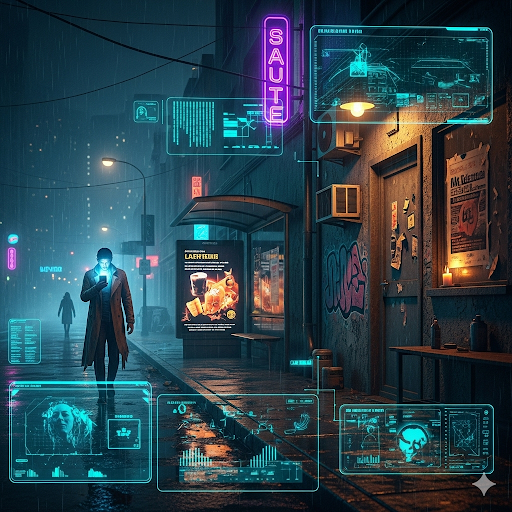
That’s when the song hits. Not on Spotify—too mainstream. It’s neural, triggered by my spike in stress: Pink Floyd’s ghost in the machine, that 1975 synth-wail bleeding into my cortex. “Welcome my son, welcome to the machine…” I freeze. The lyrics loop, a psychiatrist’s earworm from those mandatory wellness pods at school. “You’ve been in the pipeline, filling in time…” Yeah, that’s me—filler in the feed, my likes fueling the beast. The machine knows where I’ve been: Every doubt, every late-night cry over climate feeds showing drowned cities while corps greenwash their jets.
I bolt upright, implant buzzing protest. Stay. Engage. But I resist, yanking the neural jack—old-school, like ripping off a band-aid. Pain shoots through my skull, but clarity floods in. No hum. Just my breath, ragged, grounding me in the quiet. Physiology 101, from that rogue bio prof: Your body’s the original firewall. Heart rate slows; the fog lifts. I grab my analog journal—pages yellowed, no trackers—and scribble: The weapon’s in the welcome. Shun the fences, not the fight.
Outside, the sprawl pulses. Drones deliver dreams to high-rises; down here, we forage for signal in the shadows. My crew meets at the undergrid café—no nets, just face-to-faces over synth-coffee. Lena, 17 and a code-whisperer, shares her hack: Curating feeds like a garden, weeding out the poison. “Algorithms exploit the voids,” she says, eyes fierce. “Fill ‘em with your own code—hobbies, hikes, real talks. Starve the machine.” Jamal nods, fresh from a hurdle: Lost his scholarship to an AI grader that flagged his essay as “unoriginal” because it echoed too many anti-corp posts. “Survival’s not playing their game,” he mutters. “It’s rewriting the rules.”
We plot under Floyd’s echo: A zine drop, analog drops in digital dead zones. Stories of kids like us—shunting through the crazy, turning weapons into tools. One tale: A girl who turned her implant’s ad-stream into a mirror, journaling the manipulations till she saw the strings. Pulled her own, started a co-op farm in the ruins, trading truth for tomatoes. No pipelines, just pipelines of rain.
Night falls, and the hum tries again—faint, seductive. Come back. We know where you’ve been. But I’ve got my armor now: Awareness, the psych prof’s secret sauce. The machine’s a mirror, not a master. What you see? A kid, 19, fencing shadows but owning the light. What you get? A spark, ready to burn the welcome mat.
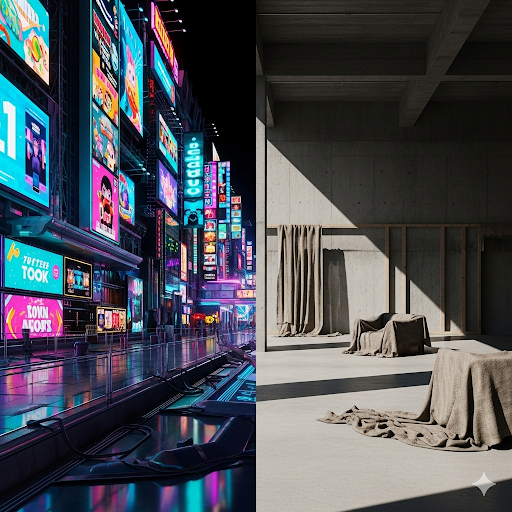
In the quiet after, I find myself whispering a resolve, something the old yogi vids called a Sankalpa—a sacred vow to cut through the noise. It’s my anchor now, recited like a mantra each morning as I breathe deep, inhaling the agency I’ve clawed back, exhaling the manipulations that try to pull me under. “I am the architect of my reality,” I say to the empty room, feeling the words root in my chest like code compiling clean. “With awareness and resilience, I navigate the illusions, honor my inner truth, and co-create a world beyond the welcome.” It builds me up, this quiet rebellion—fosters that self-belief the therapists drone about, counters the helplessness of endless scrolling, turns raw survival into something purposeful, thriving even in this wired madness. If my crew and I spread this in our zine, imagine the challenge: Kids remixing their own vows, sharing sparks in the shadows. Fade to synth-drone… but this time,
I remix it.
My beat, my dream.
 Arambhin
Leave a comment