

Posted on September 9, 2025
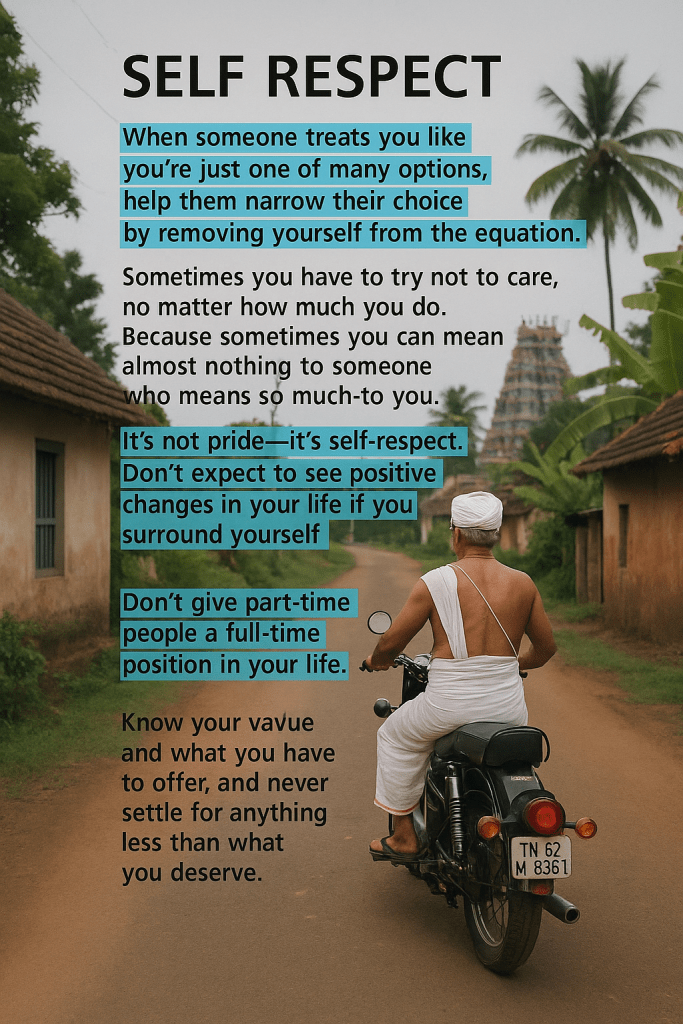
As Mahalayam (Pitru Paksha) unfolds from September 7 to September 21, 2025, culminating in Sarvapitri Amavasya, it’s a sacred call to honor ancestors through shraddha, tarpana, and charity. For me, a Dravidian Brahmin, this period amplifies the self-respect narrative amid Periyar’s Self-Respect Movement legacy—empowering non-Brahmins while marginalizing others. A viral X post’s wisdom—“When someone treats you like you’re just one of many options, help them narrow their choice by removing yourself from the equation”—mirrors our forefathers’ dignified migration. Yet, reflecting on the movement’s temple fights and language battles reveals deeper complexities, including today’s stark reality: Brahmins largely absent from teaching professions, their traditional domain, while scattered in other fields with diminished presence under Dravidian models. Reintegrating them could revolutionize science and engineering education through Vedic insights.
The Historical Echo: Migration as Dignified Detachment
The 1920s Self-Respect Movement dismantled caste hierarchies, promoting equality and rationalism. For Brahmins, it brought exclusion: Reservations and rhetoric led to exodus, shrinking our Tamil Nadu population to under 1%. We thrived elsewhere in merit-driven fields, embodying “Don’t give part-time people a full-time position in your life.” Critiques on X highlight ongoing abuse and privilege myths, while acknowledging Dravidian social justice gains.
Temple Fights and Language Battles: A Critical Lens
Then came the battles for temple entry—first for lower castes, inspired by Periyar from the 1920s onward, extending from Kerala’s Vaikom Satyagraha to Tamil Nadu protests. They fought for garbhagriha access, insisting on prayers in Tamil, not Sanskrit, decrying the latter as an “alien” imposition tied to Brahminism and Aryan culture. These efforts aligned with anti-Hindi agitations, fueled by slogans like “Hindi theriyadhu poda,” resisting compulsory Hindi in schools and public life as cultural imperialism. Periyarist groups led these in public, often atheist in rhetoric—dismissing gods and rituals as superstitions—yet many held personal prayers in private, a hypocrisy that prioritized “self-propelled wellbeing” over consistent ideology.
From a Brahmin view, these “fights” democratized sacred spaces but eroded traditions: Sanskrit, the language of ancient Tamil-integrated Vedas, was vilified to promote Tamil exclusivity, sometimes with anti-Hindu undertones. Public atheism masked alliances (e.g., with missionary influences) that targeted dharma, while private devotions revealed selective self-interest. This “wellbeing” propelled non-Brahmin uplift but at the cost of cultural erasure, prompting our quiet withdrawal.
The Current Reality: Vanishing from Teaching, Scattered in Other Fields
Today, Brahmins are scarce in teaching professions—their varna-shastra role as educators—due to systemic barriers in Dravidian states like Tamil Nadu. Historically overrepresented in education (e.g., 20% of engineers in colonial times despite 3% population), Brahmins now face exclusion from government teaching jobs via 69% reservations, leading to migration and a shift to private sectors like IT, corporate roles, or global opportunities. In Dravidian states, numbers have plummeted due to policies refusing EWS reservations, anti-Brahmin bias, and normalized hatred, risking loss of traditional knowledge and cultural diversity as per varna-shastra. This “silent genocide” ignores drawbacks for self-promotion in movements, prioritizing politics over holistic progress.
Brahmins in Teaching: A Boon for Science and Engineering
If Brahmins returned to teaching, their Vedic heritage could enrich science and engineering departments, blending ancient wisdom with modern methods to hone scientists’ skills. Vedic studies—preserved by Brahmins—offer parallels to contemporary fields: Mathematics from Sulba Sutras aids rapid computations in AI; atomic theory in Vaisheshika informs nanotechnology; astronomy by Aryabhata enhances astrophysics. Concepts like prana and maya inspired quantum pioneers like Schrödinger, fostering intuitive problem-solving. Ethical dharma from Vedas could guide AI ethics and sustainability, while historical Brahmin innovators (e.g., Raman, Chandrasekhar) exemplify merit-driven excellence. Though critiques label Vedic science metaphorical, its interdisciplinary value could elevate knowledge, countering the current void in teaching.
Mahalayam: A Timely Tribute to Ancestral Struggles
In Mahalayam’s spirit, I honor forefathers who faced these as “foreign” impositions, yet preserved Tamil Nadu’s glory—the Chola-Pandya empires, millennia-old temples, and diverse literature. Reciting this sloka for unsupported souls extends universal wellbeing:
யேஷாம் ந மாதா ந பிதா ந பந்து: நான்ய கோத்ரிண:
தே ஸர்வே த்ருப்திமாயாந்து மயோத்ஸ்ருஷ்டைகுசோதகை:
த்ருப்யத த்ருப்யத த்ருப்யத
(For those without kin, may my offerings satisfy. Be satisfied thrice.) As a Brahmin, I pray for global success and wellbeing, grateful for those who lost much yet succeeded abroad.
Hope for a Dharmic Dawn
A dharmic Kshatriya may rise among Dravidians, upholding justice beyond self-propelled gains. In this land of ancient diversity, self-respect must unite.
Share your reflections below.
Dravidian Brahmin by heritage, modern voice by choice.
 Arambhin
Leave a comment