
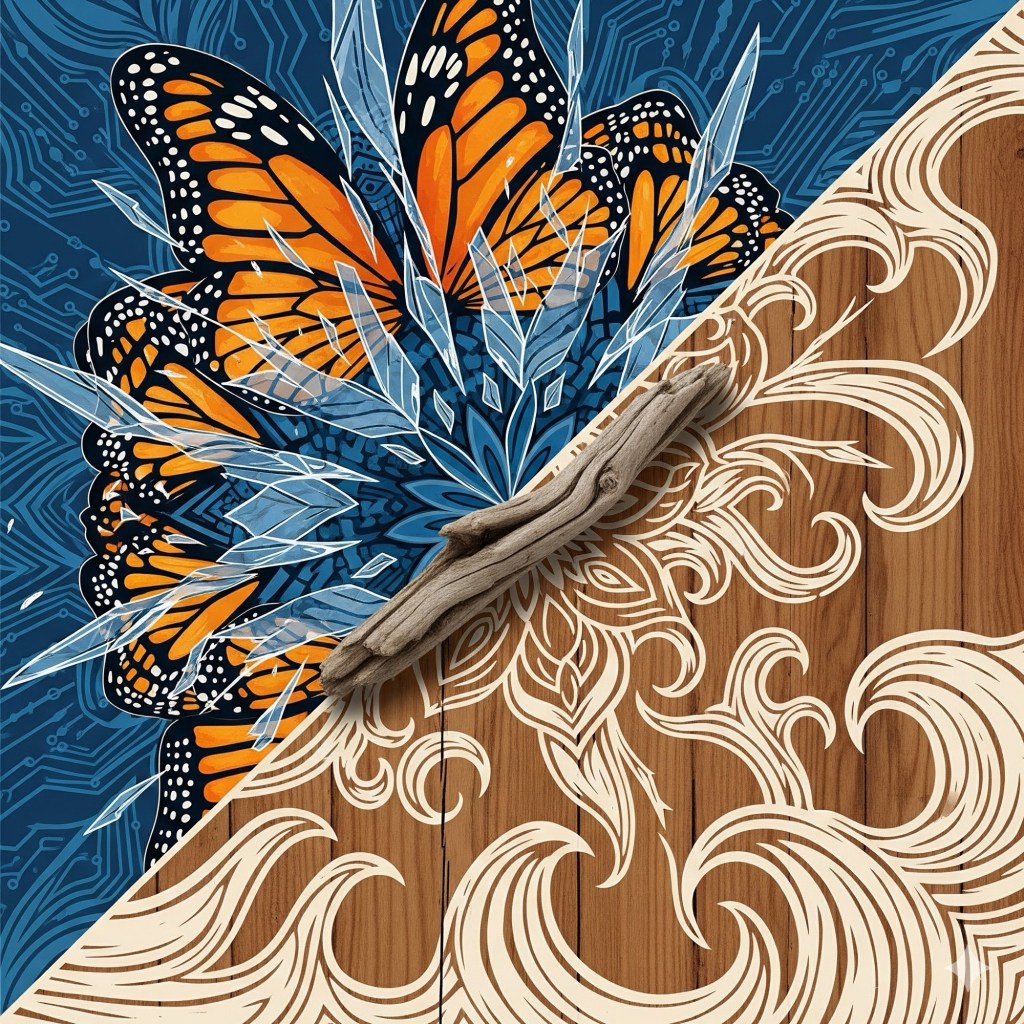
He was a dreamer’s dream, a man who lived not just in the world but in the possibilities shimmering just beyond it. Dharma was his compass, though he carried it like a distracted traveler—sometimes following faithfully, sometimes ignoring it, yet always circling back to its true north.
He was an alchemist, though not of metals and crucibles. His craft was subtler: turning failure into wisdom, solitude into sanctuary, driftwood into beauty. Every loss he touched seemed, in time, to become a lesson, though he often cursed the lesson before bowing to its grace.
There was always a bit of the ZAMM spirit in him too—Robert M. Pirsig’s Zen and the Art of Motorcycle Maintenance, with its mischief and spark: the absurd resilience of treating life’s breakdowns like a motorcycle tune-up, experiments in quality and care rather than disasters. And in the corner of his eye lingered a flavor of the Hitchhiker’s Guide to the Galaxy—a cosmic humor that saw the universe as too vast, too ridiculous, to ever be taken at face value. He would drive his motorbike along the coast, enjoying the full moon’s glow on the waves, or sit out for hours with his telescope and camera, capturing the cosmic dances of stars and planets. For him, everything was a toy game, a “let’s do it” attitude that turned the ordinary into adventure.
What made him unforgettable was his eye. He noticed what others overlooked: the twisted beauty of driftwood, the silence in a forest that suddenly felt like a mirror, the strange revelation of butterflies that might also be leeches. He was not perfect, nor did he seek perfection. He was, instead, something rarer: a dreamer’s dream—forever building, forever breaking, forever finding meaning in the infinite comedy of being alive.

The First Storm
He lived his life as a work of art, a living sculpture of a man. A 4×4 driver, he navigated the rugged trails of the world as if they were the pathways of his own mind—firm, deliberate, and certain. His latest dream, a one-of-a-kind beach villa, became the canvas for that ambition. To the world, it was a project of stone and timber. To him, it was a testament—a living monument to imagination and will.
But the storm came. His fintech company, born of vision and sweat, collapsed with a final, sickening shudder. The betrayal stung deepest: his co-founder, once a brother-in-arms, had siphoned funds for a rival venture, leaving debts like open wounds. Investors fled, partners vanished, and the villa’s foundation—meant to rise on the company’s success—now teetered on sand.

The Forest and the Leech
To recover, he turned to the forest—his sacred refuge. He believed in shinrin-yoku, the Japanese art of forest bathing, where the soul soaks in the trees’ quiet breath for renewal. The forest had always offered him that. But this time, it did not heal. It broke him.
As he walked beneath the canopy, sunlight filtering through leaves like fractured gold, a monarch butterfly alighted on his hand. Its wings brushed his skin, soft as silk, orange veins pulsing with life. Once, he would have seen grace in it, a sign of harmony. Instead, a terrible clarity pierced him: the butterflies were leeches, disguised in beauty, feeding silently, endlessly. In their swirling patterns, he saw faces—his co-founder’s sly grin amid the wings, family members who had borrowed without repaying, colleagues who praised in boardrooms but ghosted in crisis. He was the host, drained dry. And he had trusted them, invited the feast.
The butterfly’s legs clung tighter, a cold prickle against his palm, as if sucking the warmth from his veins. He fell to his knees, the damp earth soaking through his jeans, the forest floor no longer a sanctuary but a vast, cold mirror reflecting his own gullibility.
He withdrew from the world. Calls went unanswered. Days blurred into nights of reading—ancient Vedanta texts urging renunciation of attachments, modern philosophy on resilience (including Pirsig’s inquiries into values), scraps of wisdom across ages. His mind became a battlefield where two voices waged war. One whispered: All attachments are chains. Renounce, and be free. The other screamed: Build again, stronger. Let your success be their defeat.
Caught between surrender and vengeance, he was torn.
The Pattern and the Driftwood
The villa became his battlefield. He worked with obsessive energy, poring over blueprints, choosing materials not for beauty but for defiance—reinforced concrete to withstand any storm, solar panels as symbols of self-reliance. Each wall, each pillar, was an act of resistance against the doubt gnawing inside. Yet when the fevered bouts ended, hollowness returned. The victories tasted bitter; nothing built on spite could foster peace.
The cycle gripped him: feverish work dissolving into collapse, retreat to the forest’s edge, then back to the build. Work into collapse. Retreat. Repeat—until exhaustion blurred the lines, his hands callused, his dreams haunted by leech-winged shadows.
Then, one afternoon, caked in sweat and salt-stiffened dirt from the beachfront site, he stumbled upon a twisted piece of driftwood washed ashore. Its bark was scarred by waves, gnarled like an old man’s knuckles, yet it held an elegant curve, as if sculpted by the sea’s patient hand. He lifted it, not as material for the villa, but simply to trace its contours with his fingers, feeling the rough texture yield to unexpected smoothness. In that quiet gesture—like a mechanic polishing a worn part to reveal its inherent quality—the cycle shattered.
He understood, finally: the point was never the monument, never the audience, never even the vindication. The point was the joy of creation itself—the act, not the applause; the making, not the proving; the maintenance of one’s inner engine.
The villa shifted with him. No longer a fortress of ego, it became a sanctuary of peace. He swapped the harsh concrete for reclaimed wood and flowing glass, materials that whispered to his soul rather than shouting to the world. He learned to see the leeches without anger, acknowledging the co-founder’s greed as a hard lesson, and simply to walk away. True strength lay not in revenge, but in reclaiming passion.
The Return

When at last he stood in the villa, looking out over the ocean, he was not triumphant, not broken—simply whole. He understood himself not as the architect of heaven, nor as the victim of betrayal, but as something quieter: the architect of nothingness.
Nothingness not as void, but as freedom. Freedom from proving. Freedom from bitterness. Freedom to create without needing the world’s applause.
And in that stillness, gratitude came—not as an effort, but as a natural breath: “All of life is gains and losses. We are thankful for the love we receive, and for the betrayals that teach us to love ourselves more. We are thankful for the successes that show what is possible, and the failures that teach what is true. We are thankful for the sun that warms us, and the rain that cleanses us. We are thankful for life, in all its imperfections. For in the end, nothingness is not emptiness. It is space—space enough to begin again, like waves crashing eternal, carving new shores from the endless sea.”
 Arambhin
Leave a comment