

VASUDEVA SAPTAKAM

1. Introduction: A Night in Bangalore and the Mystery of Seven
In the quiet stretches of south Bangalore, near the verdant campus of the Indian Institute of Management, the frantic rhythm of Bannerghatta Road had finally slowed to a rhythmic hum. Inside a dimly lit apartment, the ceiling fan whirred with the steady, meditative drone of a tanpura holding a single note. It was a night of quiet milestones; the family had just celebrated the 70th birthday of the patriarch, Vasudevan.
As the house settled, Vasudevan’s ten-year-old grandson, Avyukth, climbed onto the bed, his young mind busy with the inherent logic of numbers. “Thatha,” he noted with the gravity only a child can muster, “you turned seventy today. And I am ten. That means ten times seven is seventy.”
Vasudevan smiled, seeing the universe’s symmetry reflected in the boy’s eyes. In the Vedic tradition, seventy is known as Saptati, a significant arrival. It represents not just a span of years, but ten completed journeys through the foundational number seven—Sapta. “Then tonight,” Vasudevan suggested, leaning back against the pillows, “we shall have a Vasudeva Saptakam—a conversation of seven turns, exploring why that number keeps us in its grip.”
2. Turn One: The Cosmic Calendar in the Sky
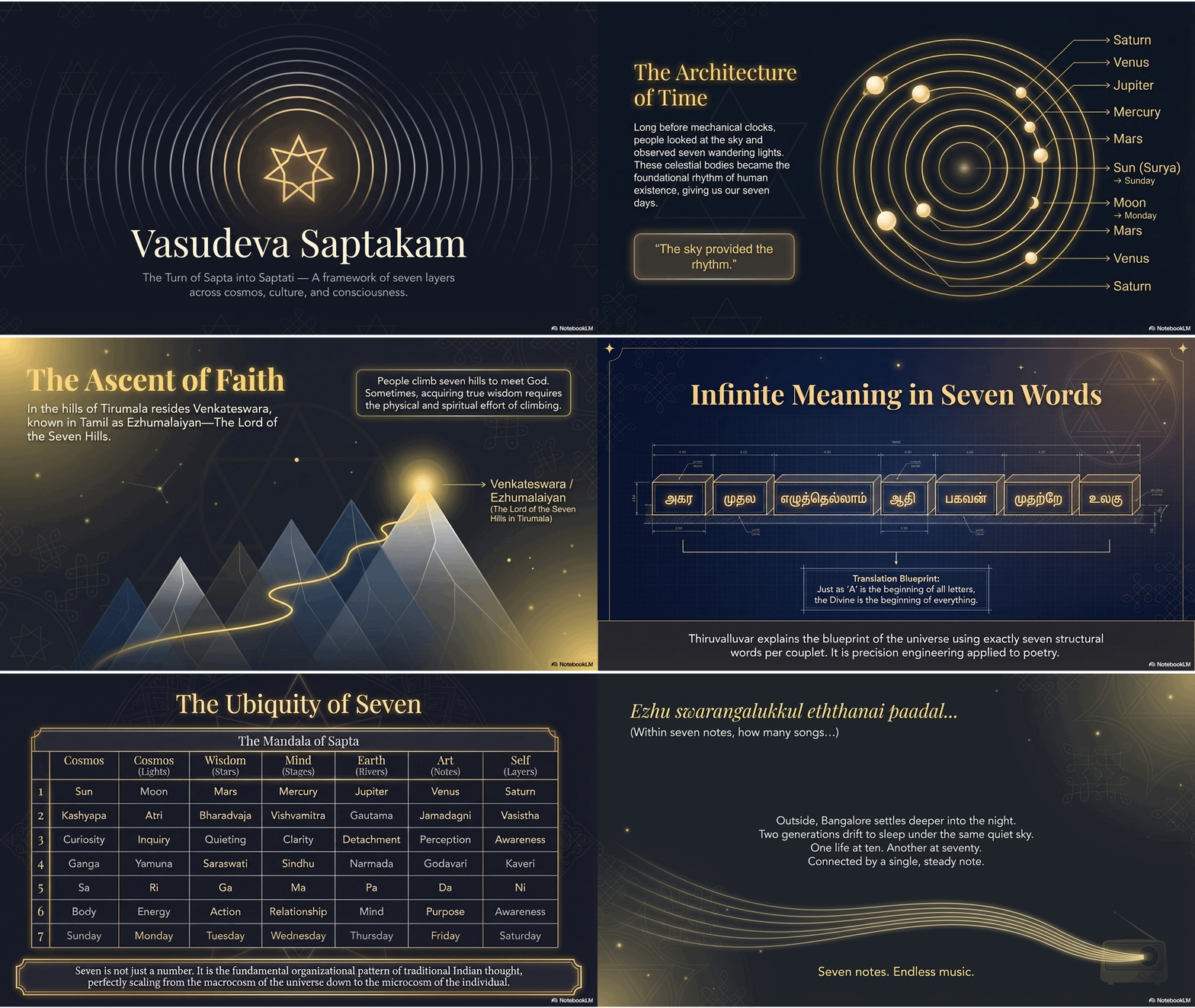
The first turn began as Vasudevan gestured toward the window, looking back to an era long before digital synchronization. He explained that ancient humanity, seeking order amidst chaos, looked upward to find seven “wandering lights” moving against the fixed tapestry of the stars: the Sun, the Moon, Mars, Mercury, Jupiter, Venus, and Saturn.
This observation birthed the Saptavara, the seven-day week that bridges ancient Vedic astronomy with our modern Gregorian calendar. It is a temporal cycle so deeply embedded in our psyche that we rarely question it. Avyukth quickly traced the linguistic lineage: Monday is “Moon day,” and Sunday belongs to Surya, the Sun. This cosmic calendar was humanity’s first attempt to harmonize the rhythm of the household with the rhythm of the heavens.
3. Turn Two: The Universe’s Original Professors
The night sky, usually obscured by the city’s amber glow, seemed to lean closer as Vasudevan pointed toward a cluster of stars shaped like a ladle. “Those are the Sapta Rishi,” he explained, “the Seven Sages who serve as the universe’s primordial teachers.”
He recited their names with a rhythmic precision: Kashyapa, Atri, Bharadvaja, Vishvamitra, Gautama, Jamadagni, and Vasistha. These were not just names, but archetypes of wisdom etched into the celestial sphere to ensure that knowledge would never be lost to time. Avyukth looked up at the stars, his imagination ignited by the thought of eternal scholars watching over the earth.
“So even the sky has professors,” Avyukth whispered.
4. Turn Three: Wisdom is a Mountain Climb
As the conversation deepened, it turned toward the physical effort of spiritual seeking. Vasudevan spoke of the great temple at Tirumala, where the deity Venkateswara resides. In the local Tamil tongue, he is hailed as Ezhumalaiyan—the Lord of the Seven Hills.
This, Vasudevan explained, is a metaphor for the human condition. To meet the Divine, or to achieve any form of true mastery, one must physically and metaphorically “climb.” Each of the seven hills represents a plateau of effort and a shedding of the ego. Wisdom is not a flat road; it is an ascent that requires us to catch our breath and push upward until the view finally opens.
5. Turn Four: The Seven-Level “Video Game” of the Mind
Drawing from the philosophical depths of the Yoga Vasistha, Vasudevan described the internal scaffolding of the mind. He explained that wisdom is not a sudden lightning strike but a progression through seven distinct stages. To make it accessible for Avyukth, he framed them as a sequence of growth:
- Curiosity: The initial spark, the “wanting to know.”
- Inquiry: The active search for truth.
- Quieting of the mind: Filtering out the internal noise.
- Clarity: Seeing things as they truly are, without bias.
- Detachment: Releasing the need for specific outcomes.
- True perception: A deep, intuitive understanding of reality.
- Abiding awareness: Living permanently within that truth.
Avyukth grinned, recognizing the structure. “That sounds like leveling up in a video game,” he said. Vasudevan laughed, noting that while the stages feel like “leveling up,” the ultimate reward isn’t a trophy or a high score—it is the quiet, indestructible gift of understanding.
6. Turn Five: The Sacred Flow of Sound and Water
In the fifth turn, the duo explored how the number seven flows through the very geography and culture of India. Vasudevan spoke of the Sapta Sindhu, the seven sacred rivers that are said to purify the land: the Ganga, Yamuna, Saraswati, Sindhu, Narmada, Godavari, and the Kaveri.
“Kaveri! Our river,” Avyukth interjected with a sense of belonging.
But the flow was not restricted to water; it moved through the air as well. Vasudevan hummed the seven primary notes of Indian classical music: Sa, Ri, Ga, Ma, Pa, Da, Ni. He reflected on the mathematical miracle that from these seven simple frequencies, musicians have woven an endless tapestry of ragas for millennia. Seven notes, yet an infinity of songs.
7. Turn Six: The Seven-Word Universe of Thiruvalluvar
Vasudevan reached for a small, well-worn book on the shelf beside a portrait of the sage Thiruvalluvar. He explained that the Thirukkural contains a structural secret: every single couplet is composed of exactly seven words. This is achieved through a deliberate mathematical symmetry—the first line contains four words, and the second contains three.
He recited the opening verse to demonstrate how a vast philosophy of the cosmos can be condensed into this 4+3 structure:
“அகர முதல எழுத்தெல்லாம் ஆதி பகவன் முதற்றே உலகு — Just as ‘A’ is the beginning of all letters, the Divine is the beginning of everything.”
In this tiny, seven-word vessel, the sage had managed to carry the entire weight of the universe’s origin.
8. Turn Seven: A Debugging Kit for the Human Experience
For the final turn, Vasudevan offered a practical diagnostic tool for the boy’s future. He explained that a human life is composed of seven distinct layers: Body, Energy, Action, Relationship, Mind, Purpose, and Awareness.
“Whenever life feels ‘wrong’ or heavy,” Vasudevan advised, “you must use these layers to find the source of the friction.” He provided a framework for what Avyukth called “debugging” life:
- If your mind is restless and wandering, perhaps the Energy layer is blocked by poor habits.
- If your Action feels empty and mechanical, perhaps it has lost its connection to your Purpose.
- If there is constant conflict, look to the Relationship layer to see where communication has failed.
By isolating the layers, the complexity of suffering becomes a manageable series of checks and balances.
9. Conclusion: From Seven to Seventy
As the “Vasudeva Saptakam” concluded, a profound stillness settled over the room. Avyukth, now weary with the weight of these seven turns, asked what happens when a person moves beyond the number seven.
Vasudevan returned to the musical metaphor. In a scale, the eighth note is not a new beginning, but the start of a higher octave. “At seventy,” he explained gently, “the ladder of these seven steps disappears. You no longer need the structure because the understanding has been built into your very bones. You don’t just know the seven layers; you transcend them.”
Just then, the old radio in the living room crackled softly. A familiar melody from the film Avaragal drifted through the hallway. The song was Ezhu Swarangalukkul (“Within seven notes…”).
“Ezhu swarangalukkul eththanai paadal…” the singer mused—Within seven notes, how many songs?
Vasudevan closed his eyes, a man who had completed ten journeys through the seven, now resting in the eighth octave. As Avyukth drifted into sleep, the song served as a final reminder that within these small cycles of seven, there is enough room for an entire lifetime of music.
Which of the seven layers of your own life—body, energy, action, relationship, mind, purpose, or awareness—needs your attention today?
 Arambhin