
The universe does not begin with chaos.
It begins with rhythm.
Look closely at nature and a quiet symmetry reveals itself everywhere: the rise and fall of tides, the waxing and waning of the Moon, the inhale and exhale of breath. Patterns repeat, forces balance, cycles return. What we call time is often nothing more than the universe keeping its rhythm.
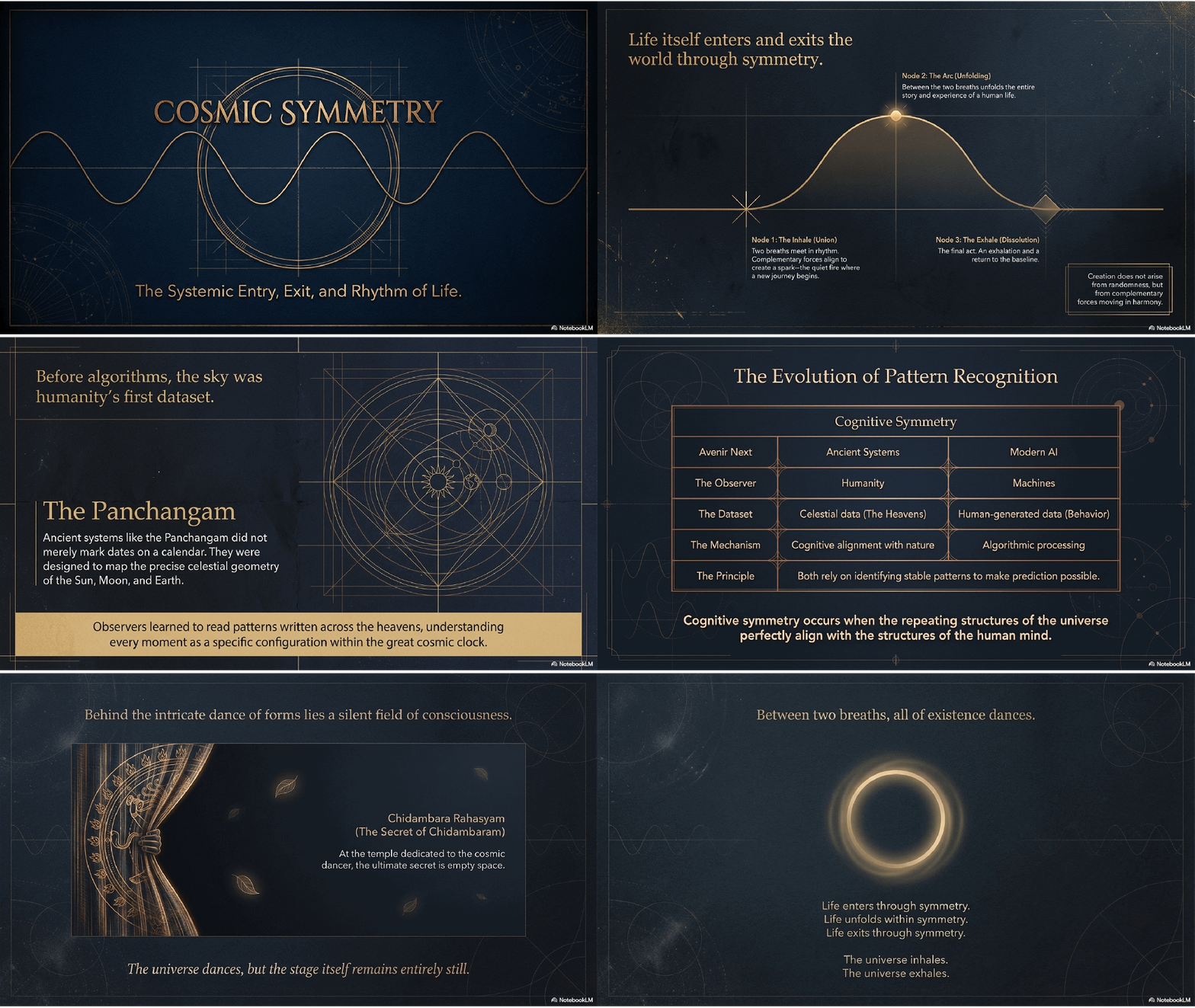
Life itself enters the world through symmetry.
Two breaths meet in rhythm. Two bodies align in balance. In that moment of union, a spark is lit, a quiet fire in which a new life begins its journey. Creation does not arise from randomness alone, but from the meeting of complementary forces moving in harmony.
The first act of life is an inhalation.
The final act is an exhalation.
Between these two breaths unfolds the entire story of a human life.
Entry and exit.
Expansion and return.
Ancient seers did not see these patterns as coincidence. They saw them as the operating architecture of existence itself. The universe, they believed, moves through cycles of symmetry where birth, life, dissolution, and rebirth follow one another like notes in a cosmic rhythm.
When life completes its arc, it does not simply vanish. It returns to the larger cycle from which it emerged.
In the language of the sages, the journey of the soul continues through cosmic pathways governed by karma. Just as the tides respond to the Moon, existence itself moves through phases of return and renewal. What appears as an ending is often a transition within a much larger system.
It is said that through the southern path of the Moon, the soul re-enters the wheel of becoming, carrying the impressions of its actions. Life is not discarded; it is recycled through the symmetry of the cosmos.
Seen this way, existence resembles a vast system of entry and exit points. Souls arrive, experience, evolve, and depart, only to return again when the conditions of the universe align once more.
Nature itself seems to affirm this rhythm.
Day becomes night.
Winter becomes spring.
Stars are born, collapse, and give birth to new stars.
The cosmos breathes.
Ancient traditions developed ways to read these rhythms. Systems like the Panchangam did not merely mark dates; they mapped the celestial geometry of the Sun, Moon, and Earth. Each moment could be understood as a specific configuration within the great cosmic clock.
In that sense, the sky became humanity’s first dataset. Long before algorithms and artificial intelligence, observers learned to read patterns written across the heavens.
Today machines learn patterns from human data.
But for thousands of years, humans learned patterns from celestial data.
Both processes rely on the same principle: pattern recognition. When stable patterns appear, prediction becomes possible.
This is where cosmic symmetry meets cognitive symmetry.
The universe moves in repeating structures, and the human mind is designed to recognize those structures. When the two align, understanding emerges.
Perhaps no image captures this idea more beautifully than the cosmic dance of Shiva as Nataraja.
In that form, Shiva dances within a ring of fire. One hand beats the drum of creation, another holds the flame of dissolution. One foot presses down ignorance while the other rises in liberation. The dance itself represents the dynamic equilibrium of the universe.
Creation and destruction.
Movement and stillness.
Form and emptiness.
All balanced within a single rhythm.
At Chidambaram, the temple dedicated to this cosmic dancer, there is also a profound secret. Behind a curtain lies empty space, adorned only with golden leaves. This is known as the Chidambara Rahasyam, the “Secret of Chidambaram.”
The message is simple yet profound: behind the dance of forms lies a silent field of consciousness.
The universe dances, but the stage itself is still.
This insight lies at the heart of what is called Sanātana Dharma. The phrase does not merely describe a religion. It points toward the eternal order that sustains the universe.
Even if civilizations rise and fall, the Sun will still appear in the east. Seasons will still change. The Moon will continue its phases. The laws governing these cycles do not depend on human belief.
They are simply the way the cosmos breathes.
Sanātana Dharma can therefore be understood as an attempt to align human life with that cosmic symmetry. It invites us to observe the rhythms of nature, recognize the patterns within them, and live in harmony with those patterns.
Symmetry becomes not just a feature of geometry, but a principle of existence.
Life enters through symmetry.
Life unfolds within symmetry.
Life exits through symmetry.
The universe inhales.
The universe exhales.
And between those two breaths, all of existence dances.
 Arambhin
Leave a comment