
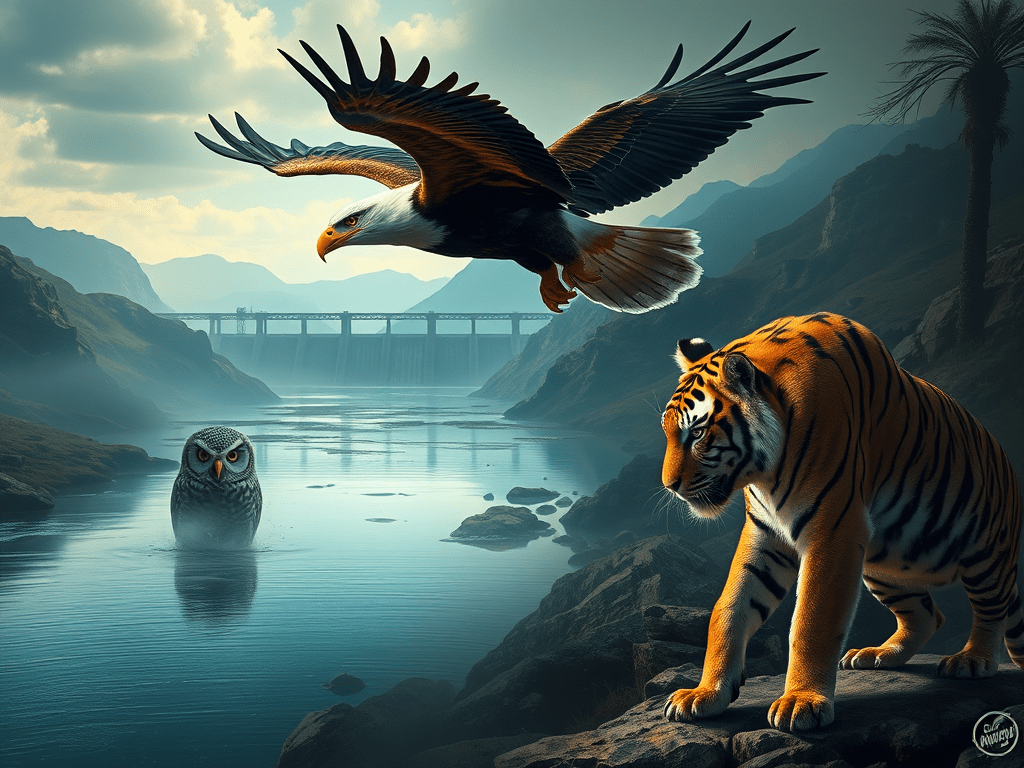
How the razor-sharp eyes of eagles, the night-vision of owls, and the instinctual focus of tigers reveal why humans overthink, hoard resources, fight endless status battles, and build “dams” that block our own flow — and what a wiser path forward looks like.
The Starting Point: Vision That Hunts, Minds That Decide
It began with a simple question: Do we have cameras that mimic the eyes of eagles, cats, and dogs? The answer opened a far deeper door.
Eagles possess dual foveae — built-in telephoto lenses — giving them 4–8× human visual acuity. They spot prey from kilometres away and see ultraviolet urine trails. Owls, with tubular eyes and massive rod density (plus a tapetum lucidum in some species), hunt in near-darkness with precision that makes starlight sufficient. Cats combine vertical slit pupils and a reflective mirror layer for unmatched low-light ambush. Dogs excel at motion detection in the periphery.
These are not just optical marvels. They are behavioural economics in action — hyper-efficient resource allocation systems hardwired by evolution. A predator’s vision is laser-focused on prey because energy is scarce and mistakes are fatal. No over-analysis. No rumination after a missed strike. The system is optimised for immediate survival.
Humans, by contrast, evolved a vastly expanded prefrontal cortex — our “cognitive storage upgrade.” This gift allows abstract planning, culture, and long-term simulation… but it also creates the very biases behavioural economists study: analysis paralysis, hyperbolic discounting (overvaluing the present while endlessly worrying about distant futures), endowment effect (clinging to assets “just in case”), and status-signalling.
The result? Animals live like a flowing river — present, duty-bound, nature-oriented. Humans build dams — rigid timelines, material accumulation, and social-validation hierarchies — often at the cost of balance, happiness, and planetary health.
The River vs. Dam Mindset: Cognition in Action
Animals operate in tight stimulus-response loops. An eagle spots prey → dives. An owl hears rustle → strikes. Once the need is met, they rest without replaying the event or planning next month’s hunt. Their foresight is pragmatic and bounded (crows cache tools for hours ahead, chimps carry rocks for later use). No chronic rumination when idle.
Humans? Our massive working memory and recursive thinking create endless “what-if” simulations. We ruminate even when no action is required. The same prefrontal power that lets us invent science and art also fuels anxiety, procrastination, and hasty decisions to escape uncertainty. Behavioural economics calls this present bias and overconfidence in our future selves — traps animals largely avoid.
No Tomorrow Goals or To-Do Lists
Animals have no cultural checklists: “Be employed by 22, married by 28, own a house by 30, have kids and 401k by 35.” Maternal care in lions, elephants, or gorillas is intense and long-term but instinct-driven — triggered by hormones and cues, not abstract five-year parenting plans.
Humans turned survival planning into a rigid social script. This is classic status validity fighting — the modern version of animal territory defence. Instead of fighting over physical land, we battle for social recognition: the “right” job, marriage, house, savings trajectory. Even in Chennai’s middle-class circles, family questions (“Shaadi kab? Job kya hai?”) reinforce the checklist as a measure of worth.
Materialism: From Bounded Inequality to Billionaires vs. Beggars
Animals exhibit modest, transient inequality. A dominant tiger claims better territory, but cannot hoard surplus prey indefinitely — it spoils, is scavenged, or territories shift with seasons. No “billionaire tigers” while others beg.
Humans, with our symbolic tools (money, property rights, compound interest), turned modest variation into extremes. We hoard far beyond need. The ultimate symbol? Locked vacant houses — resources held idle for future appreciation or “just in case.”
Latest data (2025–2026) paints a stark picture:
- 2011 Census: 11.1 million vacant urban homes (12.4% of stock) — enough to house ~50 million people.
- By 2025 estimates: Total vacant urban units creeping toward 1.5–2 crore, while affordable housing shortage remains ~9.4 million (Knight Frank).
- In top 7 cities (including Chennai), unsold inventory rose 4% in 2025 to 5.76 lakh units (Anarock report, Jan 2026), as new supply outpaced demand and sales fell 14%.
This is textbook endowment effect and status quo bias in behavioural economics: owners keep homes empty because “it’s mine for the future,” even when rental yields are low (2–3%) and millions lack shelter. Animals don’t lock dens for hypothetical offspring decades ahead.
Territory Fights → Status Validity Fights
Animals defend physical territory with displays, roars, or ritualised combat — efficient and usually non-lethal.
Humans defend symbolic territory: reputation, social rank, “validity.” Even altruism gets co-opted. Personal helping, community service, and corporate CSR are frequently filtered through status signalling. In India’s Companies Act 2013 (2% profit mandate), CSR often doubles as brand prestige and legitimacy — high-visibility projects chosen for PR value over deepest impact. Behavioural economics calls this costly signalling theory: generosity proves moral superiority and elevates rank.
The Zoo: Humanity’s Ultimate Dam
We don’t just dam our own lives — we dam entire species. Zoos confine predators and prey in artificial enclosures, regulating their “river” for human entertainment and conservation optics. While modern zoos claim ethical breeding programmes, the core dynamic remains control: animals reduced to exhibits while their wild counterparts face habitat loss from our larger dams (urbanisation, consumption).
Grow Wisely — Not Degrowth
The solution isn’t forced shrinkage (degrowth philosophy). It’s grow wisely: intentional, regenerative growth within limits.
- Recognise finite “parking spots” on a finite planet.
- Impose smart boundaries on extremes — progressive wealth taxes above high thresholds, vacancy fees on locked properties, transparency in CSR.
- Redirect ambition: grow in health, relationships, innovation, and equity; prune wasteful accumulation and status signalling.
- Learn from the river: presence, decisive action when needed, rest when not.
This honours our unique mind — shared intentionality, recursive planning, open-ended culture — without letting it possess us through materialism.
Final Reflection: From Predator Vision to Human Wisdom
The eyes of predators taught us efficiency in resource use. Their minds taught us presence and duty. Our challenge is to use our expanded cognition not to build ever-taller dams that flood or drought the river, but to channel flow harmoniously.
We don’t need to stop growing. We need to grow wisely — with the clarity of an eagle, the patience of an owl, and the humility to admit that sometimes the smartest move is simply to let the river run.
What part of this journey resonates most with you? Have you seen the “dam” effect in your own life — locked assets, status checklists, or performative giving? Share in the comments. Let’s discuss how we can live more like the river while still using our extraordinary minds.
References & Further Reading
- Anarock 2025–2026 Residential Market Reports
- 2011 Census of India & Knight Frank Affordable Housing 2025
- Behavioural Economics classics: Kahneman & Tversky (Prospect Theory), Thaler (Endowment Effect), Robeyns (Limitarianism)
- Comparative cognition: Tomasello (shared intentionality), Clayton (corvid planning)
Thank you for reading. If this piece sparked reflection, consider sharing it with someone still chasing the next checklist milestone. The river is waiting.
The question it leaves echoing: What am I damming today that was meant to flow?
 Arambhin
Leave a comment