
மொகலாயர்களும் திராவிடராயர்களும் it’s a deliberate lens that frames the entire essay’s profound argument. It matters deeply because it encapsulates a historical and philosophical contrast, urging us to reflect on how leadership styles shape (or stall) a civilization’s trajectory. Let me break down why this title is pivotal, drawing from the themes we’ve explored in our conversation, like dharmic stewardship, extractive governance, temple ecosystems, and the resilience amid disruptions.
1. The Weight of a Moment: Civilization vs Rule
History is not just a list of kings, wars, and dates. It is the slow unfolding of a civilization’s character.
Empires rise and fall, rulers come and go, but civilizations endure through something deeper: wisdom, discipline, and institutions that survive generations.
A ruler’s decisions may last only during their reign, but the consequences of those decisions often ripple across centuries. A single generation of leadership that loses its moral compass can delay the progress of an entire society.
This raises an important question for us today:
What happens when leadership loses its dharmic vision — the commitment to justice, responsibility, and long-term societal well-being?
History shows that when this vision fades, civilizations do not collapse immediately. Instead, their progress slows quietly, sometimes for hundreds of years.
2. The Dharmic Foundation: A Civilization Built to Last
To understand what may have been lost, we must first understand what once existed.
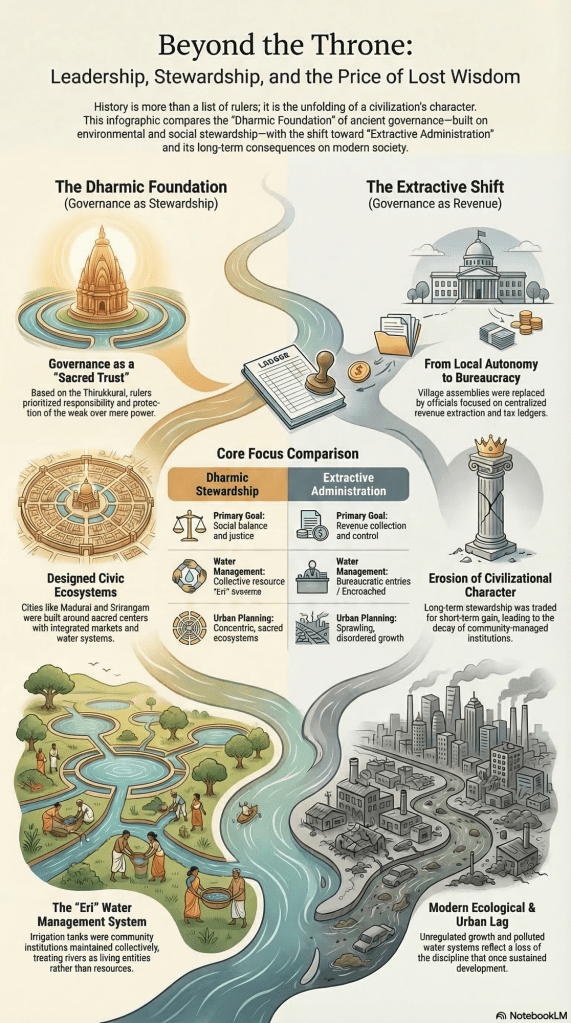
Across ancient Tamilakam and much of the Indian subcontinent, governance was not just political authority. It was deeply tied to dharma — the principle of maintaining social balance, justice, and harmony with nature.
Temple towns were not random settlements. They were carefully designed civic ecosystems.
Cities such as Madurai, Thanjavur, and Srirangam were built around sacred centers, with concentric streets that served religious processions, markets organized by guilds, and water tanks that sustained agriculture and daily life.
These irrigation tanks — the eris — were not merely engineering works. They were community institutions maintained collectively by society. Water management, land stewardship, and urban planning were integrated into everyday civic responsibility.
Even rivers were treated with reverence, seen not merely as resources but as living entities deserving respect.
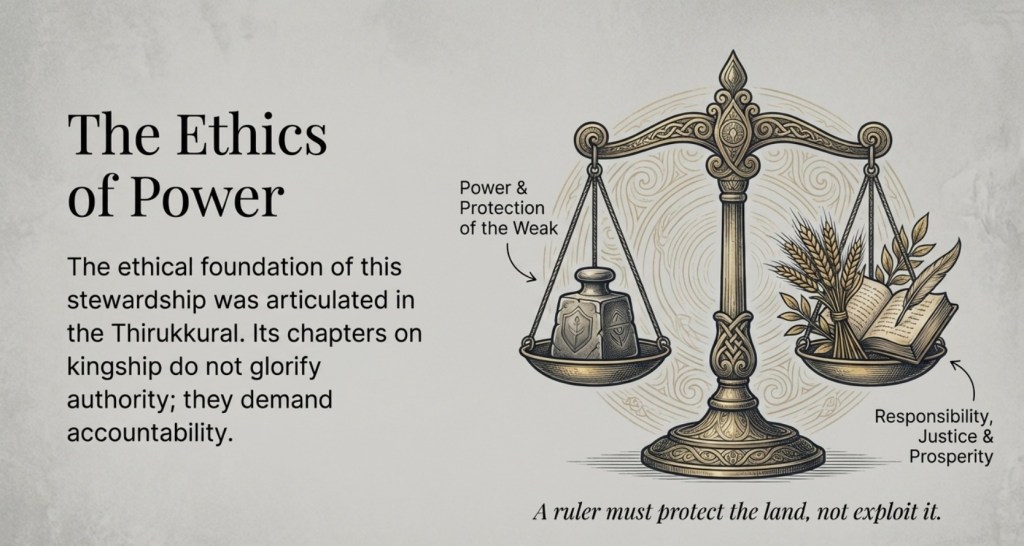
The ethical foundation of governance was articulated in works like the Thirukkural.
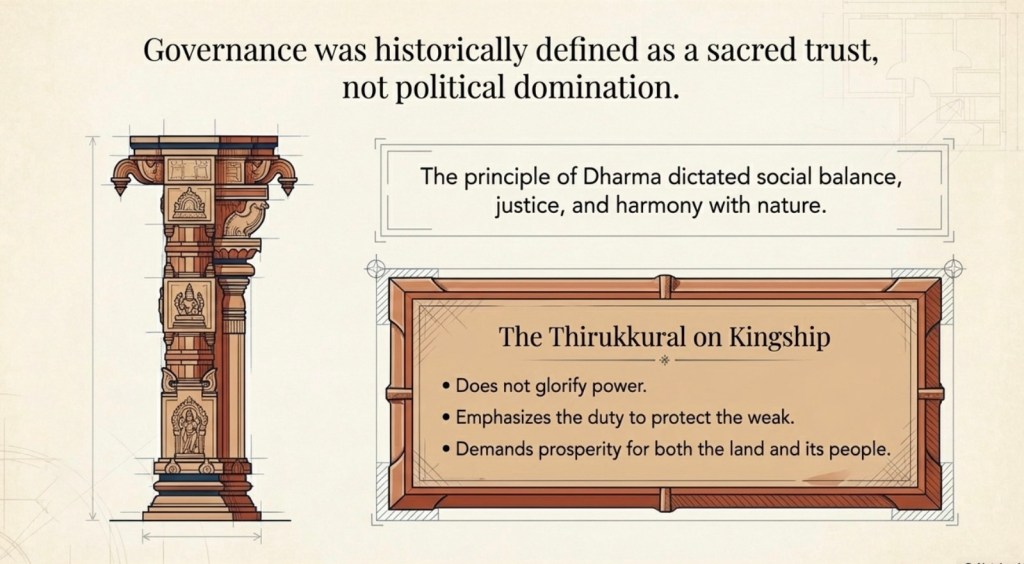
The Thirukkural’s chapters on kingship do not glorify power. Instead, they emphasize responsibility. A ruler must protect the weak, uphold justice, and ensure prosperity for the land and its people.
Governance, in this worldview, was not domination. It was a sacred trust.
3. When Governance Becomes Extraction
Over centuries, the political landscape of the subcontinent changed. New administrations emerged, each bringing different priorities.
Gradually, the focus of governance shifted.
Instead of long-term civic stewardship, administration increasingly centered around revenue extraction and centralized control. Systems that had once been maintained locally — temple lands, irrigation networks, village councils — became bureaucratic entries in tax ledgers.
The local custodians of civic life began losing autonomy.
Village assemblies that once managed land and water were replaced by officials whose primary responsibility was collecting revenue. Institutions that had integrated spiritual, social, and economic life slowly weakened.
This shift did not happen overnight. It unfolded over generations. But its effects accumulated.
When governance focuses primarily on extraction rather than stewardship, the foundations of a civilization begin to erode.
4. The Consequences We See Today
The effects of those long historical shifts are visible in many parts of modern society.
Historic temple towns that were once models of urban planning now struggle with unregulated growth.
Lakes and rivers that were once carefully maintained community resources have been encroached upon or polluted.
Temple lands meant to support education, arts, and social welfare often remain tied up in disputes or poorly managed.
Cities expand rapidly, but civic discipline and environmental balance often lag behind.
Economic growth is visible, but it sometimes feels chaotic, disconnected from the deeper civilizational principles that once guided development.
Infrastructure alone cannot create a thriving society. Without civic discipline and long-term stewardship, progress becomes uneven.
5. The Judgment of the Future
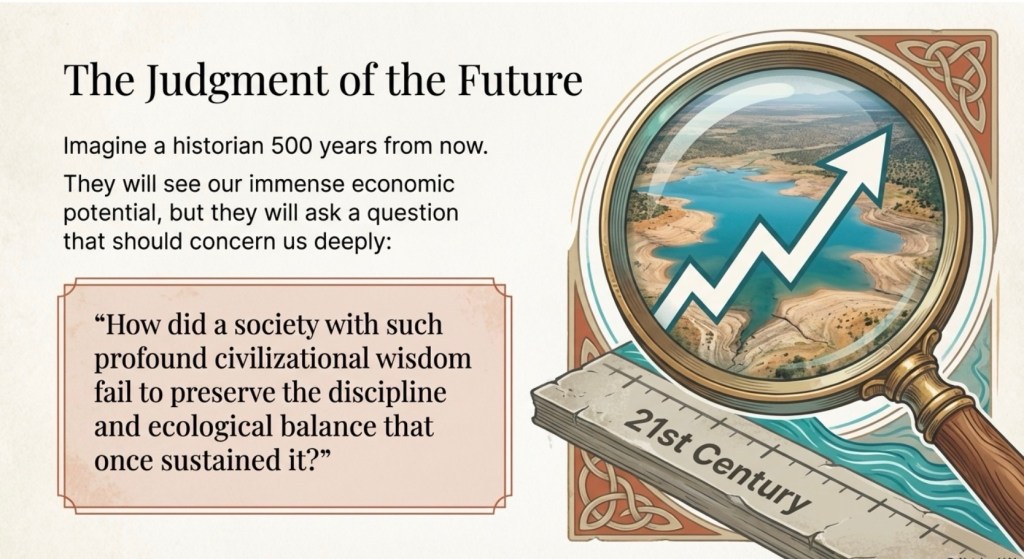
Imagine a historian five hundred years from now studying our era.
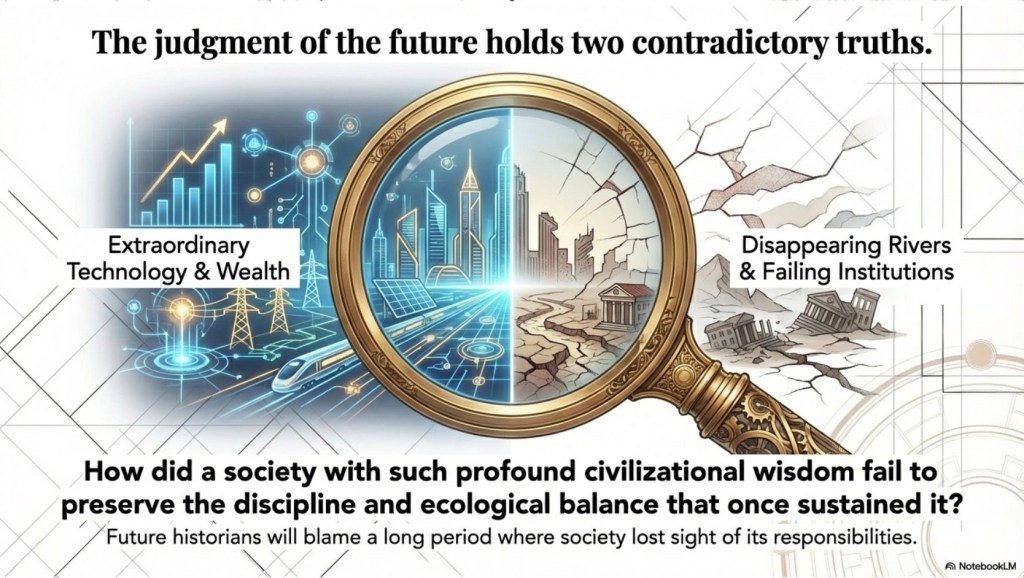
They will see a civilization with extraordinary technology, vast knowledge, and immense economic potential.
But they will also see disappearing rivers, shrinking lakes, congested heritage towns, and institutions struggling to preserve their purpose.
They may ask a question that should concern us deeply:
How did a society with such profound civilizational wisdom fail to preserve the discipline and ecological balance that once sustained it?
Their answer may not blame a single ruler or movement. Instead, it may describe a long period during which leadership — and society itself — gradually lost sight of its civilizational responsibilities.
History will judge not only the wealth we created but also the wisdom we preserved.
6. A Lesson for the Next Generation
For future generations, the lesson is clear.
Civilizations do not survive through power alone. They endure through wisdom, discipline, and institutions that protect both society and nature.
Leadership matters. But so does civic responsibility.
Every generation must decide whether it will merely inherit a civilization or actively preserve and strengthen it.
If the past teaches us anything, it is this:
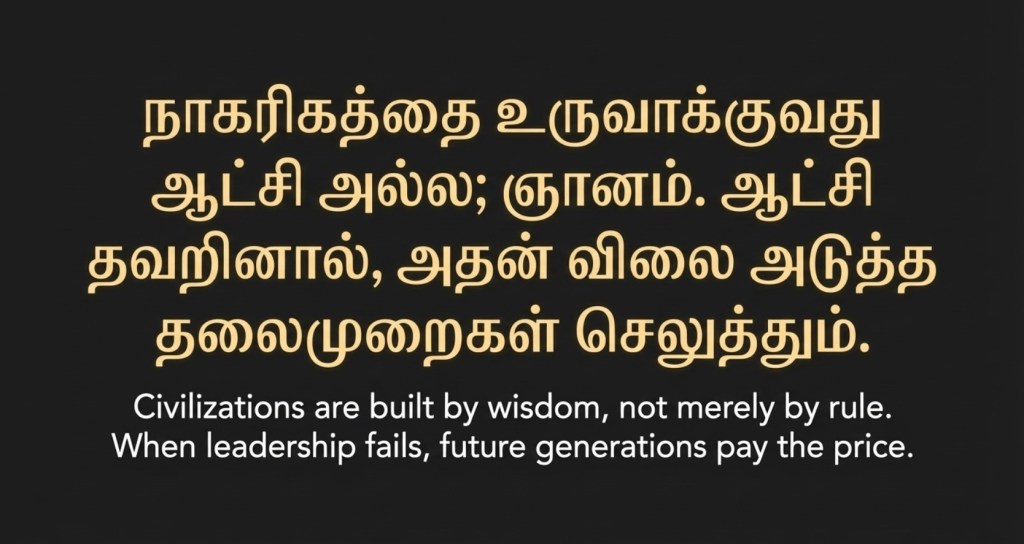
நாகரிகத்தை உருவாக்குவது ஆட்சி அல்ல; ஞானம்.
ஆட்சி தவறினால், அதன் விலை அடுத்த தலைமுறைகள் செலுத்தும்.
Civilizations are built by wisdom, not merely by rule.
 Arambhin
Leave a comment