
Navigating the Vertical Thread of the Soul in the Kaushitaki Upanishad
We arrive in this world wired for separation. Our first instinct is to draw boundaries—between “me” and “not-me,” between the living and the ancestors, between the spirit and the body. Differentiation is our birthright; it allows the individual to emerge from the vast field of existence. Yet, as we move toward our final moments, we inevitably look for the seam where our individual story joins the eternal. The Kaushitaki Upanishad provides one of antiquity’s most sophisticated “roadmaps” for this transition, revealing a Vertical Thread that stitches our transient physical existence to our spiritual origins. It suggests a profound truth: we are born to differentiate, but we are eventually invited to burn so that we may integrate.
The Lunar Crossroads: Why the Moon is the Universe’s Great Sorting Station
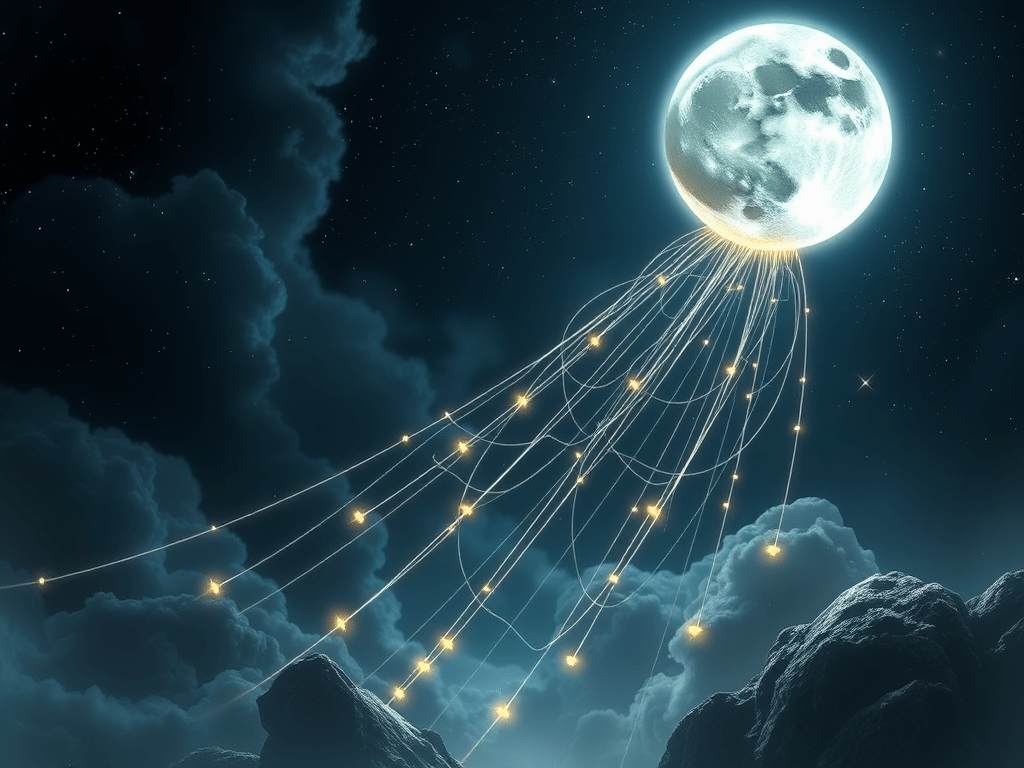
In the Vedic transition, the moon is far more than a celestial body; it is a Lunar Gate, a grand sorting station for every departing soul. The journey after death does not lead to a static heaven or hell, but to this crossroads where the trajectory of the soul is determined by two factors: Knowledge and Desire.
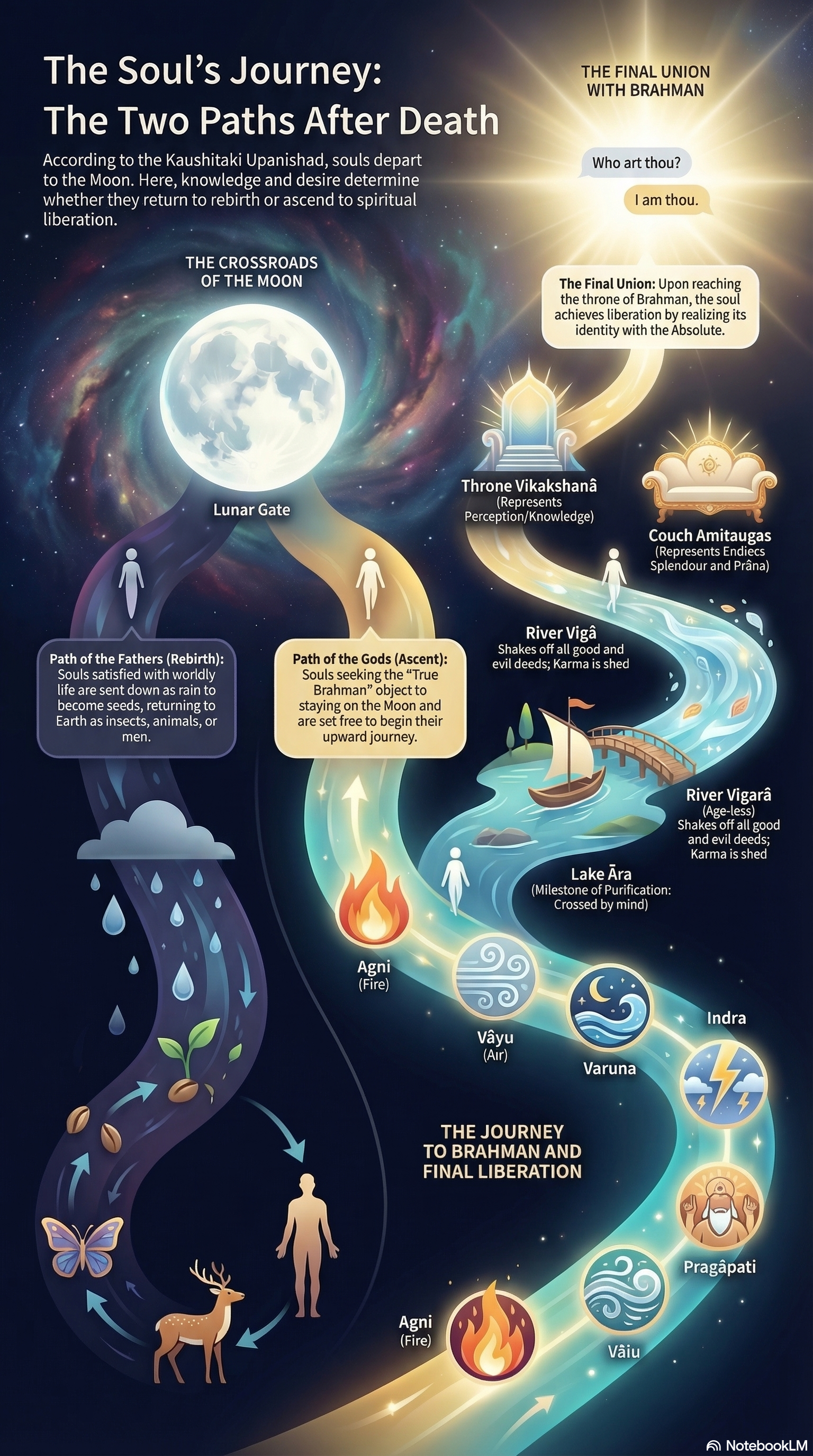
The moon acts as a celestial filter. Those who arrive without the knowledge of the Brahman—those satisfied with worldly life—are caught in its pull. However, those seeking the “True Brahman” object to staying on the moon; their clarity of purpose sets them free to begin an upward ascent toward the World of Brahman, the “unconquerable” palace that never ages.
“All who depart from this world go to the moon. In the former, the bright half, the moon thrives on their spirits; in the latter, the dark half, it causes them to be born again. The moon is the door of the heavenly world. He who knows the answer, him it lets pass.”
Under the silence of Amavasya, this gate feels closest—when the moon disappears, the ancestral realm becomes accessible, and the question echoes: “Who are you?”
The Rain of Return: Why Your Ancestors Are Literally in the Soil
For the soul whose identity is still anchored in worldly deeds and lineage, the path taken is the Pitṛyāna, or the Path of the Fathers. This is a horizontal continuity rather than a vertical ascent. The Kaushitaki Upanishad describes this return through a striking biological and meteorological cycle: the soul is sent back to Earth as rain.
This rain nourishes the earth, transforming the soul into seeds that eventually manifest as insects, animals, or men. This frames human life not as a singular, isolated event, but as a participation in the rhythms of nature. We are, quite literally, the recycled essence of those who came before us—a view that transforms lineage into a living, breathing biological reality.
The Spiritual Spine: India’s Geography as a Living Organism
To the cultural historian, India is not merely a map, but a living organism where sacred landscape mirrors the human body. The axis between Kashi (Varanasi) in the North and Rameswaram in the South forms a Vertical Thread that stitches together two cosmic poles.
- Kashi (The Crown): Associated with Akasha (Ether), Kashi represents the Sahasrara or crown chakra. It is the gateway of Devayāna (the path of light), where the eternal flames at Manikarnika Ghat symbolize the final offering of identity. Here, Shiva is said to whisper the Taraka Mantra into the ear of the departing soul, a sound that vibrates through the ether to guide the spirit upward.
- Rameswaram (The Root): Associated with Prithvi (Earth), Rameswaram represents the Muladhara or root chakra. This is the realm of Yama and the Pitṛs, where land dissolves into the ocean. Here, the focus is not on transcending life, but on the responsibility of healing lineage.
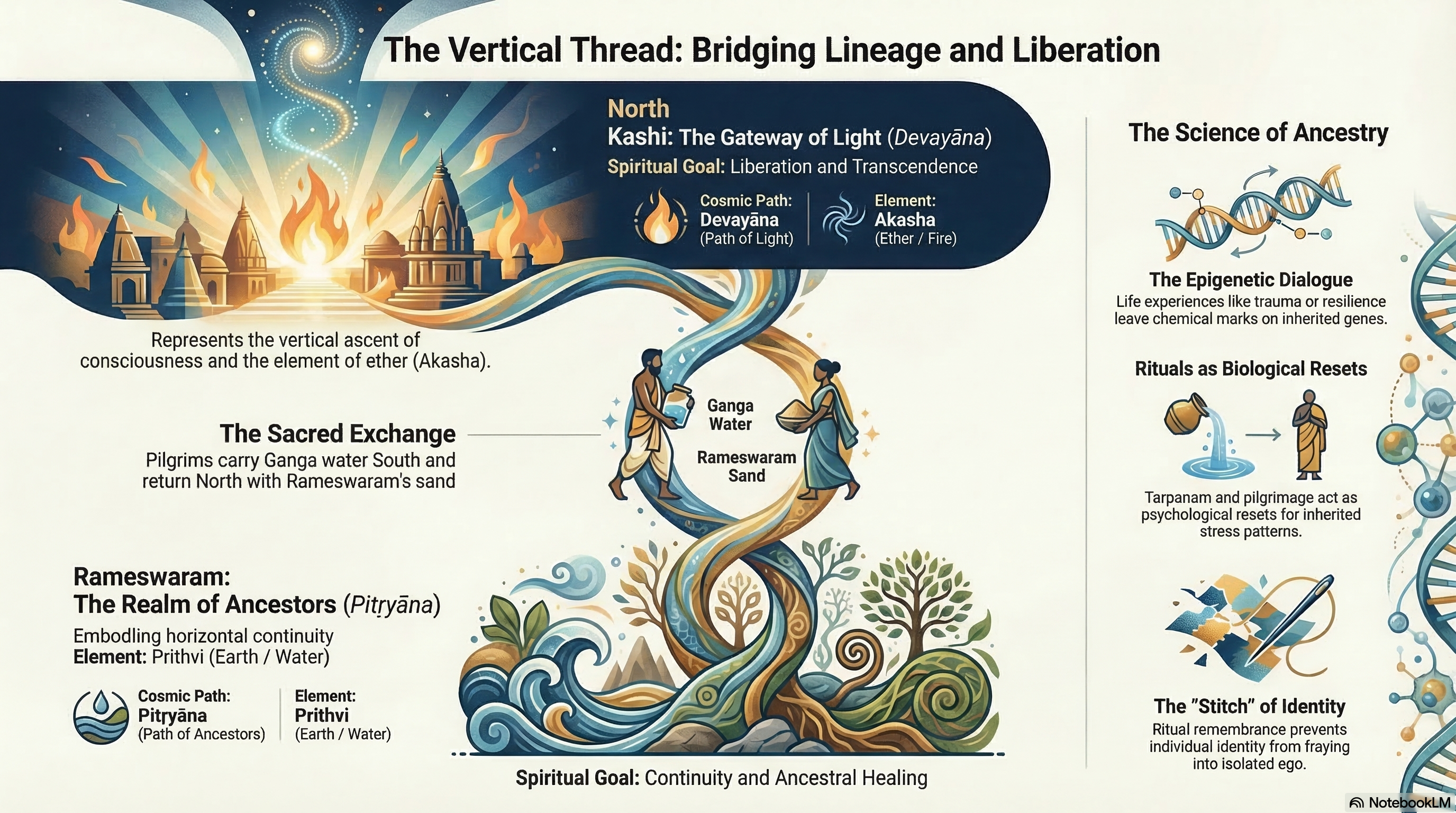
The tradition of carrying Himalayan silt from Kashi to bathe the Lingam in the South, and bringing ocean salt or sand back to the North, is a ritual “stitch.” It bridges the fire of spiritual transcendence with the water of ancestral continuity, ensuring the soul’s identity does not fray into isolation.
The Supremacy of Prāna: The King Who Holds the Senses Together
The Upanishad identifies Prāna (the vital breath) as the “King” of the senses. This is beautifully illustrated by the Spark Analogy of Awakening: just as sparks proceed in all directions from a burning fire, so do the senses proceed from the Self upon waking.
This analogy suggests that our daily cycle of waking is a micro-mirror of the cosmic cycle of creation. While we can survive the loss of speech, sight, or hearing, the body only “rises” and functions through Prāna. The text identifies this breath as the Pragñâtman, or the “conscious self.” Breath and consciousness are inseparable; they live in the body together and depart together, acting as the primary vehicle for the soul’s vertical journey.
The “I Am Thou” Realization: Passing the Ultimate Final Exam
For the soul ascending the Devayāna path, the journey involves crossing elemental realms—Fire (Agni), Air (Vâyu), and Varuna—before reaching the milestones of purification. The seeker must cross Lake Āra by the mind alone and navigate the River Vigâ (or Vigarâ), the “Age-less River.” As the soul crosses this water, it shakes off all good and evil deeds; the heavy cloak of karma is shed, leaving the spirit light enough to approach the Absolute.
The journey culminates at the Throne Vikakshanâ (representing Perception) and the Couch Amitaugas (representing Endless Splendor and Prāna). Here, Brahman poses the ultimate “final exam” question: “Who art thou?” This is not a request for a name or a lineage, but a test of non-dual realization. To answer with the ego is to fail; to answer by shedding the “me and not-me” boundary is to achieve union.
Brahman: “Who art thou?”
The Soul: “I am thou.”
The Epigenetic Bridge: Ritual as a Dialogue with the Ancestral Code
This ancient “Vertical Thread” finds a stunning modern echo in biology. The ritual of Tarpanam—performed under the dark moon of Amavasya—is described as an “epigenetic dialogue with the past.” Modern science shows that life experiences—trauma, stress, and resilience—leave “chemical marks” on our genes that travel across generations. Our ancestors are not just memories; they are biological imprints.
Rituals like Tarpanam and the Kashi-Rameswaram pilgrimage function as psychological and physiological resets: using water and intention to provide symbolic closure, release inherited stress, and shift from fraying isolation to integrated tapestry. The pilgrimage’s physical journey rewires the epigenetic field, proving lineage transcends the small ego.
Conclusion: The Question Under the Dark Moon
The Kaushitaki Upanishad leaves us with a dual vision of destiny: the Pitṛyāna, the horizontal path of return through the rain and the soil, and the Devayāna, the vertical path of fire and light. Both are essential. One sustains the world; the other transcends it.
Amavasya, the night of the dark moon, is the moment of ultimate silence. It is when the mind becomes still, the egoic identity loosens, and the vertical thread becomes most visible in the darkness. As we stand between the poles of our earthly heritage and our cosmic potential, we must eventually face the question that lingers in the smoke of the cremation fires and the salt of the southern sea:
What in you is ready to burn so the vertical thread can weave the whole? 🌑🔥🧬🙏
 Arambhin
Leave a comment