
The Colors of Silence: Finding the Seat of the Mind
விமானப் பயன் நிலையில் மனம்
ரிங்பிங் இல்லாத கணம்
இருக்கையில் இருக்கும் எண்ணம்
மௌனம் தீட்டிய வண்ணம்
The other day, I pressed a small button on my phone. Airplane Mode.
Mind in airplane mode’s hush,
English Translation of Tech நீக்கல்
RingPings’ absence in fleeting now—
Thoughts that linger in pure being,
Hued by silence’s sacred glow.
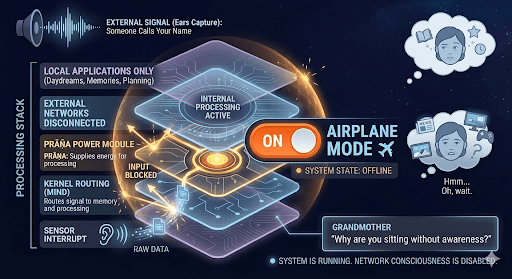
A tiny icon appeared—a silhouette of a plane taking flight. In an instant, the network bars vanished. The Wi-Fi faded into a gray ghost. Bluetooth retreated. Within seconds, the invisible highways connecting my consciousness to the digital scramble went dark.
No ringing. No “ping.” No digital pulse. No red dots demanding my temporary lease on life. Just a sudden, startling silence.
For a heartbeat, the device felt alien in my hand—a machine that had suddenly forgotten its purpose. But in that void, something unexpected happened: My mind woke up.
The Ring-Ping Symphony
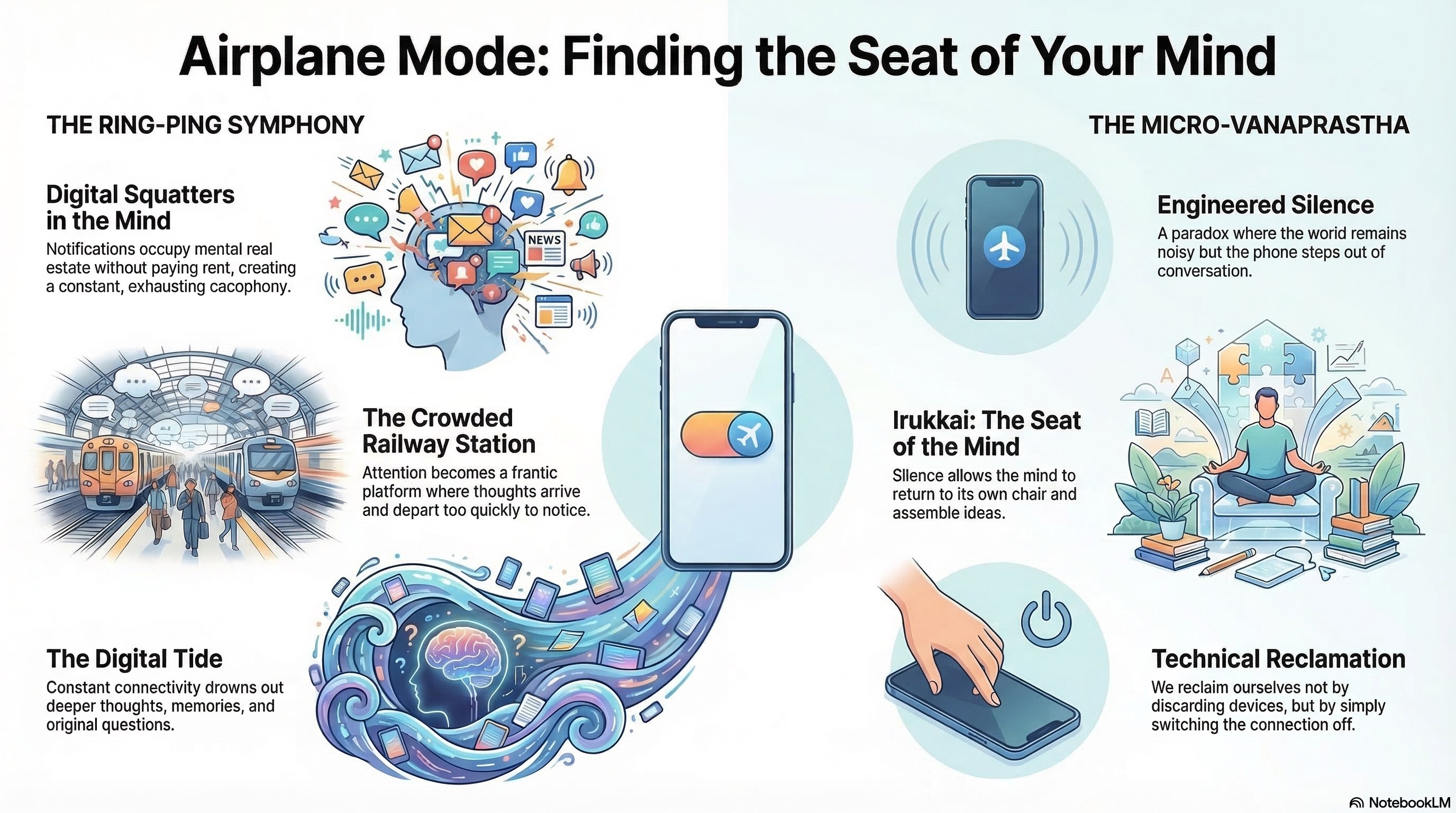
Modern life is conducted by what I call the Ring-Ping Symphony. A message here, a notification there, a soft buzz against the thigh. Individually, these sounds are harmless. Together, they are a cacophony that occupies our mental real estate without paying rent.
Our minds rarely get to simply sit. The phone rings; the mind responds. The phone pings; the mind jumps. Over time, our attention becomes a crowded railway station—thoughts arrive and depart with such frantic frequency that we forget to notice the platform itself.
The Engineered Silence
Airplane Mode creates a paradox: Engineered Silence. The world remains noisy. Emails are still screaming across servers; social media storms are still raging in the cloud. But the phone has stepped out of the conversation. It sits there, disconnected and peaceful.
And in that artificial vacuum, the true self begins to surface.
இருக்கையில்: The Seat of the Mind
In Tamil, the word இருக்கை (Irukkai) means “seat.”
When the phone rests in your hand without signals, it is literally sitting in a seat of silence. But metaphorically, this silence reveals the Seat of the Mind. When the notifications stop, the mind slowly returns to its own chair.
Thoughts that were previously drowned out by the digital tide begin to drift back to shore. Memories wander in like old friends. Questions form. Ideas quietly assemble themselves in the dark. It is as if silence has picked up a brush and begun to paint.
Mounam Theettiya Vannam
“The colors painted by silence.”
In a world addicted to stimulation, silence is the ultimate creative force. History’s greatest insights weren’t born in a chatroom; they were born in the quiet: a monk walking a mountain path, a scientist staring at the obsidian sky, a poet sitting by the river.
Today, that silence is usually murdered within seconds by a buzzing rectangle. Airplane Mode is a brief resurrection of that lost condition. It isn’t perfect, and it isn’t permanent, but it is a vital reminder of what thinking actually feels like.
The Modern Vanaprastha
In ancient Indian philosophy, Vanaprastha is the stage of life where one withdraws from worldly noise to seek reflection. Airplane Mode is perhaps our accidental, digital version of this. It is a “Micro-Vanaprastha”—a retreat that requires no forest, only a thumb and a screen.
Tech நீக்கல் literally means the removal of technology. The irony is beautiful: we don’t remove technology by discarding the device. We reclaim ourselves by simply switching the connection off.
In that small act of “Technical” operation, the mind reconnects to a deeper network—one that never needed Wi-Fi, never sought signal bars, and never needed a notification to know it was alive.
 Arambhin
Leave a comment