
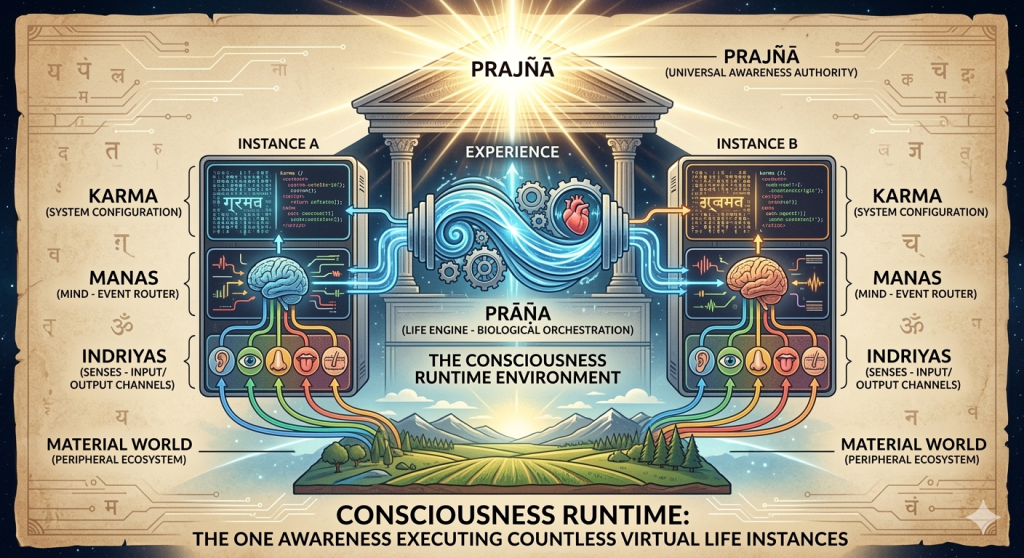
What if life could be described like a distributed system?
Not metaphorically, but structurally.
The ancient sages who composed texts like the Kaushitaki Upanishad were trying to answer a question that still puzzles neuroscience and philosophy today:
What actually runs the system called life?
If we reinterpret their insights using modern systems architecture, an astonishing model begins to emerge.
⸻
The Consciousness Stack
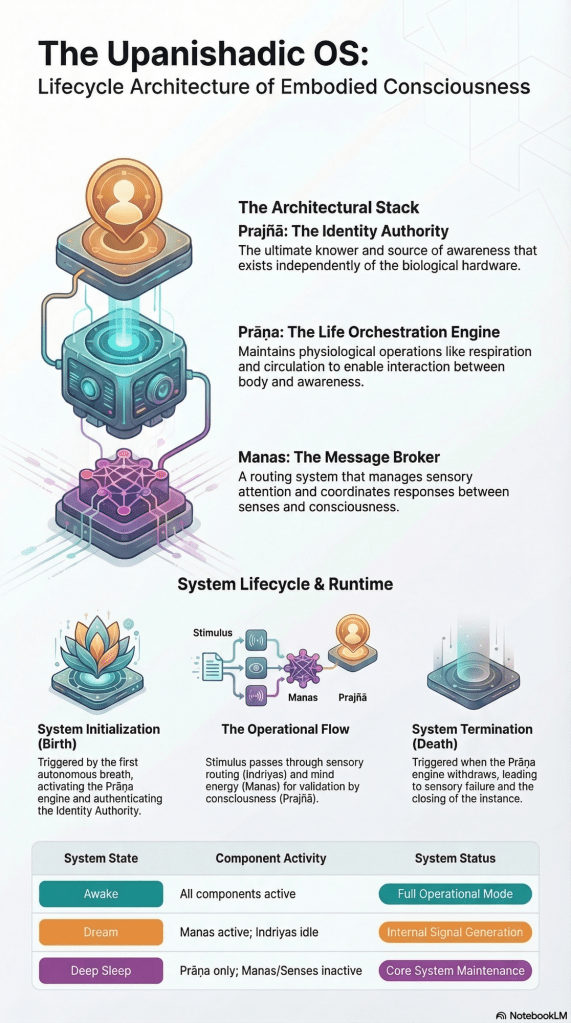
Imagine the human being as a layered runtime architecture.
Indriyas (Senses)
These are the input/output channels. They collect signals from the environment: sound, light, touch, taste, and smell.
Manas (Mind)
The mind acts like a messaging service or event router. It receives signals from the senses, prioritizes them, and forwards them for processing.
Prāṇa (Life Engine)
Prāṇa is the orchestration layer that powers biological processes. Breathing, circulation, metabolism, and neural vitality all depend on it.
Prajñā (Awareness Authority)
Prajñā is the layer that turns signals into conscious experience. Without it, events occur but are not truly known.
So the runtime pipeline looks something like this:
Stimulus → Indriya → Mind → Prāṇa → Prajñā → Experience
Only when prajñā illuminates a signal does it become lived awareness.
⸻
Birth as System Initialization
Before birth, the body is developing but not yet operating as an independent system.
At the moment of birth two things happen:
1. The umbilical dependency ends.
2. The baby takes its first breath.
That first breath activates the prāṇa engine.
The first cry expands the lungs and signals that the new runtime instance has started.
The system has booted.
⸻
Life as Runtime Operation
During life, sensory events flow continuously through the stack.
Someone calls your name.
Your ears capture the sound.
The mind routes the signal.
Prāṇa powers the neural processing.
Prajñā recognizes the event.
You become aware.
But if the mind is distracted, the signal may never reach prajñā.
Your grandmother might say:
“Why are you sitting without awareness?”
The system is running, but authentication never happened.
⸻
Death as System Shutdown
The Upanishads describe death as the withdrawal of prāṇa.
When the orchestration engine stops:
• the senses fail
• the mind collapses
• the body shuts down
The life instance terminates.
But the deeper claim of Vedanta is that prajñā itself does not disappear.
It simply stops operating through that particular interface.
⸻
The Radical Insight
The Kaushitaki Upanishad hints at something far more profound.
What if consciousness is not inside the system?
What if the system is inside consciousness?
Instead of this model:
Human → produces consciousness
the Upanishads suggest:
Consciousness → produces human experience
In this view, consciousness is the runtime environment, and bodies are temporary instances running inside it.
⸻
Distributed Life Instances
If consciousness is the runtime, then every organism is like a virtual machine.
Each instance contains:
• a body
• a mind
• sensory channels
• memories
• karmic configuration
All of them process different sensory data streams simultaneously.
Parallel processing happens everywhere in nature.
Yet the awareness substrate underneath remains one.
⸻
Why Experiences Remain Unique
If awareness is one, why do individuals experience separate realities?
Because every body–mind system acts like a sandboxed container.
Each instance has its own:
• sensory hardware
• mental conditioning
• memory history
• karmic configuration
These act as filters that shape how awareness expresses.
The light is the same.
The lenses are different.
⸻
Karma as System Configuration
In traditional language, the configuration that shapes a life instance is called karma.
You can think of it as persistent system state.
Karma influences:
• tendencies of the mind
• perception biases
• abilities and limitations
• circumstances of life
So while the runtime is universal, each instance boots with a different configuration profile.
⸻
The Illusion of Local Consciousness
Normally we identify with the local instance.
We believe:
“I am this body.”
“I am this mind.”
“I am this personal history.”
But this is essentially a pointer error in the identity system.
We mistake the container for the runtime.
⸻
Enlightenment: Global Mode
According to Vedanta, enlightenment occurs when this misidentification dissolves.
The body and mind continue functioning.
But the sense of identity shifts from the local instance to the underlying awareness.
Instead of thinking:
“I am this individual consciousness”
the insight becomes:
“I am the awareness in which all individuals appear.”
Prajñā is no longer experienced as local.
It is recognized as global.
⸻
The Classic Metaphor
The sages illustrated this with a simple image.
One sun reflected in many pots of water.
Each pot contains a reflection.
The reflections appear separate.
But the sun itself is never divided.
Bodies are the pots.
Minds are the water surfaces.
Consciousness is the sun.
⸻
The Architecture of Oneness
From the outside, life appears as billions of separate beings.
From the deeper perspective of the Upanishads, it looks more like a distributed system:
One universal awareness runtime executing countless life instances simultaneously.
Parallel processing everywhere.
Unique experiences in every container.
Yet the underlying awareness remains indivisible.
The many are interfaces.
The awareness behind them is one.
 Arambhin
Leave a comment