

The monsoon didn’t just bring rain to Kanchipuram; it brought a heavy, static electricity that made the fine hairs on Arjun’s arms stand up. Outside the stone portico, the sky was the color of a bruised plum.
“Guruji,” Arjun said, his fingers tracing the etched grooves of a palm-leaf manuscript. The oil-treated leaves felt cool, but the question burning in him was hot. “Why is the Truth fragmented? The Rig, the Yajur, the Sama… we are split into pieces. If a great fire came, or a king went mad and burned the archives, the holiest words would vanish because they aren’t all in one place. Why do we not gather them into one Great Library?”
The old teacher, whose skin was mapped with as many wrinkles as the ancient geography he taught, didn’t look up from his prayer beads.
“Tell me, child,” the teacher whispered, “where is the library of this village?”
Arjun looked toward the cluster of mud-brick homes and thatched roofs. “There isn’t one, Guruji. We have the temple sanctum, but no hall of books.”
The teacher stood, his bones popping like dry kindling. He led Arjun to the edge of the veranda and pointed a shaking finger. “Look again. There, by the kiln. The carpenter.”
“He builds chairs, Guruji. He doesn’t read.”
“He remembers the exact tension of every joint that holds a temple door against a century of storms,” the teacher corrected. “And there, the farmer? He knows the language of the soil better than any botanist’s scroll. And the priest? He carries hymns older than the dynasties that claim to rule us.”
The boy frowned, unimpressed. “That is a village, not a library.”
The old teacher chuckled, a sound like dry leaves skittering on stone. “It is the only library that cannot be burned.”
The Architecture of Air
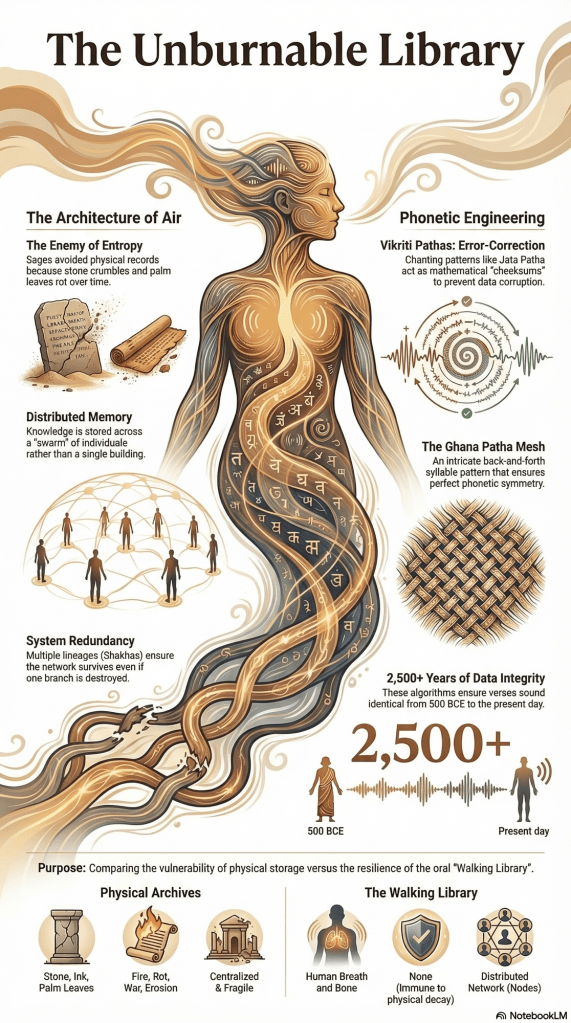
Thousands of years ago, the sages—the Rishis—stared into the abyss of time and saw a terrifying truth: Matter decays. Stone crumbles. Palm leaves rot in the humidity. Ink fades under the sun. If they committed the Vedas to physical objects, they were handing the blueprints of the universe to the enemy of all things: Entropy.
So, they designed a system of “Distributed Memory.” They didn’t build a fortress of stone; they built a fortress of breath and bone.
They turned the human mind into a biological hard drive.
The Science of the Sound
“The Vedas are not just stories, Arjun,” the teacher said, drawing a circle in the dust of the courtyard. “They are frequencies. A single slip in the Svara—the pitch—and the meaning collapses. To protect this, the Rishis became engineers of the air.”
He explained the Vikriti Pathas—the complex “error-correction codes” of antiquity.
• Jata Patha: Where words are chanted in a 1-2-2-1-1-2 pattern.
• Ghana Patha: An intricate back-and-forth mesh of syllables.
If a reciter missed a single beat, the mathematical symmetry of the chant would break, alerting the entire circle. It was a checksum, an algorithm written in phonetics, ensuring that a verse chanted in 500 BCE would sound identical in 2026 CE.
The Survival of the Swarm
“But why the division?” Arjun asked, the first raindrops darkening the dust circle.
“Redundancy,” the teacher snapped. “If one lineage, one Shakha, is wiped out by war or famine, the others survive. We are not a single scroll that can be torn. We are a network. A web. One branch carries the music, another the ritual, another the philosophy. No single man is the Library, but the Library lives through every man.”
Arjun looked at the dots the teacher had drawn. They weren’t just individuals; they were nodes.
“It is a living system,” Arjun whispered.
“Exactly,” the teacher replied. “Centuries will pass. Empires will rise and be forgotten like mist. Great stone libraries will be leveled by conquerors who fear what is written inside. But they cannot kill what is carried in the morning breath of a thousand different villages. They cannot burn a book that walks.”
The Connection
The rain began to fall in earnest now, a silver curtain closing around them. Arjun hurriedly gathered the manuscripts, but he handled them differently now—not as the source of knowledge, but as mere backups for the true treasure stored within.
“Guruji,” Arjun said, watching the water wash away the circle in the dust. “In the future, will there be machines to hold all this? Great metal boxes that remember everything?”
The teacher smiled enigmatically. “Perhaps. And they will try to mimic what we have done. They will call it a ‘distributed network.’ They will brag of ‘data redundancy.’ But they will always be vulnerable to the pull of a plug or the rust of a wire.”
He stood and began a low, resonant chant. The sound didn’t just stay in his throat; it vibrated in the stone floor, in Arjun’s chest, and in the very rhythm of the falling rain.
Arjun closed his eyes and joined in. He wasn’t just a student anymore. He was a node. He was a walking shelf in a library that had been traveling for five millennia and was nowhere near its destination.
 Arambhin
Leave a comment