
Rama Nama Japa
Most of us read the Ramayana as history: a chronicle of a lost golden age. Some read it as devotion: a prayer offered in the dim light of an altar. A few read it as politics: a boundary line drawn in the dust.
But what if the Ramayana is not a story about what happened, but a manual for what is happening?
Not a rulebook, but a systems diagram. A cartography of the human spirit. What if Valmiki wasn’t just a poet, but a spiritual engineer mapping the very mechanics of consciousness?
This is not mythology. This is mechanics.
1. Rama: The Radiance Within
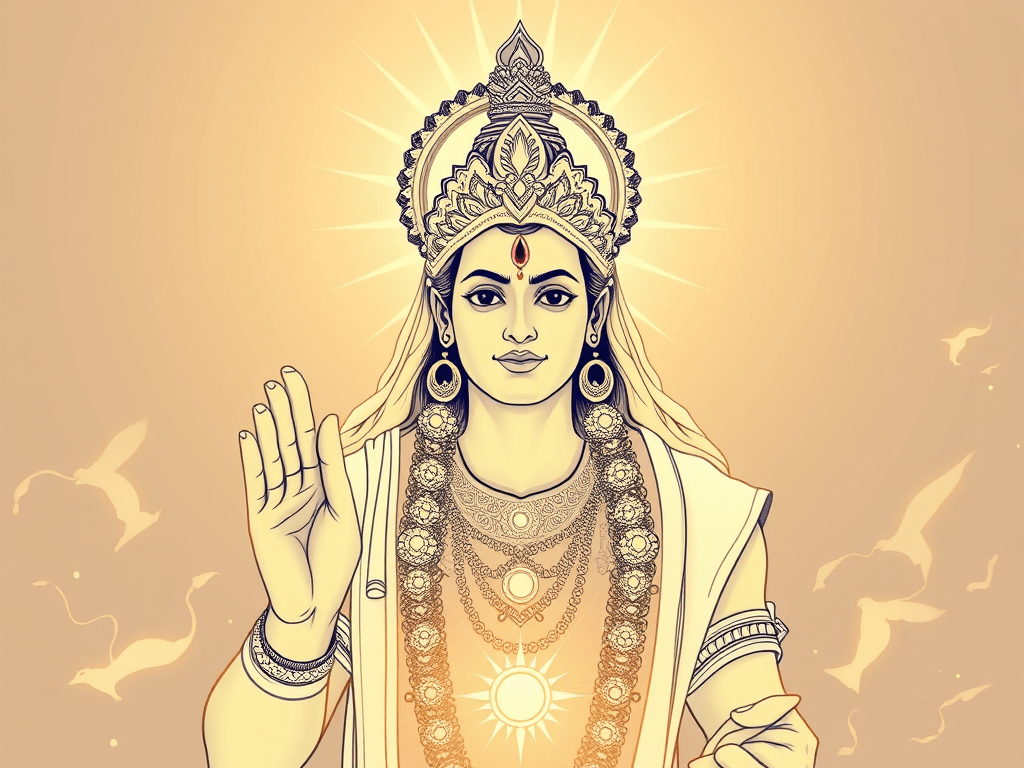
Etymologically, “Ra” signifies light; “Ma” signifies within. Rama is not merely a prince of Ayodhya; he is a condition of being. He is the “Radiance Within” the cave of the heart. The epic begins not with a declaration of war, but with a miracle of birth. In the laboratory of the soul, radiance is not manufactured—it is revealed only when the internal environment achieves a specific state of grace. That isn’t poetry; it is psychology.
2. Dasharatha: The Ten Chariots of Perception
Dasharatha translates to “one who commands ten chariots.” These are the ten forces of human interface:
- Five Gnanendriyas (Senses of Perception): Sight, Sound, Smell, Taste, Touch.
- Five Karmendriyas (Organs of Action): Speech, Grasping, Movement, Elimination, Reproduction.
These ten chariots are constantly pulling the “Self” outward into the chaos of the material world. Dasharatha represents the mastery of these senses. Only when the chariots are skillfully aligned can Rama (Illumination) be born. Undisciplined senses do not give birth to clarity; they give birth to distraction.
The difference between a King and a Tyrant—between Dasharatha and Ravana—is not the number of chariots. It is governance.
3. Kousalya: The Mother of Skill
Rama is born to Dasharatha and Kousalya. Her name means “Skill.” Illumination is the offspring of Mastery and Skill. This skill is not the blunt force of suppression; it is the “intelligent engagement” with one’s own nature. Radiance is not the reward for denying the world; it is the inevitable outcome of aligning with it.
4. Ayodhya: The Invincible Mind
Ayodhya means “The Unconquerable” or “That which cannot be fought.” It is a city defined by the absence of war. This is the psychological state of Samadhi—a mind no longer fragmented by internal contradictions. When the civil war within the psyche ceases, sovereignty returns. Ayodhya is not a coordinate on a map; it is the silence between thoughts.
5. The Inner Cast: A Metaphysical Map
The drama unfolds within the biological kingdom of the reader:
| Epic Figure | Inner Principle | Function |
| Rama | The Atman (Soul) | Pure, untouched Being. |
| Sita | The Manas (Mind) | The reflective mirror of the Soul. |
| Lakshmana | Awareness | The vigilant guard of focus. |
| Hanuman | Prana (Breath) | The bridge between the physical and subtle. |
| Ravana | Ahankara (Ego) | The delusion of “I” and “Mine.” |
6. The Abduction: When Ego Claims the Mirror
When Ravana kidnaps Sita, it is the Ego capturing the Mind. The Ego cannot touch the Soul (Rama); it can only disconnect the Mind from its source. The Ego takes the Mind to Lanka—a city of gold and sensory overstimulation. This is the human condition: a Mind mesmerized by its own desires, weeping in a garden of shadows, while the Soul wanders the wilderness in search of its reflection.
7. Hanuman: The Bridge of Breath
The Soul cannot command the Mind back through logic once the Ego has taken root. It needs a messenger. Hanuman is Prana—the life force. Breath is the only faculty that is both voluntary and involuntary; it exists in the world of the body and the world of the spirit. This is why every contemplative tradition begins with the breath. It is the only doorway that remains unlocked when the Ego has bolted the gates.
8. The Fall of the Ten Heads
Ravana also has ten heads—the same ten chariots of Dasharatha, but gone rogue. Where Dasharatha governs the senses, Ravana is enslaved by their multiplication. He represents “Excess without Equilibrium.” He is defeated not by a sword, but by the return of the Mind (Sita) to the Soul (Rama), facilitated by Breath (Hanuman) and Awareness (Lakshmana).
9. The Perpetual Coronation
The Ramayana is not a historical event with a “The End” at the finish line. It is a cycle. Every morning, our mind is distracted (Sita is lost). Every afternoon, our ego claims ownership of our achievements (Ravana rules). And every moment, the possibility of a “Rama Rajya”—the Kingdom of Light—exists.
The real coronation happens when the breath deepens, the awareness sharpens, and the mind finally rests in the radiance of the self. The war is internal. The kingdom is internal. And the light has always been home.
The Eternal Rewiring
The Ramayana is not happening once.
It is happening in synapses.
Every time the mind drifts into egoic loops and returns through breath and awareness, the epic unfolds.
Neuroplasticity is modern language for an ancient truth:
We become what we repeatedly contemplate.
Rama Nama is not escape from thinking.
It is training thinking to align with light within.
Radiance is not imported.
It is remembered.
And remembrance, repeated enough times, becomes structure.
 Arambhin
Leave a comment