
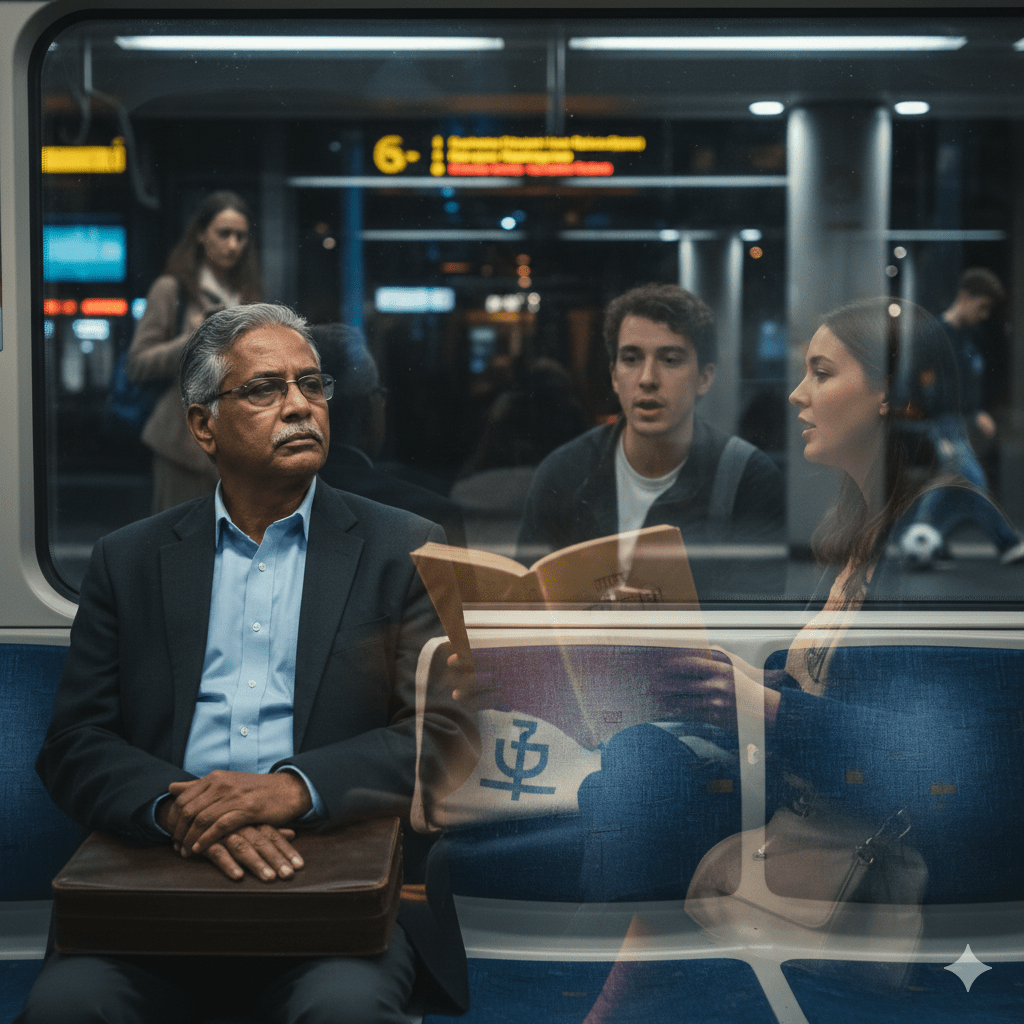
By a window in Munich, a man from Madurai realizes what left him
The U5 was delayed.
It was always delayed.
Murugan stood by the door, hand wrapped around the pole, briefcase balanced between his shoes. Outside, the platform stretched gray and precise. A woman in beige scrolled through her phone. A teenager practiced ball control against a pillar.
Forty-three years since he left Madurai.
Thirty-two years in Germany.
He was German now. Passport. Pension. A careful back shaped by office chairs and winters. His Tamil still came easily when he called his sister, but the words arrived differently now, some landing late like luggage on a missed connection. He thought in German at work. Dreamed in a blend. Sometimes forgot which language he had used five minutes earlier.
The doors opened. He found a seat.
Two stops later, they boarded.
Late twenties. Students, probably. One carried a canvas bag with a yoga symbol. The other held a book printed in Devanagari. Murugan noticed it the way you notice someone from your village in a foreign airport. Surprise first. Then curiosity. Then a quiet rearrangement of assumptions.
They sat across from him.
They spoke German.
But he caught the word.
“Sanskrit.”
“The verb system rewires how you think about time,” one said. “Panini’s grammar is almost algorithmic. Four thousand rules. It generates language from within.”
“I’m memorizing the Shiva Sutras this semester,” the other replied. “To feel the structure in the mouth.”
“There are studies. Different neural activation during memory tasks. It changes cognition.”
The train lurched.
Murugan watched his reflection in the window, his older face layered over the two young Germans.
Sanskrit.
And suddenly, the air smelled of drying ink and the heavy, humid promise of rain.
In school, his history classroom had ceiling fans that trembled but rarely cooled. Mr. Selvam would tap a wooden ruler against a map of the Chola Empire.
“Our tongue is a living river,” Selvam would say, voice bright and fierce. “Tamil is the soil under your fingernails. Sanskrit? That is the dust on a temple shelf. A locked room, Murugan. Why seek a key to a room that holds nothing but ghosts and old hierarchies?”
The boy had nodded.
He wanted to build bridges, not study ghosts. He wanted the sleek metallic future promised by his physics textbooks, written in English and printed in Madras.
By college, the “ghost language” had faded into background hum, like a ceiling fan you eventually stop hearing. You did not study the Shiva Sutras if you wanted thermodynamics. You studied what moved you across oceans.
He had not been a rebel.
He had been a pragmatist.
He traded the locked room for a boarding pass.
For thirty-two years, he believed he had made the better bargain.
The students kept talking.
“The oral preservation is insane,” one said. “Pitch accents, meter, repetition. It’s cognitive cross-training.”
“Our professor says the recitation techniques strengthen working memory. Imagine growing up with that.”
“We’re scanning traditional scholars next year. fMRI studies.”
Murugan did not move.
Germany had given him anonymity. No one asked his caste. No one knew his father’s profession. He was simply Murugan. Mechanical engineer. Taxpayer. Resident of floor three.
But something else had dissolved quietly in that clean anonymity.
Sanskrit was not Hindi. It was not an invader. It was not a political slogan. It was a root system. Invisible but nourishing. Tamil had grown beside it, not beneath it. His grandmother’s prayers had been carried by it. The rituals he sat through as a boy were not superstition alone. They were fragments of a cognitive discipline he never entered.
His generation had not destroyed it.
They had simply stopped choosing it.
Not with anger.
With practicality.
With progress.
With the reasonable decision to educate children in English so they could build futures elsewhere.
The train announced Hauptbahnhof.
The two students stood.
“One day I want to read it without translation,” one said.
“Same. To think in it,” the other replied.
They stepped off.
The doors closed.
Murugan remained seated.
⸻
That night, in his apartment in Pasing, he opened his laptop.
Sanskrit lernen München.
There was a course at LMU. Open to auditors. Beginners welcome.
He stared at the screen.
He thought of Mr. Selvam’s ruler tapping the Chola map. Of the locked room filled with ghosts.
He thought of his father, who could recite the Vishnu Sahasranamam without pause but never explained a word. Of his grandmother, who insisted he sit through homams but never translated the sounds.
He thought of his children, who spoke German with Bavarian precision and knew nothing of any of this.
The form was simple.
Name.
Address.
Reason for interest.
He typed:
I am Tamil. I am 55. I heard Sanskrit my whole life but never learned it. I would like to learn it now.
He paused.
For the first time, the locked room did not feel haunted.
It felt unopened.
He pressed submit.
Then he sat in the dark kitchen, listening to the distant rhythm of the S-Bahn.
Outside, Munich slept.
Inside, a key had turned.
 Arambhin
Leave a comment