
A Comparative Epistemology of Quantum Cognition and Vedantic Astrology
By Raghu Jagannathan
Abstract
This paper investigates the structural isomorphisms between Quantum Cognition—the application of non-commutative mathematical formalisms to human decision-making—and Vedantic Astrology (Jyotisha)—a traditional Indic system for mapping the “karmic probability” of psychological states. Rather than asserting a physical identity between subatomic particles and planetary bodies (a common category error), this inquiry focuses on their shared Non-Newtonian logic. By analyzing how both frameworks utilize field-based ontologies, state-superposition, and context-dependent “collapse,” we argue that Jyotisha functions as a proto-quantum model of the psyche, offering a symbolic technology for navigating an indeterminate reality.
1. Introduction: The Death of the Clockwork Mind
The Classical (Newtonian) view of the mind as a predictable, billiard-ball mechanism has largely failed to account for the irrationality of human choice and the fluid nature of identity. In response, two disparate fields offer alternative maps:
* Quantum Cognition: A rigorous mathematical field asserting that human mental states do not follow classical logic, but rather “quantum logic,” where outcomes are interference-dependent and context-sensitive (Busemeyer & Bruza, 2012).
* Vedantic Astrology (Jyotisha): A symbolic system where the “self” is viewed not as a fixed entity, but as a karmic probability field (Sanchita Karma) that becomes “actualized” (Prarabdha) through the lens of time (Kala).
This paper explores whether these two systems are describing the same underlying architecture of uncertainty.
2. The Measurement Problem: Collapse vs. Actualization
A central critique of applying physics to psychology is the “Scaling Error.” However, if we treat “Quantum” and “Karmic” as information systems, the parallel becomes robust.
2.1 Wave-Function Collapse as Decision Making
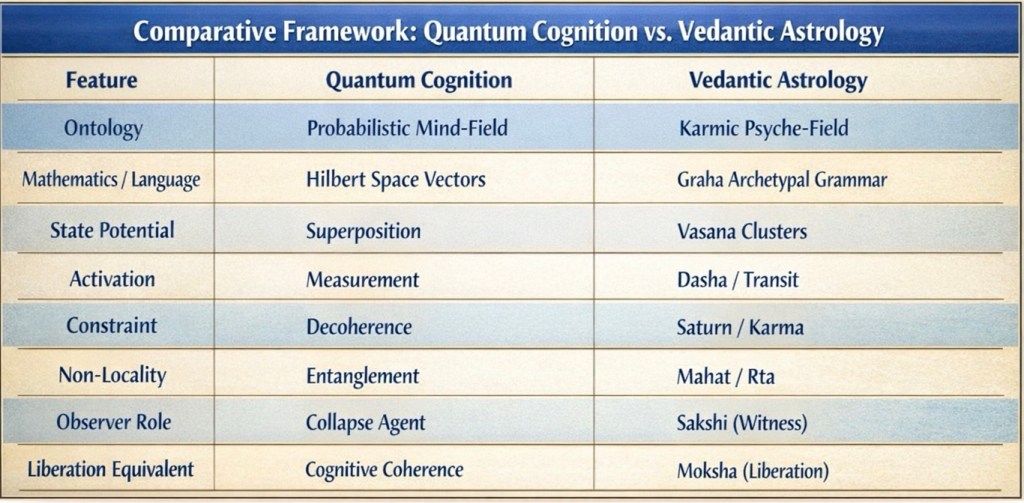
In Quantum Cognition, a person in a state of indecision is in a superposition of potential actions. The act of “deciding” is an measurement that collapses these possibilities into a single state.
2.2 The Dasha System as Temporal Measurement
In Jyotisha, the Vimshottari Dasha (planetary cycles) serves as the “measurement apparatus.” A person may possess a latent potential for leadership (a “Sun” quality), but it remains in a unmanifested state until a specific time-cycle “measures” or activates that potential.
Key Isomorphism: Both systems posit that potentiality is the primary reality, while actuality is a secondary, context-triggered event.
3. Non-Locality: The Entangled Self
A primary liability of modern psychology is the “Skin-bound Ego.” Both our target frameworks reject this.
* Quantum Entanglement: Suggests that systems once in contact remain correlated regardless of distance. In “Quantum Psychology,” this is used to explain non-local empathy and the “interconnectedness” of the observer and the observed.
* The Graha as “Seizer”: Jyotisha views the Grahas (planets) as non-local intelligences. In the Vedantic view of Prana (life force), there is no separation between the “internal” hormone and the “external” cosmic rhythm. They are “entangled” parts of a single field (Mahat).
4. Resolving the “Saturn-Decoherence” Fallacy
Previously, “Decoherence” was used to describe Saturn’s restrictive influence—a scaling error in physics. To rectify this, we must view Saturn (Shani) as the Environmental Constraint.
In quantum mechanics, decoherence is the loss of quantum “freedom” when a system interacts with its environment, forcing it to become “classical” (fixed). In Jyotisha, Saturn represents Gravity, Time, and Karma—the very forces that force the “infinite” soul into the “fixed” constraints of a mortal, physical body.
* Decoherence: The price of manifestation.
* Saturn: The guardian of that price.
5. Comparative Framework Table
6. Conclusion: The Conscious Veto
The most significant intersection is the “Free Will” debate. In Quantum Physics, the Quantum Zeno Effect allows an observer to “freeze” a state through intense focus. In Vedanta, this is the power of Dharana (concentration). Both suggest that while the “Probability Field” (The Chart) provides the terrain, the Awareness (The Observer) has the final veto power over which state is collapsed into reality.
By synthesizing these views, we arrive at a Neurophenomenology of the Stars: a world where the mind is not a clock, but a constellation of possibilities waiting for the light of consciousness.
 Arambhin
Leave a comment