
The forest taught me something no classroom ever could.
It spoke through the eloquence of absence.
For years I chased the moment across countless safaris. The chevron of a rare bird’s wing. The amber flicker of a tiger slipping between teak trunks. The precise geometry of golden-hour light photographers worship.
I carried the right glass, the right sensors, the most meticulous preparation.
Yet the forest remained indifferent.
The bird never waited.
The tiger never appeared.
I moved through the jungle like a ghost inside a machine, trying to capture a world that did not acknowledge my existence.
Only later did I grasp the truth.
The forest does not respond to effort.
It responds to alignment.
I watched veteran guides, men who seemed blessed by the grammar of the wild. Every third drive, a tiger would cross their path as casually as breath leaving lungs.
Tourists called it luck.
It wasn’t.
They were not hunting animals.
They were reading the manuscript of the woods.
A snapped twig.
A subtle shift in wind temperature.
The sudden brittle hush of deer.
A langur’s alarm call sharp and jagged, not for leopard, but for something heavier. Something royal.
The tiger always arrived last.
The forest rang the bell first.
That old Tamil proverb suddenly revealed its depth:
யானை வரும் பின்னே — மணியோசை வரும் முன்னே
Before the elephant arrives, the sound of the bell is heard.
Great events never erupt suddenly.
Only inattentive minds believe they do.
Nature does not hide truth.
She whispers it until we become quiet enough to listen.
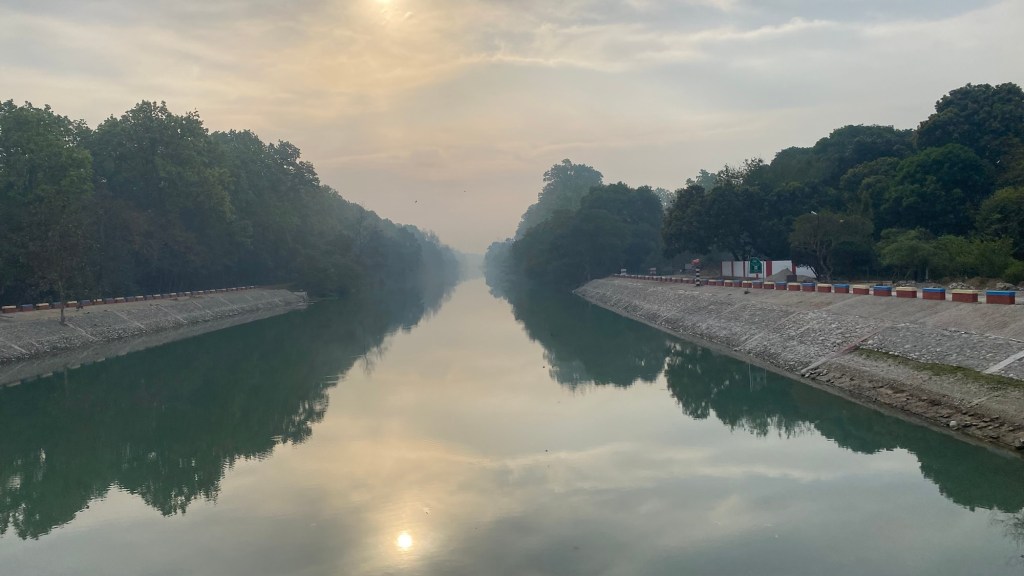
Rivers operate by the same ancient ledger.
We build glass-and-steel lives on dry riverbeds because the land looks silent. For decades nothing happens. Dust settles. Satellites confirm stillness. Rainfall data justifies ambition.
Then one night the sky breaks.
Flash floods roar through settlements, reclaiming forgotten corridors, sweeping away concrete and confidence alike.
We call it a natural disaster.
But the river is not angry.
It is remembering.
A dry river is not dead.
It is resting.
Rivers recall their paths after centuries.
Elephants remember migration routes after ten generations.
We cut forests, raise walls, and pave over history. Still they return, not in aggression, but in ancestral obedience.
Nature does not forget.
Only humans do.
This is the fault line of modern civilization.
We experience time as a straight line.
Past → Present → Future.
A vector of permanent acceleration.
Linear thinking built our machines, our markets, our artificial intelligence.
But life does not move in straight lines.
In the ancient vision of the Kalachakra, time is a wheel.
Seconds loop.
Minutes rotate.
Days circle.
Seasons recur.
Every sixty years, cosmic alignments reset. The same geometry returns, not repeating events, but restoring conditions.
We are now in the 27th cycle of that rhythm.
The classroom has reopened.
The same question waits on the board:
Have you learned yet?
Today we master linear algebra to train machines.
Vectors. Gradients. Optimization.
We teach artificial intelligence how to learn.
Yet we have forgotten cyclic intelligence.
The wisdom that knows excess demands correction.
That growth requires rest.
That silence precedes renewal.
Linear thinking asks:
How fast can we reach the goal?
Cyclic wisdom asks:
Is this the right season to move at all?
Without rhythm, even perfect algorithms accelerate collapse.
A civilization that ignores cycles eventually builds cities on floodplains and wonders why rivers return.
So who is the guru?
Rarely a person.
For elephants, it is the matriarch’s memory.
For rivers, it is gravity.
For forests, it is rainfall rhythm.
Their guru is memory.
Humans were given conscience.
And when conscience sleeps, nature resumes the role of teacher.
Not through punishment,
but through correction.
There is also a forgotten teacher within us.
The inner guru.
Not mystical. Not dramatic.
It is the intelligence that retrieves exactly what is needed at the right moment.
The guide turning the jeep seconds before a sighting.
The driver braking before danger becomes visible.
This does not come from learning more.
It comes from growing quiet enough to remember.
Only then did I understand why the bird never waited for me.
I believed preparation was enough.
But nature does not reward readiness alone.
She rewards rhythm.
The bird was never hiding.
The tiger was never elusive.
I was simply out of season.
When alignment arrives, effort softens.
Moments appear without pursuit.
Like the guru stepping down from the chariot once vision clears.
Civilizations collapse not from lack of intelligence,
but from loss of memory.
The river remembers.
The elephant remembers.
The forest remembers.
Time remembers.
We are the only species capable of forgetting.
But when the bell rings again, faint and rhythmic before the elephant appears, the wise will pause.
They will not search for the beast.
They will listen for the sound that comes before it.
And in that listening, we do not merely reconnect with nature.
We remember ourselves.
 Arambhin
Leave a comment