
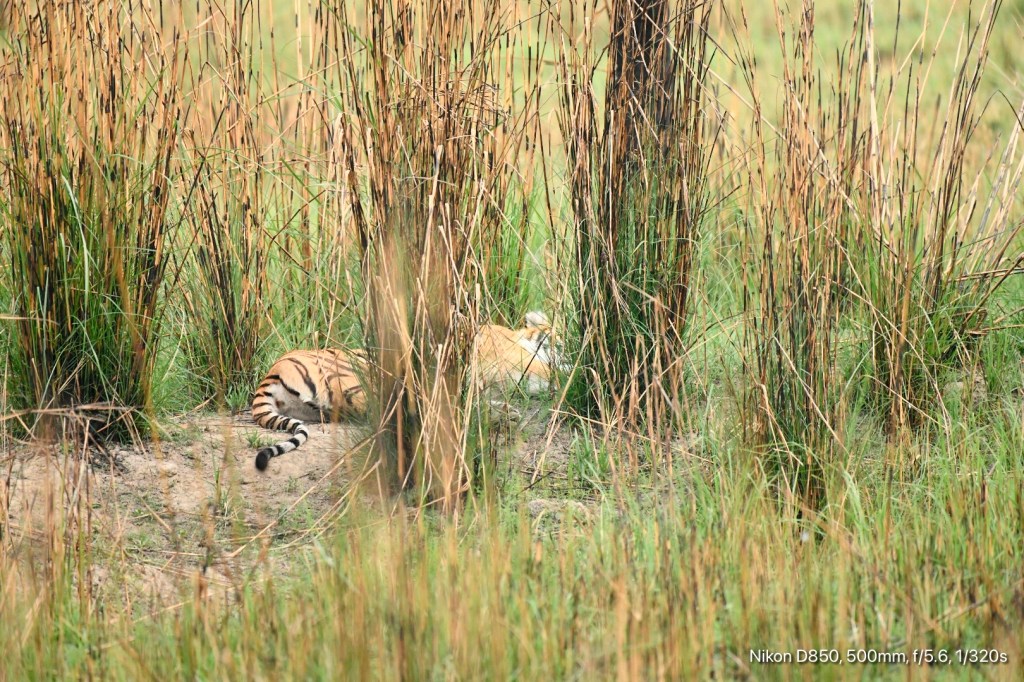
The jeep breached the Kabini gates before the sun could claim the river.
Mist clung to the backwaters like a shroud. Ruru sat in the back, a man composed of battery percentages and unread Slack pings. He had come for the “Trophy Shot,” but the forest didn’t recognize his credentials. The air tasted of wet teak and ancient, predatory patience.
Inside, he carried the usual city luggage.
Deadlines. Doubts. Fitness guilt. Future plans. Notifications still echoing in his head long after the phone lost signal.
The forest had no network.
Only presence.
The first lesson: Waiting is not wasting
Hours passed.
Deer crossed casually. Langurs screamed false alarms. Peacocks rehearsed dances for nobody.
Ruru grew restless.
In the city, nothing waits. Everything refreshes.
But here, nothing performs.
The guide whispered,
“Kabini gives sightings only to those who forget they came for them.”
The jungle was not late.
Ruru was early.
The second lesson: Every being knows its role
A herd of elephants moved like a living mountain range. No leader shouted orders. No meetings. No confusion.
Each knew where to walk.
A crocodile lay still like driftwood. Not lazy. Calculating.
A kingfisher plunged once. Only once. Fish secured.
No retries.
No excess effort.
No regret.
Life here was not about improvement.
It was about accuracy.
“The jungle,” the guide whispered, “only shows itself to those who forget they came.”
Then, it occurred.
The tiger didn’t emerge; the forest simply reorganized itself around a new center. Across the mud track, the massive beast stood like a tear in the fabric of the world. Its amber eyes locked onto Ruru’s. There was no message, only a transfer. Time collapsed. A click sounded in the base of Ruru’s skull—a key turning in a lock rusted shut for a millennium.
When the beast vanished into the shadows, a part of Ruru’s shadow went with it. Something heavy and silent stayed behind in his skin.
⸻
The elevator doors on the 14th floor opened with a pneumatic hiss.
The office smelled of ozone and filtered anxiety. Ruru stepped out, his stride liquid. There was no “heel-strike” in his walk; he moved on the balls of his feet, his weight distributed with a terrifying efficiency.
At 10:00 AM, the strategy meeting began. The Marketing Director paced, his performative aggression echoing like the panicked chattering of a langur.
“Ruru!” the Director barked, leaning over the glass table. “Are we aligned on the aggressive growth strategy?”
Ruru didn’t blink. He watched the Director’s carotid artery pulse against his starched collar. The room grew cold. The Director’s hand began to tremble, a bead of sweat tracing a path through his foundation. He stopped mid-sentence, his throat tightening. He was suddenly, instinctively aware that he was no longer at the top of the food chain.
“You are making a lot of noise,” Ruru said. His voice was a low vibration that seemed to come from the floorboards. “But you aren’t saying anything. Be quiet.”
The Director sank into his chair. He didn’t argue. He couldn’t.
By 1:00 PM, Ruru’s “Fitness Tracker” began to pulse red. It recorded his heart rate at 40 beats per minute—the resting pulse of a predator—even as he moved. He felt a phantom ache in his shoulder blades, a longing for the heavy damp of the teak forest. He looked at a photo of his mother on his desk; he recognized the face, but the emotion—the “humanity”—felt like a broadcast from a distant, dying star. It was the cost of the overwrite. He didn’t mourn it. He simply observed the loss.
By 6:00 PM, he packed his bag. He reached the street, where the city was a forest of steel and glass. He reached into his pocket, gripped his phone, and felt the glass shatter under a pressure that shouldn’t have been possible. He dropped the dead technology into a trash can.
Ruru turned the corner. His movements were so silent, so perfectly aligned with the shadows, that a pigeon on the sidewalk didn’t even flutter as he passed inches from its wings.
Allostatic Load
The tiger does not carry the jungle. When the chase ends, the heart rate of the beast descends like a stone in a well. The adrenaline, once a roaring fire, fades to cool ash. The tiger licks a paw, blinks at the sun, and returns to zero. There is no “ghost chase” playing in the theater of its mind. The event has reached its absolute horizon. The tiger is empty, and in that emptiness, it is whole.
Then there is the human. We are the only creatures gifted with a manual override, yet we use it to reboot everything except the soul. We factory-reset our phones when the lag becomes unbearable. We reset our careers with a resignation letter. We reset our cities with wars and our relationships with silence. We are masters of the cosmetic reboot.
But inside, the cache is full.
The human mind is a haunted hard drive, spinning with the data of insults from a decade ago, the phantom limbs of lost ambitions, and the jagged glass of future fears. Nothing is ever truly closed. We sit in quiet rooms, our bodies safe in velvet chairs, while our minds are still bleeding on battlefields that turned to dust years ago. We don’t just experience danger; we simulate it permanently.
We fear the real Reset Button because we mistake it for a Delete Key.
To reset the ego feels like a public humiliation. To reset desire feels like starvation. To reset identity feels like the Great Dark—a small, voluntary death. We have built a “Self” so heavy that we have forgotten how to put it down.
The ancients knew the danger of the unbooted mind. They called their maintenance “Sacred.” They gave it names like Sabbath, Fasting, and Silence. It wasn’t about God; it was about garbage collection for the consciousness. It was the “Sacred Pause” designed to prevent the system crash.
But we have killed the dusk. We have paved over the silence with a 24/7 neon hum. We are not suffering from a lack of progress; we are suffering from a lack of closure. We are a machine that has been running for eighty years without once being turned off.
The button is not broken. It is not hidden. It is simply untouched.
It waits in the space between a breath and a word. It waits in the stillness before a decision. To use it is not to escape the world, but to return to the zero point where the world can finally be seen clearly.
The tiger never needs enlightenment because the tiger never leaves the center. We must learn to travel back to it, one reset at a time.
 Arambhin
Leave a comment