
Vedantic Frames for Capturing the Physics of a Cool Mind
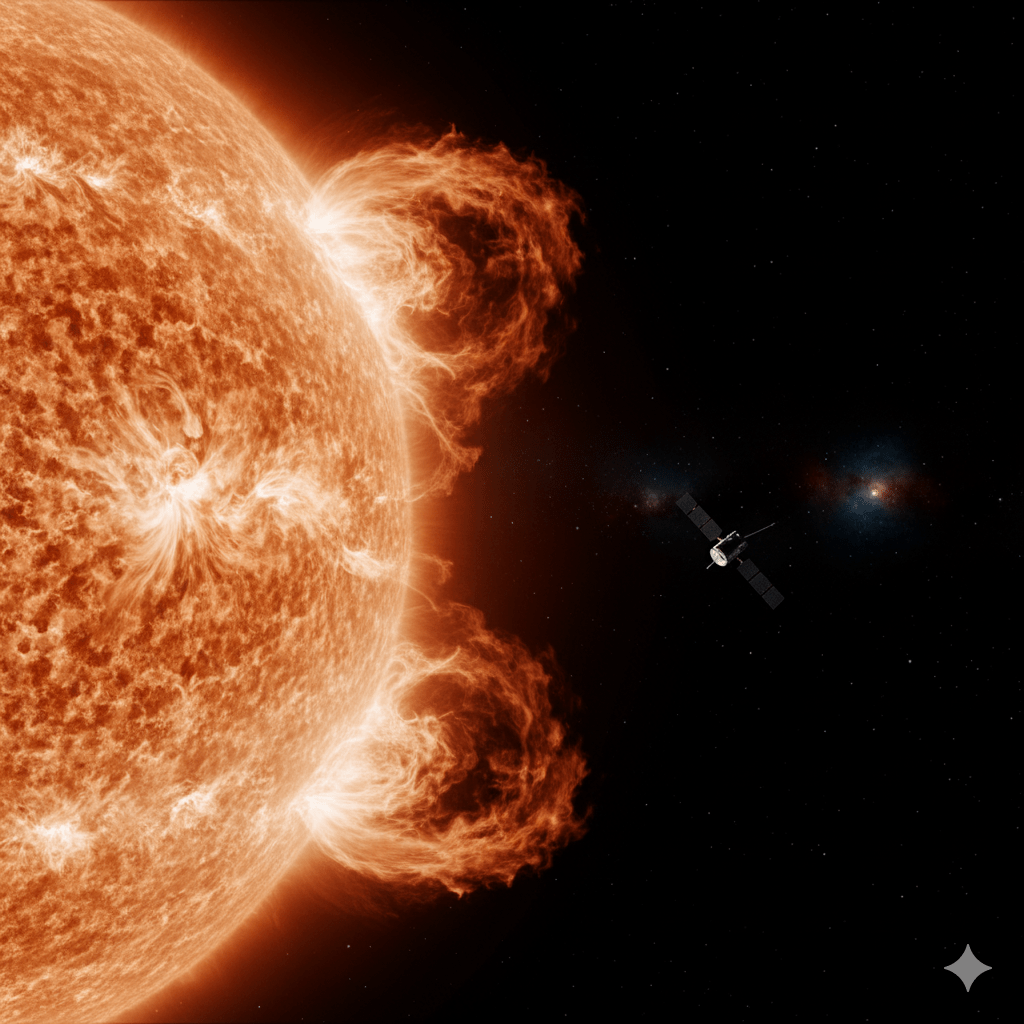
Have you ever asked yourself one of the simplest, yet most profound questions in science: If the Sun is so incredibly hot, why is space so incredibly cold?
It seems contradictory. The Sun is a blazing inferno, blasting radiated energy across the solar system. Yet, the moment you step outside Earth’s atmosphere, the temperature plunges to near absolute zero.
The answer to this cosmic riddle isn’t just about astrophysics. It holds the secret to high performance, mental peace, and what ancient Vedantic philosophy has taught for millennia.
It turns out, the universe runs on a simple principle: To handle intense energy without burning up, you need to be empty.
The Cosmic Principle: The Brick vs. The Vacuum
On Earth, heat travels by bumping into things. Air molecules hit your skin, a hot spoon touches your tongue. This is conduction and convection.
But space is a vacuum. It is—for the most part—empty.
When the Sun’s massive energy travels through space as radiation (light), there is nothing there to “catch” it. There are no molecules to absorb the energy and start vibrating. Because there is no vibration, there is no “heat.”
Earth, however, is like a dense brick. It absorbs that radiation, holds onto it, vibrates wildly, and gets hot.
The takeaway? Space isn’t cold because of a lack of Sun. It’s cold because it has nothing to hold onto the Sun’s gift.
The Superconducting Mind
This is where science meets spirituality. In Vedanta, the mind (Chitta) is often compared to space or sky (Akasha).
Life throws massive amounts of energy at us every day—stress, joy, insults, challenges.
- The “Earth” Mind: A cluttered mind is dense with ego, worries, memories, and desires. When life’s energy hits this density, it gets absorbed. The mind vibrates with anxiety and anger. It gets “hot.”
- The “Space” Mind: A meditative, cleared mind is like a vacuum. It lets the energy of life pass right through it. It sees everything, experiences everything, but holds onto nothing. It remains “cool.”
In physics, when materials get super-cold, they become superconductors. Electricity flows through them with zero resistance. A cool mind works the same way. By removing the thermal friction of unnecessary thoughts, your performance and clarity skyrocket.
The Exposure Triangle of Life
So, how do we build this “cool mind” in a practical way? We can use the best analogy for capturing light and energy: Photography.
Life is the light source. Your mind is the camera sensor. The quality of your experience depends on how you set your mental “Exposure Triangle.”

1. ISO: The Mental Thermostat (Managing Inner Noise)
In photography, ISO is the sensor’s sensitivity.
- High ISO (The Hot Mind): When you crank the ISO up in the dark, you get a brighter image, but it’s full of nasty, grainy digital noise. In life, a high mental ISO means you are hyper-sensitive and reactive. Every little comment makes you vibrate with insecurity. You create “noise” (paranoia, anxiety) where there should be clarity.
- The Vedantic Frame (Low ISO): The goal of meditation is to lower your ISO to its base level. You stop artificially amplifying the world. You see reality exactly as it is, crystal clear, with zero added grain.
2. Aperture: The Focus of Desire (Attachment vs. Awareness)
Aperture is the opening in the lens that controls depth of field—what is in sharp focus versus what is blurry.
- Wide Aperture f/1.8 (Obsession): A wide-open lens creates a razor-thin focus. You are obsessed with one tiny desire or problem, and the rest of the universal “background” becomes a messy blur. You lose context.
- The Vedantic Frame f/16 (The Witness): A stopped-down aperture sees everything in focus—the foreground task and the distant horizon simultaneously. This is “Witness Consciousness.” You aren’t attached to one point; you are aware of the whole landscape.
3. Shutter Speed: The Art of Letting Go (Presence)
This is the direct application of the “vacuum of space” principle. How long do you let the light hit the sensor?
- Slow Shutter (Clinging): If you leave the shutter open too long while moving, you get motion blur. A slow mental shutter means you are holding onto the past. You are still processing the insult from five minutes ago while trying to live right now. The result is a blurry, messy life experience.
- The Vedantic Frame (Fast Shutter): A fast shutter clicks in a fraction of a second. It captures the “Now” with tack-sharp precision, and then immediately resets to empty, ready for the next moment. It doesn’t hold the light; it lets it pass through.

Developing the Perfect Shot
The master photographer doesn’t just point and shoot; they balance the triangle.
A life lived with high performance and deep peace requires the same balance: keep your internal noise (ISO) low, widen your awareness beyond narrow desires (Aperture), and learn to let go of moments instantly (Shutter Speed).
When you do this, you become like deep space. The Sun of life can shine with maximum intensity, but you remain a cool, superconducting vessel—an open lens through which the universe can clearly see itself.
In One Frame
Life rewards not those who react fastest, but those who remain clearest under pressure.
Like MS Dhoni, calm is not withdrawal from the game. It is deep presence within it.
The mind that stays cool near intensity reads reality better, chooses cleaner actions, and lets outcomes unfold without inner turbulence.
Lower the noise.
Widen the view.
Release each moment when it’s done.
Stay near the flame.
Remain cold inside.
That is clarity.
That is performance.
 Arambhin
Leave a comment