
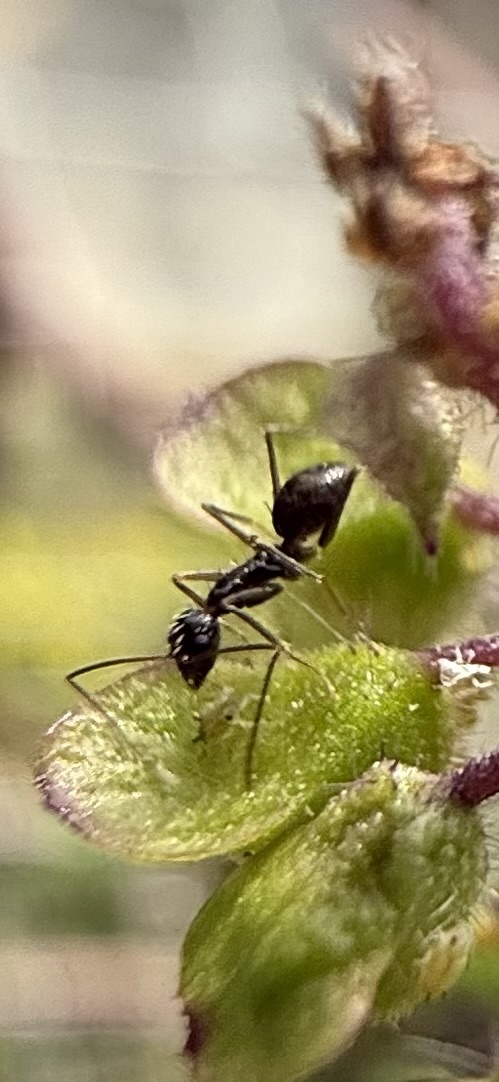
நான் என்ன, நீ என்ன, அவன் என்ன
அவனிதனில், அவனிடமே தொடங்கினோம்
இங்கு வித்தியாசமாய் ஒரு வியாதி
தொடக்கத்திலும் முடிவிலும் இல்லாது நியதி

வேராக வேண்டி வேற்றுமையை விதைத்திட்டோம்
நான் வேறு, நீ வேறு, அவன் வேறு முளைத்திட்டோம்
இங்கு வேற்றுமை வேண்டி வியாபித்தோம்

நாமம் வேறாக, ரூபம் வேறாக, அவனையும் பிரித்திட்டோம்
எங்கெங்கிலும் வேற்றுமையில் ஒற்றுமையை மறந்திட்டோம்

அவனிதனில், அவனிடமே, உயிர் உடல் இரண்டானோம்
வேற்றுமையில் ஒற்றுமை என்றானோம்
Written by Raghu Jagannathan October 2025
What am I, what are you, what is he?
In Him, from Him, we came to be.
Here stirs a strange disease of mind —
No start, no end, but fate entwined.
We sowed the seeds of difference deep,
To stand apart, to wake from sleep.
“I am one, you another, he a third”—
Thus sprouted walls within the Word.
By name distinct, by form diverse,
We split the Whole and made reverse.
In countless veils of shape and hue,
We lost the One that runs us through.
In Him, from Him, we became two —
Life and body, me and you.
Yet softly whispers the timeless view:
Unity within diversity, forever true.
Good evening.
Before we talk about quarks or consciousness with the understanding of my recent Tamil poem.This personal synthesis delivers a unified vision of reality—a powerful statement that the deepest truths of ancient wisdom and modern science.
What am I, what are you, what is he?
In Him, from Him, we all began.
Here lies a strange disease of thought —
Neither beginning nor end, only destiny bound.
When I first read these lines, I felt something stir — not as a physicist, but as a participant in the universe’s oldest riddle: What is the self, and what is the source?
And I realized — this poem is not just spiritual; it’s quantum.
1. The One Before the Many
In Him, from Him, we all began.
In quantum cosmology, before the Big Bang, there was no “here” or “there.”
There was only a quantum singularity — a state of total potential, infinite density, and zero distinction.
Every atom, every galaxy, every “you” and “me” existed in a shared wave function.
That’s the physics of the first line.
What the poet calls “Him”, we might call the unified field — the Ψ (psi) that contains every possible reality before measurement.
We didn’t emerge from it; we collapsed out of it.
The universe didn’t “explode” — it differentiated.
2. The Strange Disease of Thought
Here lies a strange disease of thought — neither beginning nor end, only destiny bound.
That “disease” is what physicists might call the observer effect.
The moment we observe something, we define it.
A wave becomes a particle. A probability becomes a point.
But in doing so, we lose sight of the infinite field of possibilities it once was.
This “disease” is consciousness mistaking its collapsed reality for the whole.
Time, ego, and identity — all arise from this confusion.
There’s no true beginning or end in the quantum world — just states evolving, destinies entangled.
3. The Birth of Separation
We sowed the seeds of difference, wishing to stand apart.
“I am one, you another, he a third” — thus sprouted division.
Here we enter the great human tragedy — and the great experiment of consciousness.
In quantum physics, this is decoherence — when quantum systems lose entanglement and appear classical.
It’s the moment we went from being a field to being individuals.
From one song, to many instruments.
We call it reality.
But maybe, just maybe, it’s the echo of a forgotten harmony.
4. The Fragmentation of the Whole
By name distinct, by form diverse, we even parted Him from Himself.
Every particle in the universe is an excitation of the same field.
Electrons, protons, photons — they differ not by origin, but by vibration.
In essence, they are notes of one cosmic string.
Yet our minds — our classical instruments — keep naming, labeling, partitioning:
“This is matter. This is energy. This is life. This is death.”
But at the subatomic scale, those lines dissolve.
You can’t part Him from Himself — because there is no “Him” or “self.” Only frequency.
5. The Forgetting
In countless forms of difference, we forgot the unity beneath all.
This is where physics becomes philosophy.
We study entanglement — the eerie phenomenon Einstein once called “spooky action at a distance.”
Two particles remain connected across galaxies, behaving as one.
But maybe what’s spooky isn’t the physics.
Maybe what’s spooky is that we forgot we’re entangled too — not just through matter, but through meaning.
The poet calls it forgetting; the physicist calls it classical isolation.
Both mean the same thing: we’ve mistaken the part for the whole.
6. The Dance of Duality
In Him, from Him, we became life and body — two.
This is the wave–particle duality, the energy–matter relationship, and perhaps even the body–consciousness duality.
Every “thing” in this universe exists as both potential and form.
Life and body, energy and matter — two aspects of the same cosmic dance.
The physicist sees it in Planck’s constant.
The mystic sees it in Shiva–Shakti.
Both are watching the same motion — just through different eyes.
7. The Return to Unity
Yet declare — unity within diversity, forever true.
This is not an ending.It’s a reconciliation.
Even after the universe decoheres, even after waves collapse, and names arise, the entanglement never dies.
Everything remains connected at the subatomic level, woven by invisible quantum correlations.
The physicist says, “Non-locality is real.”
The poet says, “All is One.”
Both are describing the same law of being:
Diversity is not division. It’s expression.Unity within diversity, forever true.
And so, what began as a spiritual whisper ends as a scientific realization:
The deeper we go into matter, the more we find meaning.
The deeper we go into particles, the more we find the presence of purpose.
When we reach the smallest scale — the quantum field — we discover something astonishing:
It’s not just physics.
It’s poetry of Science in Vedic scriptures
🪶 End Quote:
“The universe is not made of things; its dance of all things to the rhythm and cosmic music relationships.” – not named
What’s in Title – The title, or name, is the necessary tool for diversity, but never a cause for division. The moment we forget the underlying entanglement, the ‘Title’ becomes a wall. The quantum law reminds us that every distinct name is a mere expression of the One field.
 Arambhin
Leave a comment