
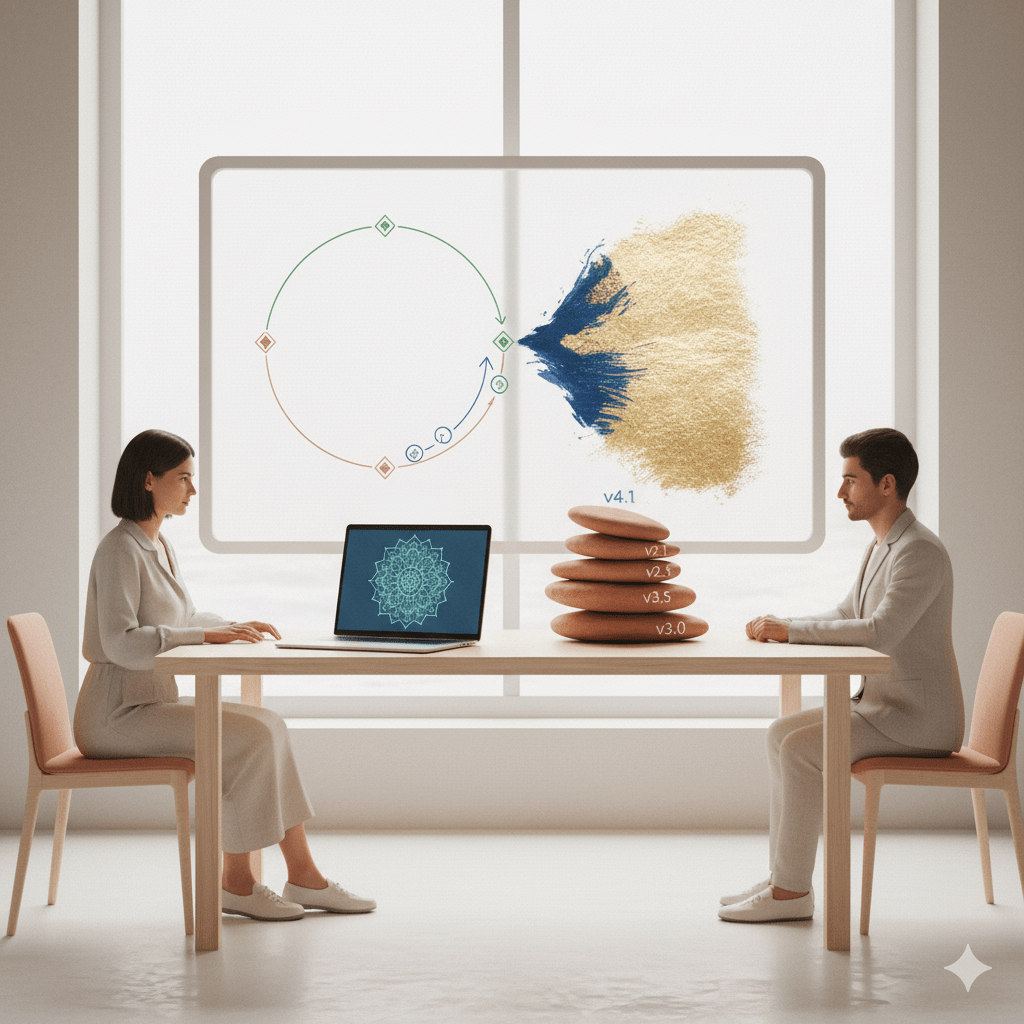
A Karmic Comedy of Continuous Integration.
The conference room, all chilled glass and polished chrome, felt less like an office and more like a minimalist temple. The whiteboards, usually chaos, were covered in three perfectly symmetrical circles connected by clean, thin arrows—architecture diagrams that suspiciously resembled cosmic charts.
The morning sunlight, filtered through the city smog, cast an institutional yellow on the faces of the three attendees.
Priya (Project Manager): The voice of the Product Requirements Doc (PRD). She understood the Why.
Anya (The Developer): Focused on the current code sprint. She lived in the How.
Rohan (Release Manager): The calm, all-seeing ops guru. He managed the When and Where.
Priya: “Okay team, let’s get started. Anya, your star dev status is non-negotiable, but your feature branch, feature/atman-v3.2.1, is hemorrhaging resources. We’re seeing high latency in the ‘Inner Peace’ module and a critical bug in the ‘Contentment’ method. The user feedback from this release cycle is—and I’m quoting here—‘turbulent.’”
Anya: (Anya pushed her laptop away, the aluminum cold against her palms. A thin vein pulsed at her temple.) “I know, Priya. I’m drowning. The entire codebase is a legacy mess. Every time I try to compile a ‘Happy’ object, it throws a KarmaNullPointerException. And I’m constantly getting spammed by notifications from the ‘Desire’ and ‘Aversion’ services. It feels like the backend algorithms are actively working against me.”
Rohan: (He leaned back, stroking his impeccably trimmed beard. His tone was a low, resonant hum.) “The algorithms aren’t working against you, Anya. They are you.” Anya and Priya exchanged a look. The air conditioning hummed, a nervous tension in the silence.
Rohan: “Think about it. You’re not just a developer. You are a living, self-modifying repository. Your entire codebase—every function, every variable, every line of commented-out trauma—is carried forward from every single release you’ve ever had.”
Priya: “Exactly. And that’s the PRD I’m talking about. We call it Sanchita Karma—the total, accumulated tech debt and feature requests from all past sprints. Your current build, atman-v3.2.1 (your current life), was specifically compiled to handle a subset of that debt. That subset is Prarabdha Karma.”
Anya: (She shook her head, a grim realization settling in.) “So my frustrating parents, my job anxieties, that irrational fear of pigeons… they aren’t random bugs. They’re just… assigned tickets?”
Priya: “They are the prioritized backlog for this sprint. They’re not punishments; they’re dependencies. But here’s the problem: while you’re trying to close these tickets, you’re panic-coding and creating new ones with every commit you make.”
Rohan: “Let’s use your analogy. You said the ‘algorithms’ control you. But what is an algorithm? It’s a patterned instruction. A habit. Here, it’s your Vasanas.” He smoothly walked to the whiteboard, picked up a dry-erase marker, and drew a single, elegant loop: [PAST COMMIT] → [SAMSKARA (Code Pattern)] → [VASANA (Algorithm)] → [WRITES NEW CODE (Karma)] → [NEW COMMIT] “You see? You feel controlled because you’re operating on autopilot-merge. The CI/CD pipeline—the law of Karma—sees your thoughtless commit, runs its tests, and automatically schedules a new build for a new market. You get stuck in a loop: v3.2.2, then v3.3.0, and before you know it, you’re debugging v4.0.0… forever.”
Anya: (She stared at the loop. It was a digital prison.) “A reincarnation loop… So how do I break the CI/CD cycle? How do I stop the auto-merge?”
Priya: “You don’t break it. You transcend it by changing your development practices. You move from being a junior dev, hacking away reactively, to a Senior Architect who writes intentional, clean code.”
Rohan: “Precisely. It’s a three-step refactor,
Anya: git log –oneline (Self-Observation): Stop coding on impulse. Use mindfulness to git log your thoughts. Observe your commit patterns. Why did you write that angry function? What dependency injection (attachment) did you miss? This is Dhyana. git reset –soft HEAD~1 (Letting Go): This isn’t deleting history, it’s unstaging your bad code before you ship it. When a harmful impulse arises—a desire to write a malicious function—you don’t git add and git commit it. You observe the bug, acknowledge it, and let it pass without integrating it into the main codebase of your character. Practice Nishkama-Karma (DevOps): The master practice. Perform your duties—write your code—flawlessly, but detach from the merge request and the release notes. Do the work because it’s the right architecture (Dharma), not for the ego boost of a successful deployment. When you code without desire for the outcome, you stop generating new, binding tech debt.”
Anya: (Her eyes widened, a sudden light in the chilled room.) “So the goal isn’t to make atman-v3.2.1 the most successful app in the market… The goal is to write such clean, elegant, and debt-free code that the feature branch becomes so perfectly aligned with the main branch… that a merge is inevitable.”
Rohan: (Smiling, a flicker of true compassion in his eyes.) “The final Pull Request. The merge where the feature/atman branch realizes it was never separate from the main branch—the universal source, Brahman. No more rebuilds. No more painful releases. Just pure, silent, source code. That merge… is Moksha.”
Priya: “And that, team, is why the other SD—Sanatana Dharma—is the original, and ultimate, guide to Software Development. Not for building apps, but for deconstructing the one that’s been running you all this time.” The stand-up ended. Anya looked at her terminal, no longer with frustration, but with the quiet, terrifying focus of a developer who had just been granted root access to her own existence.
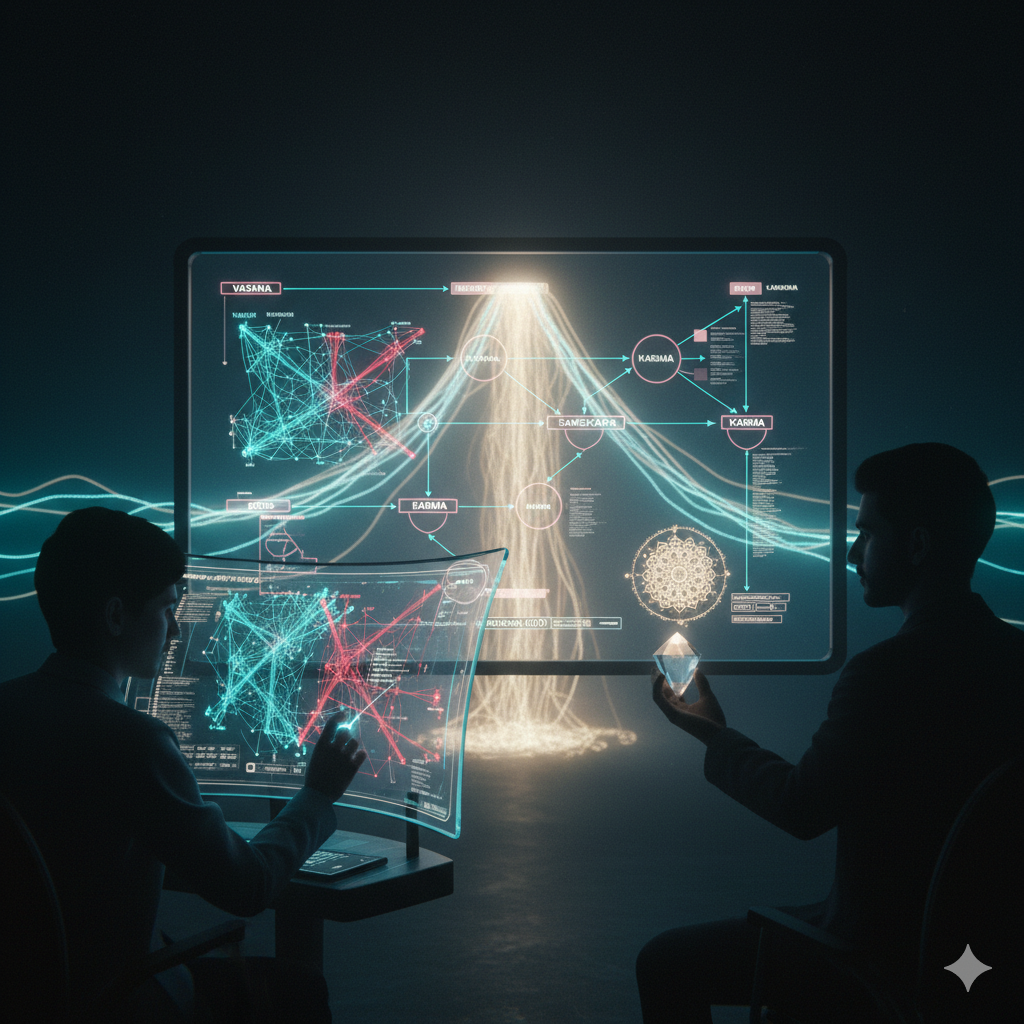
| Agile / Tech Concept | Sanskrit / Philosophical Equivalent | Narrative Purpose |
|---|---|---|
| Feature Branch | Jiva / individual self | The isolated sense of ego |
| Main Branch | Brahman / universal source | The totality from which all forks arise |
| Merge Conflict | Ego resistance / ignorance | The friction of identity |
| CI/CD Pipeline | Law of Karma | Automatic process of cause → effect |
| PR (Pull Request) | Spiritual surrender | Union with Source |
| git reset –soft | Vairagya (detachment) | Undoing binding action |
| git log | Dhyana (self-observation) | Seeing your own mental commits |
| Clean Code | Sattva / purity of mind | Code aligned with Dharma |
| Technical Debt | Sanchita Karma | Accumulated karma backlog |
 Arambhin
Leave a comment