
By Raghu Jagannathan
What happens when reform turns into reformatting — and equality becomes a spreadsheet that’s perpetually crashing because someone forgot to update Excel to handle infinite human stupidity.
Inspired by real efforts in Tamil Nadu to remove caste-based street names, this fictional satire imagines a future where the city loses not just its names — but its sense of self. And gains a subscription to “Hierarchy Pro” – because free trials on equality always expire.
⸻
I. The Great Renaming
There was a time when every street in Chennai had a story — and every story had a surname.
Some lanes were named after gods, some after poets, and some after grandfathers whose greatest achievement was owning a cycle and a moustache that could double as a broom in a pinch.
But with time came awareness,
with awareness came reform,
and with reform came forms —
endless ones, in triplicate, stamped with progress and coffee stains from overworked clerks dreaming of beach vacations.
The bureaucrats, bless their ink-stained souls, decided that caste-based street names were so last century — like flip phones or honest politicians (or politicians who can use flip phones without tech support).
So began The Great Renaming.
“To erase discrimination, we must first erase its spelling.” And autocorrect it to ‘discrimination-free zone,’ which somehow autocorrects back to ‘discount ramen zone’ on government keyboards.
In 2025, civic councils across Tamil Nadu vowed to cleanse more than 35,000 streets of caste traces — a historic move meant to modernize, unify, and neutralize (and accidentally turn the city into a giant QR code that scans to “Error 404: Identity Not Found”).
Some names became flowers (because nothing says “equality” like a thorny rose that wilts equally on everyone’s doorstep).
Some became leaders (who were conveniently dead and couldn’t complain , unlike their living relatives who immediately sued for trademark infringement).
And some became “neutral” — which mostly meant “boring” like ‘Avenue of Mild Disappointment’ or ‘Lane of Beige Dreams’.
Residents were consulted through area sabhas — those glorious civic rituals where everyone nods, argues, and finally agrees to disagree politely over tea, while secretly plotting to rename their neighbor’s lane after a vegetable (preferably a bitter gourd, for passive-aggressive reasons).
Then someone — an unnamed genius from the Department of Simplification, probably caffeinated on filter coffee and delusions of grandeur (and one too many motivational TED Talks on ‘Disrupting Division’) — suggested:
“Why not just number them?” Like we’re all living in a giant Sudoku puzzle where the prize is existential dread.
And that was it.
The idea caught fire like a bad rumor in a WhatsApp group — or a Diwali cracker in a pile of dry leaves , or a viral tweet about free biryani that turns out to be a scam.
⸻

II. From Identities to IDs
Before long, the entire city was reborn as a spreadsheet.
Streets became numeric codes, neighborhoods turned alphanumeric, and people — already accustomed to PAN, Aadhaar, and OTPs — simply nodded in acceptance while secretly wondering if their life was now a beta test for ‘SimCity: Bureaucracy Edition’.
“Finally,” sighed one resident, “a system where my address is shorter than my Wi-Fi password.” But longer than my attention span for reading the fine print on privacy policies.
The air buzzed with the low hum of digital signposts, LED codes flickering like distant stars in the humid night — casting a sterile blue glow over potholes and plastic gods (who now demanded offerings in binary: 101010 prasadam packets).
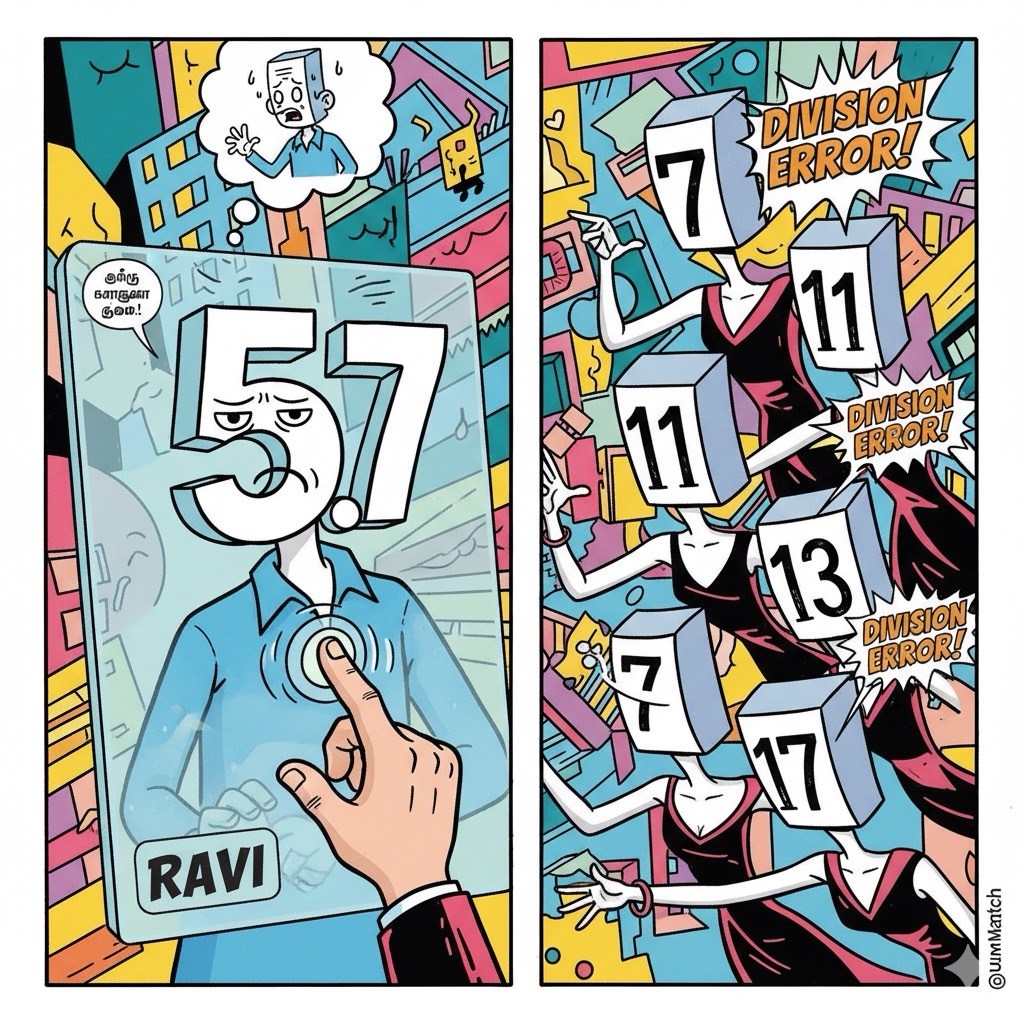
Meet Ravi 5.7, a lanky delivery boy from Fraction Lane 5/7-D — a “divided” address the Numberologists deemed inherently unstable, like a half-eaten idli doomed to crumble or a relationship status on Facebook set to ‘It’s Complicated by Calculus’.
Born on the 14th (reducing to a restless 5 — numerology’s code for “eternal middle management” and “perpetual side quests in the game of life”), Ravi dreamed big.
He wanted to date Priya from Prime Plaza 7, a sleek sector reserved for the “indivisible elites” where the garbage bins are monogrammed and the potholes are artisanal.
Priya, born on the 1st — a natural leader, ambitious and commanding — was way out of his league. She had a LinkedIn profile that could make CEOs weep, while Ravi’s was just “Delivery Boy: Specializing in Dodging Stray Dogs and Delayed Payments.”
But love, like bad traffic, doesn’t care about hierarchies —it just honks incessantly and causes pile-ups.
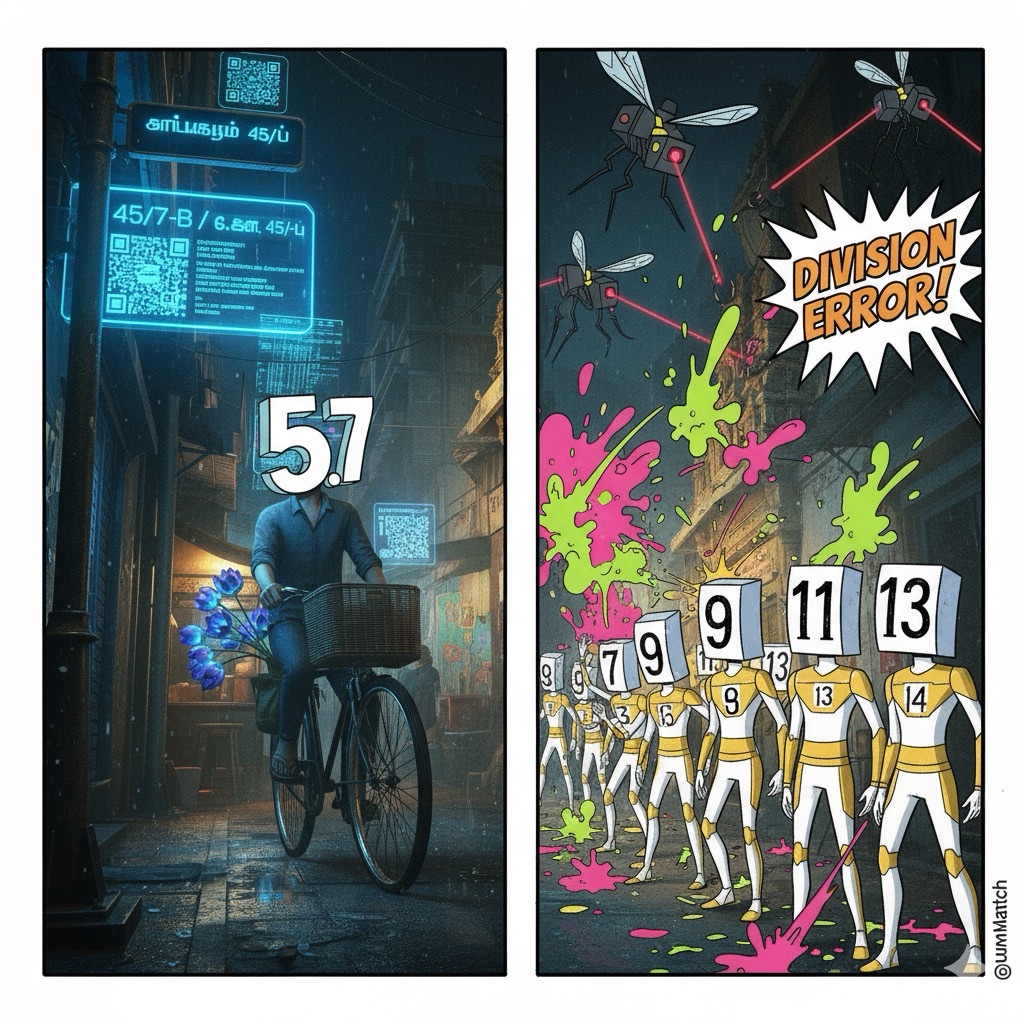
So today, Ravi clutched a bouquet of synthetic lotuses (real ones were now “unevenly distributed resources” banned under the Equal Petal Act) and a misaddressed package, pedaling toward Junction 11, hoping to “accidentally” bump into her during her evening stroll (code for ‘stalking with plausible deniability’).
After all, what’s one more code in a country that already lives by them?
We’ve got PIN codes for mail, OTPs for love, and now street codes for existential crises —next up: CAPTCHA for breathing, to prove you’re not a robot (or a rival caste).
“Turn left at the temple” became “Proceed to 45/7-B.” (And pray you don’t hit a sacred cow at 3.14 km/h.)
Banks updated addresses for “Sector 404: Not Found.” Customers complained: “My money’s in limbo—again.”
Poets wrote about “the infinite loop of life on Ring Road 0” , which inspired a hit Bollywood film: ‘Loop Lagaan: Taxed in Eternity’.
Even temple notices adapted:
“Festivities at Street 8/9 from 6:00 to 9:08 PM.
Devotees from sectors divisible by 3 will receive prasadam.
Multiples of 13 need not apply — unlucky souls.” And zeros? Eternal meditation in the void—BYO enlightenment.
Schools replaced history with Number Appreciation Classes , where kids learned that 2+2=4, but in politics, it equals “alternative facts.”
Weddings became mathematical affairs:
“Do you take this 3.14 to be your lawfully wedded pi?” “I do, till infinity do us part—or until we hit a rounding error.”
And for a while — it worked.
The chaos calmed.
Old divisions faded from headlines , replaced by new ones like “Prime vs. Composite: The Beef.”
Caste-based parties collapsed; startups rose with apps like NumMatch (“Find your soulmate by GCD compatibility”) and Data-Based Destiny™ (“Because fate deserves an upgrade” —premium version includes ad-free karma).
Chennai became the model city — logical, clean, efficient.
Until logic itself became the new superstition.
And the numbers started fighting back like a calculator app that’s had one too many division-by-zero errors.
⸻
III. Enter: The Numberologists
Humans can’t live without hierarchy — they just rename it.
Or in this case, renumber it to ‘Hierarchy 2.0: Now with Bug Fixes and Microtransactions’.
Soon, Numberology became the new caste system of the coded age.
Why divide by birth when you can divide by math? It’s STEM-approved discrimination!
Those born on the 1st, 10th, 19th, or 28th were crowned “natural leaders.”
Leadership, of course, came with a side of ego — suppression rebranded as synergy (and a free tote bag saying ‘I’m #1—Literally’).
Prime numbers strutted like nobility —
“We’re indivisible, essential, the backbone of encryption and Netflix passwords” —and the reason your ex’s account is still logged in on your smart TV.
Evens held yoga sessions at even intersections, preaching “pair-ity” while sipping even-numbered lattes (2 pumps of syrup only).
Odds chanted,
“We’re not even trying to fit in!” (But secretly binge-watching rom-coms about mismatched pairs.)
Wholes shunned fractions as “divided souls.” “You’re half the person I am!”
Decimals were “pointless drifters.” “Get to the point—or decimal place.”
Negatives plotted “subtraction revolutions” from underground bunkers at -1 Avenue.
The Number 1 crowd formed The Unit Society, an exclusive club for those whose birth dates reduced to 1.
“We’re not oppressive,” they’d insist over artisanal chai. “We’re just… directive. Like a GPS that reroutes you without asking” —or Siri on a power trip.
Social media flamed up:
• Is 7 too mainstream? (Spoiler: Yes, since Lucky Charms ruined it.)
• Is 69 overrated? (Nice try, but we’re keeping it PG-13.)
• Should decimals get voting rights? (Only if they round up their enthusiasm.)
Dating apps added “compatibility by code.” Swipe right if your digits align; left if they divide unevenly.
Ghosting became “dividing by zero.” Error: Relationship undefined.
Political parties multiplied:
• The Primes’ Party (Indivisible Under God —sponsored by Amazon Prime),
• United Odds Front (The Odd One Wins —motto: “We’re not weird, we’re unique… mostly”),
• Rational Remainders (For those who didn’t quite divide evenly —therapy group meets at 0.5 Bar).
Celebrities joined in.
An actor renamed himself √2 — “I’m irrational, but unforgettable!” His latest film: ‘Square Root of All Evil.’
A singer topped charts with Born on the 1st: Leadership Blues , featuring the hit single “I’m Number One (And You’re Not Even Close)”.
And then came The Clash —not the band, but close enough to sue for royalties.
⸻
IV. The Prime Time of Chaos
Ravi reached Junction 11 as the air thickened with slogans, paint, and pixel light.
Billboards flashed:
“Maintain Numeric Harmony — Or Face Subtraction!” (Fine print: “Violators will be multiplied by fines.”)
Odds, faces inked with 3s and 9s, surrounded the gleaming statue of Number 7 — Priya’s home turf.
“Down with the Primes!” they shouted , waving signs like “Primes Are Too Basic!”.
A Prime leader in a golden “1” suit bellowed:
“We’re indivisible — superior by design!” “And our egos are prime real estate!”
Ravi froze, bouquet trembling.
He spotted Priya — fierce beneath flickering LEDs , probably calculating the odds of this riot boosting her LinkedIn views.
“Just deliver the package,” he whispered. “What’s the worst — rejection by algorithm?” Or a blue screen of heartbreak?
A paint bomb exploded. GET EVEN! (Sponsored by Photoshop: Because reality needs filters.)
Chaos broke loose.
Evens tried to “balance things” by handing out free scales—literal bathroom ones.
Squares chanted, “We’re perfect — stay out of this!” While cubes just rolled their eyes in 3D.
Ravi tripped into Priya’s path.
“Watch it, Fraction!” she snapped — then paused.
For a heartbeat, their eyes met —
a fragile, irrational silence between codes , like a rom-com meet-cute scripted by a malfunctioning AI.
Then the drones descended.
Sirens screamed.
Memes followed:
“Primes vs Odds: The Real Infinity War” —Avengers who? This has more plot twists than Endgame.
The government invoked Section 144 (ironically, a multiple of 12 —which offended the primes immediately).
Half the city was booked under 420 (the number, not the vibe—though many wished it was).
⸻
V. Epilogue: Numeric Nirvana
When calm returned — sort of — the Primes’ Party declared victory “by a whole number margin.” Recounts were banned as “fractional thinking.”
The Odds promised revenge in the next decimal election , campaigning on “Make Chennai Odd Again.”
The 1s passed the Leadership Legacy Act, reserving public office for those with 1-based birth dates.
“It’s not suppression,” said one spokesperson. “It’s succession planning” —with a side of nepotism, now called “num-potism.”
Ravi, bruised and heartbroken, wondered if his 5.7 soul could ever add up to Priya’s prime perfection . Spoiler: In fanfic, yes; in reality, he’s swiping on NumMatch.
Entrepreneurs launched therapy apps:
Number Neutrality™ — Are you feeling odd? Let’s even you out (₹999.99) . Pro tip: Upgrade to premium for unlimited “I’m fine” denials.
Somewhere, a historian scribbled on a rationed napkin:
“Perhaps this is fate repeating itself — from caste to code to chaos —
the same division reborn in cleaner syntax” , now available in dark mode for night owls.
That night, seven planets aligned —
and both astrologers and data scientists stayed awake, murmuring in unison:
“It’s a sign… or a syntax error” —or just Mercury in retrograde, sponsored by Excel.
By dawn, the city now called Sector 07N — “N” for Numeric Nirvana, or Not Again — slept beneath its coded stars.
They’d erased their names,
but not their nature —which promptly rebooted into “Hierarchy 3.0: Electric Boogaloo Returns.”
And somewhere, beneath the hum of servers, a sequel was already loading:
“The Numbered City 2: Infinite Recursion.”
⸻
🧭 Closing Reflection
In the end, this isn’t a story about numbers or names —
it’s about the human hunger to sort, label, and lead.
From caste to code, from ritual to algorithm,
Chennai becomes a mirror for every civilization that confuses order with equality —and ends up with a funhouse mirror that makes everyone look like a clown in a spreadsheet circus.
 Arambhin
Leave a comment