
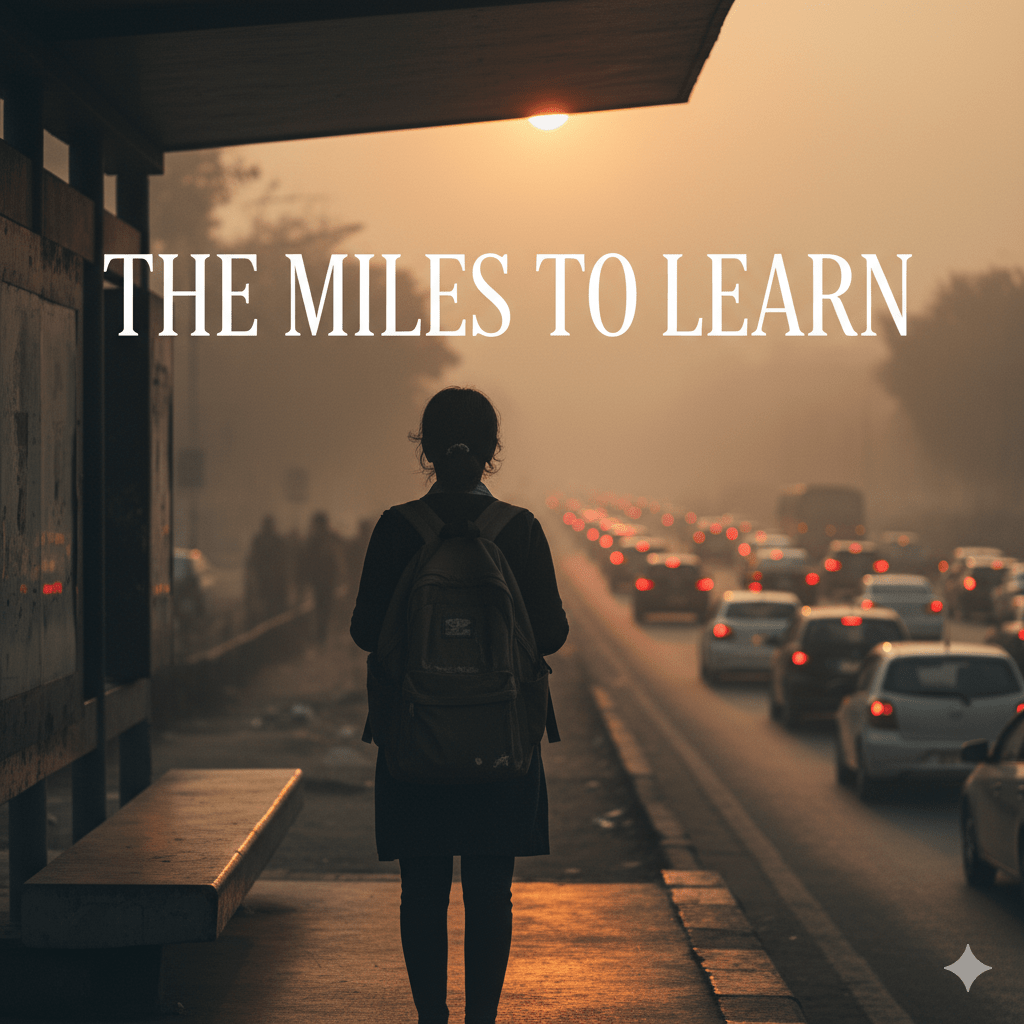
Education in India has become a commute, not a classroom.
Every morning, millions of students wake not to ideas but to engines. Most engineering colleges are built on city fringes. Therefore, students undertake 25–35 km one-way journeys. These commutes swallow 1–2 hours daily. Before the first lecture begins, 10–20% of their waking life is already lost to asphalt.
Watch the morning ritual:
- 6–7 AM: College buses choke highways.
- 7–8 AM: School shuttles swarm in.
- 8–10 AM: Office goers wage war for the same lanes.
Six days a week, learning and earning clash for road space. The seventh day? Spent behind weary wheels. We call this “education,” but what unfolds is fatigue. Knowledge shrinks to a commodity chained to distant buildings. Students stagger into classrooms drained, parents bankroll fuel and fees, and roads—not ideas—set the rhythm of our days.
The irony stings:
- Life devolves into a commute.
- Learning into logistics.
- Earning into endurance.
If knowledge should liberate, why does the system shackle us to buses, bottlenecks, and bells?

Dawn’s Derailment: Time, Stress, and Synaptic Sabotage
Do the math: 30 km daily, 5 days a week, 250 days a year—15,000 km of mandated migration.
The human toll is stark:
- 53% of engineering students struggle with punctuality, trapped by the 75% attendance rule.
- 93% are crammed into overcrowded buses, arriving battered before labs or exams.
- 67% rely on peer notes, 64% skip clubs, social life sacrificed to logistics.
Academically, the hit is measurable. A 2023 study of 244 B.Tech. students showed commuters had a GPA of 6.45 vs. 7.50 for on-campus peers. Longer commutes directly correlated with poorer grades (r = -0.38). The longer the ride, the lower the performance—and the higher the stress.
This isn’t transport delay. It’s derailment. Dawn dreams dissolve into dusk doldrums.

The Money Machine: Fees, Fumes, and Fiscal Fatigue
Behind every idling bus is an invisible ledger.
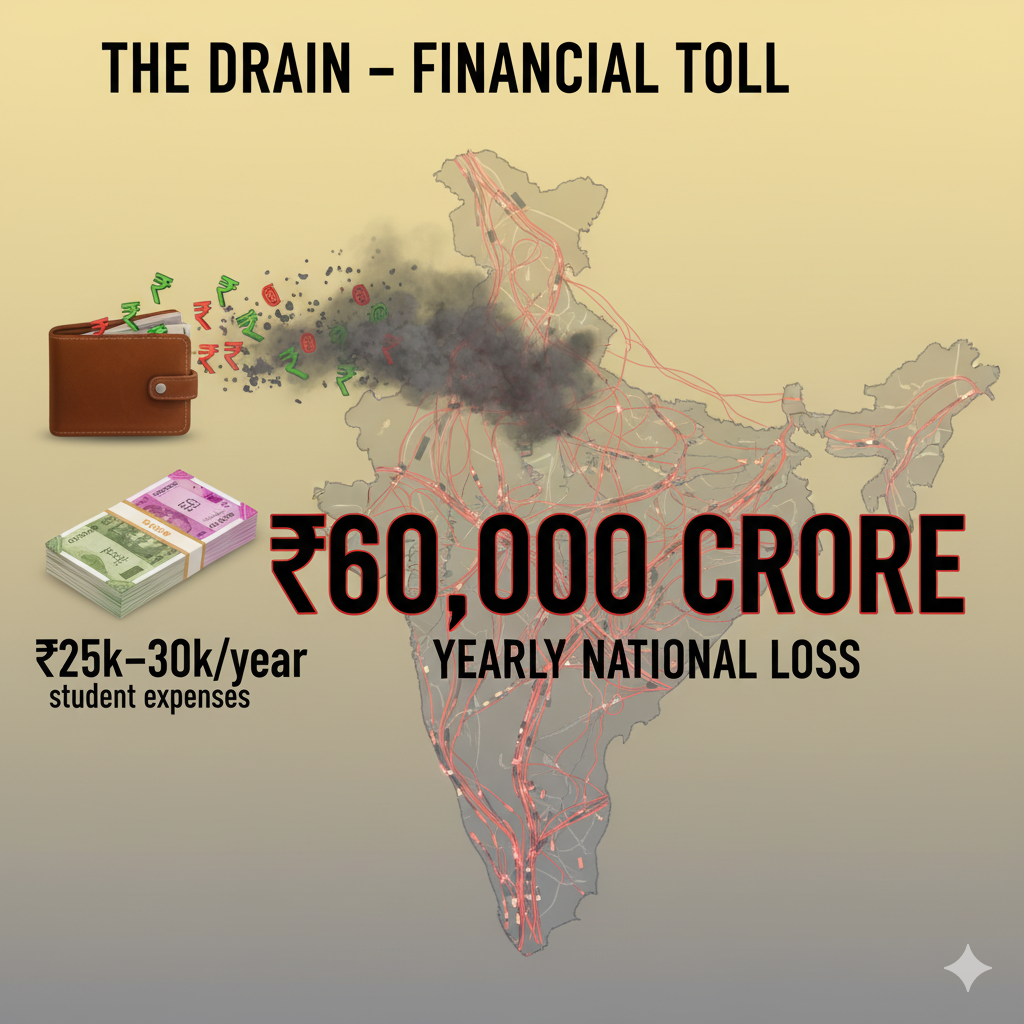
- Bus fees: ₹25,000–30,000 annually, layered atop tuition.
- Two-wheeler: a half-year commute burns ₹12,500 in fuel plus ₹5,000–10,000 in maintenance.
- Health: exhaust-fueled pollution links to 1.7 million premature deaths yearly and adds ₹5,000–15,000 in medical costs per household.
At a national scale, congestion costs India 13% of GDP—over ₹60,000 crores annually. For students, that translates to 500–700 wasted hours each year—time that could have been invested in learning, creation, or rest.
The economics of education has become the economics of exhaustion.
The Weekly Whip: Five Days of Drudgery or Four Days of Flight?
Why the six-day siege? Colonial-era rhythms, factory schedules, and CBSE conventions. But do they still make sense in 2025?
Pilots of four-day weeks show promise:
- Fuel costs halved, saving families ₹10,000–20,000.
- Morale boosted by 10–20%, attendance up 2–5%.
- Stress reduced by 20–30%, with students reclaiming time for projects and pursuits.
Yes, longer days can dull focus, and rural-urban divides remain. But the bigger truth is clear: the five/six-day model belongs to factories, not futures.

Silicon Summons: AI’s Arsenal Against Asphalt
Technology already offers alternatives:
- AI-optimized routes in Bengaluru and Delhi trim jams by 20–25%.
- Smart fleets like NeoTrack cut school delays by 40%.
- VR/AR classrooms halve carbon impact and teleport students into labs.
The challenge isn’t invention—it’s implementation. Open data, policy push, and subsidies can make AI-driven transit and hybrid classrooms mainstream.

Virtual Vanguards: The 60-40 Mandate
The National Education Policy 2020 envisioned 50% digital learning by 2030. It’s time to go bolder: a 60-40 mandate for higher education.
- 60% virtual: lectures, AR labs, digital assessments via SWAYAM 2.0.
- 40% physical: projects, peer learning, and labs that need presence.
The impact:
- Commutes cut by 40–60%, reclaiming hours and energy.
- Costs reduced by ₹10,000–20,000 per student.
- Engagement up 15–20%, with GPA improvements reported in early pilots.
Challenges—digital divides, faculty training—can be bridged with AI tools, device subsidies, and phased audits. The blueprint exists; the mandate is overdue.
Breaking Free: From Chains to Wings
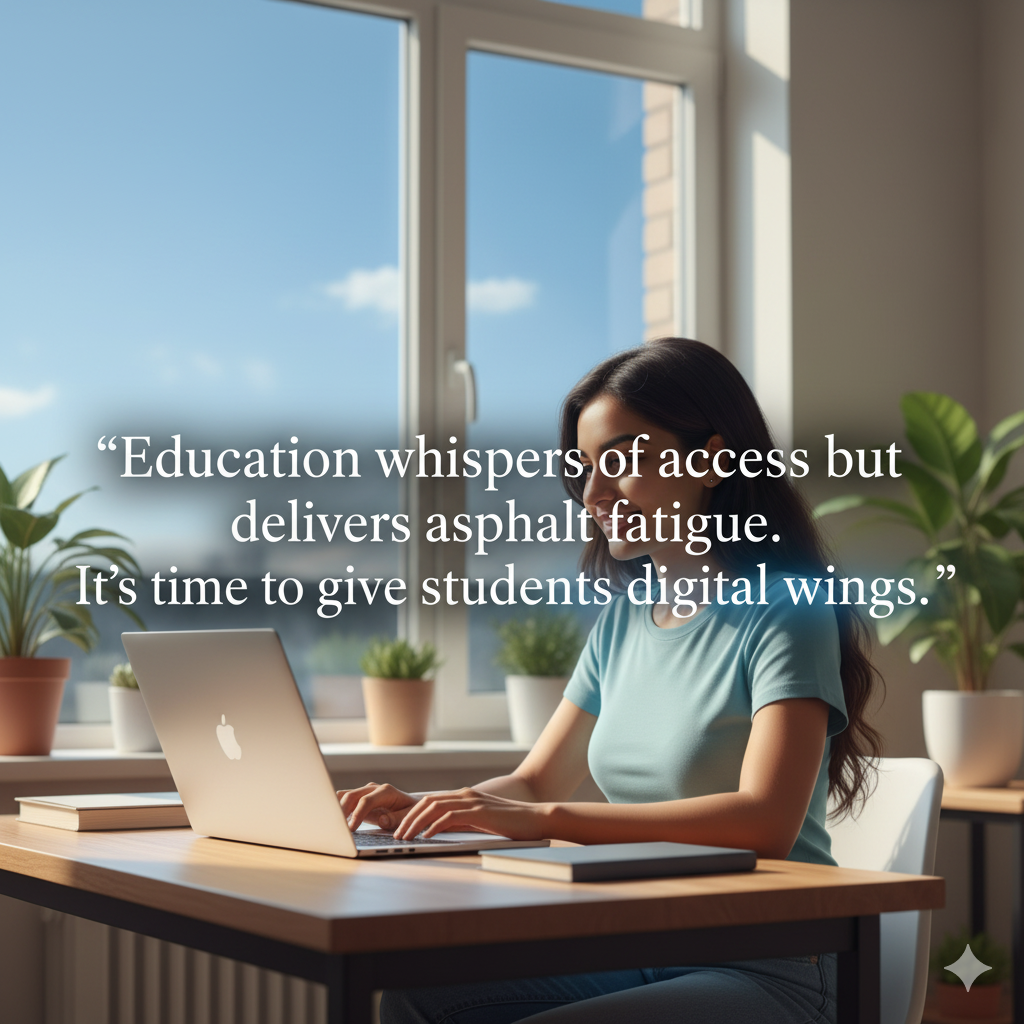
The tally is heavy: wasted hours, drained wallets, polluted lungs, diminished minds. Education whispers of access but delivers asphalt fatigue.
And yet, hope lives in hybrid models, AI interventions, and courage to redesign calendars.
Picture Rahul, a third-year coder from Hyderabad. Once chained to a 45-minute bus ride each way, he now learns in a 60-40 hybrid pilot. Those two reclaimed hours fuel his open-source app that maps safe student routes using AI. No longer a prisoner of pavement, he’s building solutions for peers—and pitching for startup seed.
Rahul’s story is not an exception. It’s the future, waiting for scale.
India’s youth deserve unbound ideas, not exhaust elegies.
It’s time to break the asphalt chains.
It’s time to give them digital wings.
 Arambhin
Leave a comment