

The sun sagged over Bangalore’s glass towers, their mirrored facades reflecting not triumph but silence. Raghu stood outside the shuttered gates of his former company—his company—once a bustling hub of innovation, now reduced to a padlocked carcass. At 50, he had spent half his life in boardrooms, drawing up strategies, delivering quarterly numbers. Now he held only a severance cheque and questions that gnawed like stray dogs.
Should I scramble for another role in a world that worships youth? Should I retire and fade, even with a mortgage half unpaid? What happens if I stop earning—who catches me then? Family? Friends? The government? Gods?
As dusk bled into neon, Raghu noticed a saffron-robed cyclist adjusting his pannier bag near the corner tea stall. The monk’s face was weathered but lit by an unhurried calm, as if deadlines had never existed for him. Strangely, he was wheeling not a clunky ashram bicycle but a sleek solar-powered e-bike.
Curiosity tugged at Raghu. He hadn’t spoken to a stranger without an agenda in years. The monk introduced himself with a warm nod.
“I am Rurukshu,” he said, voice steady as flowing water. “Once I was in your world—targets, teams, mergers. Then I lost it all, and gained something else. You look like a man standing between maps.”
Raghu let out a bitter laugh. “Maps, yes. Every path seems blocked. If I work, I fear irrelevance. If I stop, I fear poverty. Whom do I even ask for help? Colleagues are scattered, family depends on me, and faith feels distant.”
Rurukshu mounted his e-bike, then gestured at the spare cycle leaning against the stall. “Ask not for help, Raghu. Ask for enabling. Come ride with me to Mysuru. The road has its own answers.”
Raghu hesitated, the weight of his briefcase pulling him back like an anchor. But something in Rurukshu’s eyes—a mirror of his own past struggles—propelled him forward. He slung the bag over the spare bike’s rack, and they set off into the twilight, the city’s cacophony fading into the hum of tires on asphalt.
The air grew cooler as they escaped Bangalore’s grip, carrying the faint metallic tang of rain on the horizon. Raghu’s legs, unused to such exertion since his weekend golf games, protested with a deep ache. The neon lights gave way to starry skies, punctuated by the distant rumble of trucks and the earthy scent of roadside eucalyptus groves.
“Rurukshu Ji,” Raghu panted, the crunch of gravel under his tires a rhythmic counterpoint to his labored breaths. “This ride is already testing me. Why push ourselves like this? A car would be easier—quicker help to get where we’re going.”
Rurukshu glanced back, his e-bike whirring softly under the solar panels’ faint glow. “Ah, Raghu, that’s the essence. There are two ways to guide—or even live. One is helping: I could hail a cab, solve the distance for you, make you comfortable now. But you’d remain dependent. The other is enabling: I share the route, teach you to pace your breaths, build your endurance. It’s harder, but soon you’ll conquer roads I couldn’t dream of. Helping keeps you under the giver; enabling lets you surpass them. That’s true leadership—not just in boardrooms, but in life.”
Raghu mulled it over, the wind whipping his salt-and-pepper hair, carrying whispers of jasmine from blooming fields. His mind flashed to his old teams: how he’d “helped” by micromanaging, only to watch talent flee. “But why do most—like my former bosses—prefer helping? It’s simpler, gets results fast.”
“Precisely,” Rurukshu replied, his voice cutting through the night’s emerging chorus of crickets. “Helping spotlights the helper—makes them vital, applauded. Like quarterly bonuses for quick wins. Enabling fades you into obscurity; you’re irrelevant as the other thrives. Helping strokes the ego swiftly; enabling demands patience, forging a legacy. Don’t mistake it for compassion, Raghu. Helping binds; enabling liberates. This ride? We’re enabling ourselves—no chauffeurs, no shortcuts.”
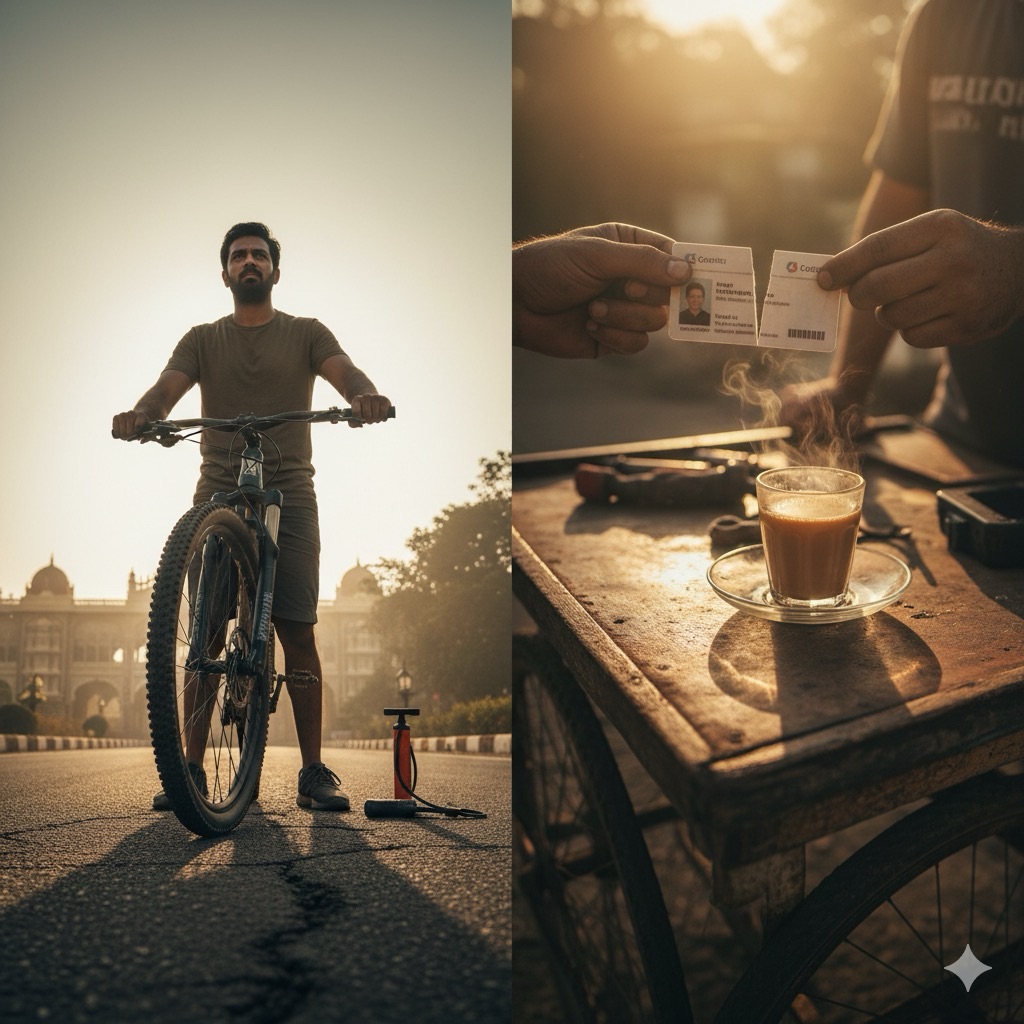
Their dialogue wove through the darkness, but dawn brought conflict. Near Mandya, as the sun crested in a blaze of orange, painting the sugarcane fields in fiery strokes, Raghu’s tire deflated with a sharp hiss—a puncture from a jagged stone hidden in the dust. The bike veered, forcing a dusty halt that coated their throats with grit and stung their eyes like forgotten regrets. “Bloody hell!” Raghu cursed, slamming his fist on the handlebars, his severance worries surging back. “Stuck again. Just like my career—one prick and it’s over. Now what? Call for help?”
Rurukshu dismounted, but Raghu caught the monk’s subtle grimace, a hand pressing his lower back—an old corporate injury from endless desk hours, perhaps, or a deeper scar from his own fall. Vulnerability etched his face briefly, humanizing the serene facade. “Easy, Raghu,” he said, voice softer, pulling out a repair kit. “I could fix it—help you. But that chains you to saviors. Here, take the tools. I’ll guide; you mend.”
Raghu’s hands shook at first, calluses from keyboards no match for the levers’ bite. Sweat beaded on his forehead, mixing with the morning’s humid embrace, the scent of ripening cane cloying in the heat. But Rurukshu’s patient instructions—“Pry gently, seal firm”—steadied him. As the tire inflated under his pump, a spark ignited. “I… fixed it,” Raghu said, standing taller, the ache in his muscles now a testament, not a torment.
“Exactly,” Rurukshu affirmed, straightening with a quiet exhale, dusting his robes. “Enabling in motion. Now, how do you discern true aid from traps? Offers come disguised.”
They pedaled on, under a canopy of banyans where sunlight dappled the road like scattered coins. The air buzzed with bees, carrying the sweet rot of overripe fruit from orchards. “Helpers sort into three buckets, like investment portfolios,” Rurukshu explained. “Rare genuines: Selfless, no returns expected—pure equity. Win-win players: Mutual gains, like balanced funds. Controllers: They ‘invest’ to dominate, keeping you indebted. Choose wisely, or you’ll mortgage your freedom.”
At a chai stall, the sizzle of bhajis and steam’s spicy warmth revived them amid locals’ murmured Kannada. Raghu sipped, the hot liquid grounding his swirling thoughts. “Hits close. My company ‘helped’ with perks, but controlled my life. How to escape that cycle?”
Rurukshu leaned in, eyes reflecting the stall’s flickering bulb. “A parable for our times: Many make you bread seekers—a salary crumb today, so you beg tomorrow, forever hungry. But enablers see you as a bread winner. They hand seeds, tools, recipes. You bake, thrive, perhaps feed empires. Seekers kneel; makers rise. Enablers? Their legacy bakes on. Be a winner, Raghu—not a corporate queue.”
Reinvigorated, Raghu matched pace through paddy fields, the slosh of water channels a soothing rhythm. Yet another hurdle: A burly trucker blocked the lane, his rig belching diesel fumes that burned their nostrils, his shouts echoing over the engine’s growl. “Outta the way, you relics!” he bellowed, sweat-glistened face twisted in road rage.
Raghu tensed, old boardroom instincts flaring for a fight. But Rurukshu, with a steadying touch, approached humbly, offering water from his flask. The trucker paused, sharing his own tale of endless hauls and family pressures. They parted with nods, the truck grinding away. “Enabling diffuses control,” Rurukshu murmured, a hint of weariness in his tone, echoing his own past battles.
Crossing the Cauvery bridge, mist rising like forgotten dreams, cooling their sun-kissed skin, Raghu probed deeper. “This isn’t just personal. NGOs, governments—they ‘help’ endlessly.”
“Indeed,” Rurukshu agreed, the river’s murmur underscoring his words. “NGOs often handout loaves—relief that traps in dependency. True ones enable: Skills, tools for self-sustaining villages. Charities mirror buckets—pure, traded, or controlling. Governments? Good ones pave enabling paths: Education, fair systems, no bribes. Corrupt ones chain with red tape, forcing bows. Clear processes uplift; twisted ones bind. Demand empowerment, not enslavement.”
They rolled past a village square where banners fluttered like promises. A late-afternoon crowd clustered around a stage: bright plastic chairs, a brass mic, and a truck stacked with shiny boxes—ceiling fans, small fridges, boxes of ration. A local MLA waved from the steps, smiling with a practiced generosity, while volunteers handed out coupons and colourful pamphlets promising “monthly cash transfers” and a new fertilizer subsidy. People lined up, clutching identity cards; children peered at the boxes like prizes at a fair. Raghu watched a middle-aged farmer accept a ration packet with a smile that quickly turned into a worried glance—the farmer’s field had no irrigation. “It’s help, isn’t it?” Raghu asked.
Rurukshu held the reins of his bike and said, “Help that feeds a stomach today is not the same as enabling a farmer to irrigate a field tomorrow.” He tapped the stack of pamphlets. “This is politics dressed as charity. It buys votes now and buys back choices later.”
Many politicians, Rurukshu explained, win loyalty the old-fashioned way—not by convincing people with policy papers but by filling their immediate bellies. “Freebies”—one-time cash handouts, free electricity, subsidised goods, loan waivers or a long list of targeted schemes—arrive just before elections like ritual offerings. They feel like help, and for many households they are life-changing in the short term. But repeated handouts can also build a dependency: voters come to expect the loaf and the lightbill waiver, and leaders get rewarded at the ballot box for keeping the supply flowing. The cycle hurts long-term budgets, invites fiscal strain, and shifts political incentives from building self-reliance to maximizing short-term payouts.
“A loaf handed daily keeps the baker from being born,” Rurukshu added with a sigh. “When leaders count votes in rice sacks, they stop counting futures. True public service equips a village to feed itself; populist service feeds the ballot box. Help that arrives with an election date tastes like a bribe, not a blessing.”
Raghu’s bitterness softened with each mile, his posture unbowing. “Help hides behind masks—loyalty, security, even family ties.”
“Be alert,” Rurukshu cautioned, voice tinged with personal shadow. “Masks of love, care, camaraderie conceal leashes. True bonds don’t bind or cage; they don’t feed on weakness. Question: Does it build or break?”
“How to filter the genuine?”
“Emulate the swan,” Rurukshu said, gesturing to a pond where birds dipped gracefully, splashes rippling softly. “It extracts milk from murk. You too: Absorb nourishment—wisdom, skills. Discard poison—quick fixes, dependencies. Viveka, discernment, your daily practice.”
“A guiding mantra?”
“Simple: 🛡️ Beware • 🔎 Aware. Beware false aid, chains, corrupt webs. Aware of your strength, clarity, path. Etch it in your soul.”
As Mysuru’s palace glowed on the horizon, its spires piercing the twilight like beacons, Raghu surged ahead, legs powerful, mind clear. The mortgage loomed less like a noose, more like a challenge. “Rurukshu Ji, this journey… it’s remapped me.”
“Good, Raghu. Live by Beware and Aware: From bread beggar to abundance architect. Embrace genuine aid, offer unbound, enable yourself—no enslavement by kin, NGOs, states, or fears. That’s sustainable self-help, spirit’s freedom.
Recall: Helping spotlights till crisis. Enabling elevates others beyond. Self-enabling? Eternal liberty.”
Raghu grinned, pedaling strong. “Race to the palace?”
Rurukshu smiled. “Lead on, bread winner. Lead on.”
 Arambhin
Leave a comment