
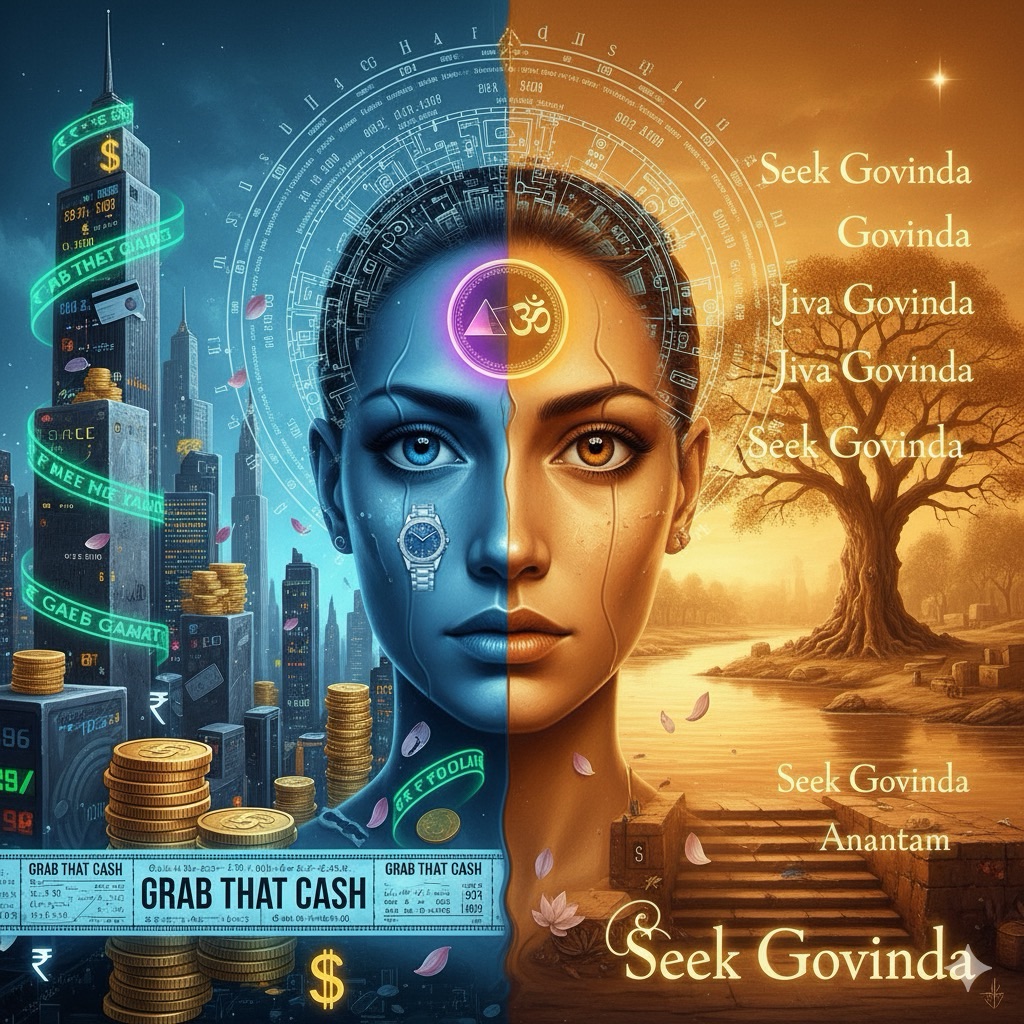
Arjun weaves through Mumbai’s neon-lit chaos, his smartwatch buzzing with stock alerts. At 32, he’s a financial analyst, his life a spreadsheet of gains and losses. Money, he’s learned, is the hidden grammar of the world—a syntax that decides who speaks, who’s silenced. Skyscrapers gleam with promises of wealth, but their reflections taunt him with colleagues’ Instagram posts: Maldives vacations, Rolexes, penthouses. Comparison is relentless; without money, you’re “as good as dead,” erased from the city’s pulse.
Pink Floyd’s Money hums in his earbuds: “Grab that cash with both hands and make a stash.” The sarcasm stings as he checks his portfolio—$10,000 invested five years ago at 8% is now $14,693, compounding like a heartbeat. But across the street, a vendor named Raju hawks chai from a battered cart, his earnings never growing, trapped at zero. Arjun recalls a report: the richest 1% own 50% of global wealth (Oxfam, 2024). “Everyone’s a money launderer,” he mutters, feeling complicit in a system that rewards the few.

He thinks of his birth in a dusty town, his parents’ shop barely funding his education. He sees a street child, thin and barefoot, selling trinkets near a traffic light, her eyes bright but future dim. A statistic flashes in his mind: children in low-income homes are three times more likely to face malnutrition (UNICEF, 2024). Money writes your first sentence, a lottery of privilege or struggle. At a riverside ghat, pyres burn, and a funeral planner pitches a $8,000 “dignified exit” to a grieving family (NFDA, 2023). Arjun imagines his own funeral, lavish but hollow. Even death demands payment, money’s grammar threading through every moment—birth’s chances, life’s comparisons, wealth’s compounding, death’s costs.
Then he spots Maya at the ghat, her simple kurta stark against the city’s glitz. She’s 28, a former colleague who left her marketing job for an ashram. Once, she was like him—chasing bonuses, buying handbags, trapped in comparison’s cage. But a late-night X thread on Bhaja Govindam changed her. She’d read Adi Shankara’s words, “No grammar will save you,” and saw her life’s pursuit of wealth as futile. Now, she lives simply, bartering skills at the ashram, though she still saves for its leaky roof, torn between transcendence and necessity. Her eyes carry both peace and struggle, making her real, not just a sage.
“You still chasing numbers?” Maya asks, handing him a coin etched with strange symbols. “This world’s grammar isn’t the truth.” Arjun scoffs. “Money’s all that matters. Without it, I’d have no degree, no apartment.” But the air thickens, the ghat blurring like a dream. Maya’s voice cuts through, quoting Bhaja Govindam: “Seek Govinda, seek Govinda.” She tells of Shankara, the 8th-century sage who mocked obsession with worldly constructs—grammar, status, wealth—as meaningless before death and liberation. Pink Floyd’s Money echoes faintly: “Share it fairly, but don’t take a slice of my pie.”
The city shifts, and they’re in a bustling market. Raju, the chai vendor, counts coins to buy medicine for his son, his face etched with worry. Maya points to him. “Money buys survival, but not meaning.” She gestures to a group of children playing with sticks, free from comparison’s weight. “What if you don’t need it?” Arjun thinks of X posts on minimalism, hashtags like #NoMoneyLife trending in 2025. He counters, “What if you don’t have it? Look at Raju—he’s trapped.” Maya nods, her own struggles surfacing. “I left my job, but I still pay for the ashram’s repairs. Liberation’s hard when the world demands cash.”
The market fades back to the ghat, the coin glowing in Arjun’s palm. “Money, it’s a crime,” Pink Floyd taunts, but Maya chants, “When the body falls, what use is wealth?” Arjun sees Raju’s son, frail but smiling, and the street child, weaving bracelets with hope. He imagines walking away, like Maya, but the weight of survival—his, Raju’s, the child’s—holds him. Maya’s peace, though, hints at another path, one beyond money’s syntax.
The coin grows heavy, and the ghat dissolves. Arjun wakes in his apartment, the coin on his bedside table, its symbols faded but real. Was it a dream? His phone buzzes with X posts—wealth tax debates, Bhaja Govindam quotes. At work, he overhears a colleague, Vikram, boasting about a new car. Instead of envy, Arjun feels a shift. “I donated to a school yesterday,” he says casually. Vikram raises an eyebrow, but Arjun shrugs, sipping his coffee, no longer craving the latest gadget. That evening, he walks past Raju’s cart, slipping him an extra 500 rupees. “For your son,” he says, meeting Raju’s grateful eyes.
Across the city, Maya meditates by a river, her savings jar half-full for the ashram’s roof. She’s not fully free of money’s pull, but Bhaja Govindam guides her: transcendence is a journey, not a destination. The coin’s weight lingers for both, a reminder of the choice: live by money’s grammar or seek a higher truth. For you, the reader, the coin spins. Money writes life’s story—birth’s lottery, comparison’s trap, compounding’s math, death’s price. Pink Floyd sneers, “Get a good job with more pay and you’re okay.” Shankara whispers, “Seek Govinda.” If you don’t have money, the world may call you dead, but hope persists in smiles like Raju’s son’s. If you don’t want it, liberation beckons, though society’s grammar pulls hard. What story will you write?

 Arambhin
Leave a comment