

In the heart of Mumbai’s humid hustle, where monsoon puddles reflected the glow of streetlights and vendors shouted over the din of autorickshaws, Aryan stumbled upon his father’s old notebook while rummaging through a dusty shelf in their cramped apartment. The 22-year-old GenZ coder, earbuds blasting a lo-fi beat to drown out the neighbor’s blaring TV, paused his freelance gig—debugging an app for a startup—to flip through the yellowed pages. Amid faded sketches of monsoon storms and scribbled thoughts on life’s fleeting rhythms, a short poem caught his eye. Titled Garden’s Call, it was in Raj’s elegant handwriting, the ink slightly smudged as if written in a hurry during one of his late-night inspirations.
Garden’s Call
In Mumbai’s maze, a dream takes flight,
Freedom’s garden calls with distant light.
The words hit Aryan like a notification ping—sharp and insistent. He felt the pull of that “distant light,” the American Dream his uncles had chased and caught, but it stirred a whirlwind inside him: excitement mixed with gut-twisting fear. What if the visa process crushed him? What if he poured his savings into applications, only to get rejected, left broke and stuck in the same cycle? Or worse, what if he made it there, but the isolation hit hard—homesick for Mumbai’s chaos, regretting the leap? Heart racing, Aryan pocketed the notebook and headed out for his evening jog, hoping the run would clear his head.
The streets were a frenzy: Dodging potholes slick with rain, weaving through crowds of office workers spilling from the local train station, horns blaring like an endless alarm. A stray dog nipped at his heels, and the air thick with diesel fumes and street food spice made his lungs burn. Aryan paused at a traffic light, sweat dripping, watching a family of four cram onto a single scooter—Dad driving, Mom balancing groceries, kids sandwiched in between. This is the grind, he thought, the cultural load everyone carries. No space to just… breathe. His mind flashed to the pics his uncles sent: Wide-open trails in California, no crowds, just fresh air and freedom. By the time he got back, panting and frustrated, he knew he had to talk to his dad.
That sticky evening, as the sun melted into the Arabian Sea, Aryan found Raj on their cluttered balcony, sipping chai and gazing at the twinkling city skyline. Raj, the poet in his late 50s with salt-and-pepper wisdom etched into his face, looked up with a warm smile. Aryan thrust the notebook forward. “Dad, I found this,” he said, voice edged with hype and hesitation, pulling up his phone to scroll through pics of his uncles’ Cali lives—Uncle Vik grilling in a sprawling backyard under palm trees, Uncle Samir hiking a sun-dappled trail with his dog, their faces relaxed in a way Aryan envied. “Your poem nails it—the garden calling. I need that life, like Uncle Vik and Samir. They ditched the grind here for real quality vibes: no family drama chaining you, safe parks to vibe in, building on your terms. But what if I can’t hack it? That $100K H-1B fee Trump dropped yesterday? Tariffs spiking costs? Door’s slamming, and stakes are massive—if I stay, I’m ghosting my potential; if I leap and flop, I’m done. It’s not just tech; it’s the lifestyle—merit-based wins, no cultural baggage slowing you down. Uncles say it’s like upgrading your OS: smoother, freer, with space to reinvent without the old norms dragging.”
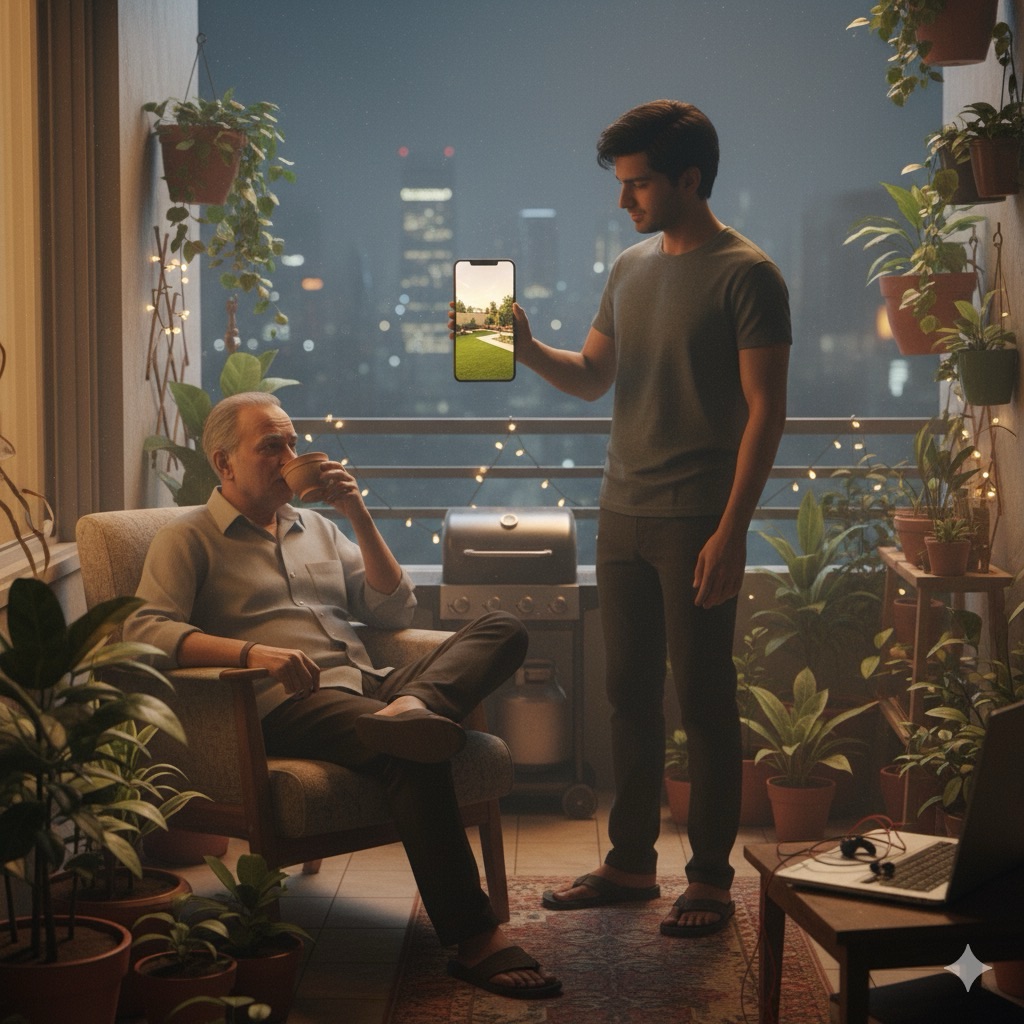
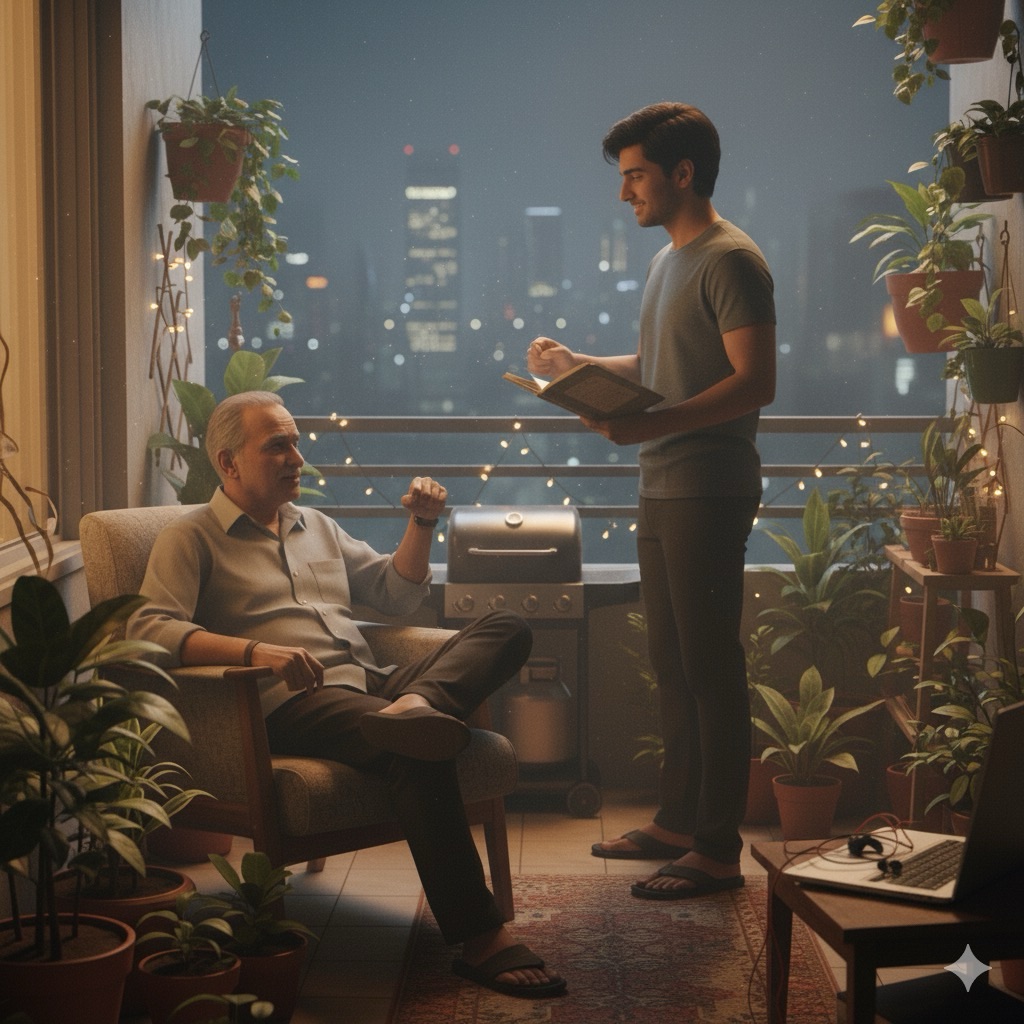
Raj took the notebook gently, his eyes lighting up as he flipped to another page. “Ah, my bold remix king,” he said, voice weaving warmth like a gentle rhythm drop, his poetic cadence a soothing contrast to Aryan’s rapid-fire slang. “That poem’s from my heart, but you’ve got the spark to live it. Your doubts are real—visas feel like a rigged game now, with that fee hitting like a paywall on dreams. But think bigger: Call your uncles. Hear it straight from them; maybe it’ll ease the storm.”
Aryan hesitated, then nodded and hit video call. The screen lit up with Uncle Vik’s face, beaming from his sunny kitchen in San Jose. Behind him, Aryan glimpsed the open-plan living room: Sleek countertops cluttered with fresh produce from the farmers’ market, a big window overlooking a quiet suburban street where kids biked without a care. No blaring horns, no crowded sidewalks—just space. “Aryan, beta! What’s up?” Vik said, his voice carrying that easy American twang mixed with lingering Mumbai lilt. He was mid-40s, successful founder of a fintech startup that had just hit unicorn status, but he looked relaxed in a casual tee, sipping coffee from a massive mug.
“Uncle, tell me about the life,” Aryan urged, leaning into the camera. “The real stuff—not just the wins, but how it feels day-to-day.”
Vik laughed, turning the phone to show his backyard: A patio with lounge chairs, a grill still warm from last night’s BBQ, and a small garden blooming with herbs. “It’s freeing, kid. Mornings, I jog on trails—no dodging traffic or crowds. Work’s intense, but merit rules—no nepotism or endless hierarchies. Weekends? Hikes in the hills, diverse friends from everywhere. We built this from short gigs at first—H-1B opened doors, but now with green cards, it’s home. Sure, homesick sometimes for Mumbai’s energy, but here, you reinvent without the weight. Family visits keep the blend alive.”
Before Aryan could respond, Uncle Samir joined the call from his spot in LA, his background a cozy home office with ocean-view windows and minimalist decor—yoga mat rolled in the corner, a shelf of books on AI ethics next to family photos from India. Samir, a biotech innovator in his early 50s, had co-founded a startup revolutionizing healthcare apps, employing hundreds back in Bangalore via their GCC. “Spot on, Vik,” Samir added, his tone steady and inspiring. “We started with doubts too—visa lotteries felt like gambling. But the lifestyle? Game-changer. Safe neighborhoods, work-life balance where boundaries mean something. No ‘log kya kahenge’ dictating choices. We blend it: Diwali parties with American twists, remote teams pulling talent from India. Tariffs and fees suck now, but it pushes innovation home—our GCCs are booming, reusing talent like yours. Don’t fear the flop; pivot. Start remote, build hybrid.”
Aryan nodded slowly, the uncles’ glimpses making his longing visceral—the quiet backyards versus Mumbai’s chaos, the merit-driven ease versus cultural pulls. He flipped another page in the notebook, drawn to a brief verse that felt like a personal reset button amid his swirling fears.
Gates of Doubt
When gates rise tall, doubts swarm the night,
Yet in the storm, new paths ignite.
“You’re spot on about the lifestyle pull,” Aryan replied to his dad and uncles, energy building as he paced the balcony. “Seeing your setups… it’s not abstract anymore. Jogging without chaos, workplaces respecting boundaries, ditching those pressures forever. Surveys back it—folks from India eye the US for quality over just jobs, like 20% in polls dreaming of that mobility. But with policies tightening, it feels personal. If migration slows, talent like mine gets reused here—startups popping in Bangalore, unicorns multiplying. Maybe that’s the silver lining? I could build my own hybrid life, blending their freedom with our culture. But damn, the fear of missing out… what if I regret not going all-in? Uncles, how’d you handle the stakes?”
Vik leaned in, serious now. “We hedged, kid. Short assignments first—test the waters without burning bridges. Built networks, saved up. When H-1B came through, it was calculated. Now, with fees skyrocketing? Smart play is virtual gigs or O-1 for your coding chops. India’s rising—our companies are hiring there to dodge costs. Turn the barrier into your edge.”
Samir nodded. “Exactly. We live proof: Freedom’s fragrance spreads. Blend it—host virtual BBQs, import that merit mindset here. No regret if you adapt.”
Raj chuckled supportively, his poetic tone grounding the convo like a steady bassline. “See, beta? Your uncles echo what I’ve scribbled. If the garden’s gates creak, the pollen spreads anyway. They proved it: Short dips taught them merit over tradition, and they wove it home. Low-risk ways to taste it, and globally? This could make India a beast—reverse brain drain fueling our economy, with US firms expanding here. No flop if you pivot smart; turn doubt into drive. Read this next one—it’s about that rebound.”
Aryan scanned the lines, feeling a shift from fear to fired-up resolve, the uncles’ real-time vibes amplifying the words.
Pollen’s Return
From fields afar, pollen flows back,
Hybrids bloom on a fresh new track.
“Alright, you’re all hyping me up,” Aryan admitted, fist-bumping his dad as the call wrapped with promises of more chats. “Maybe I start with freelance for US teams, soak the vibes remotely. Build that fresh start here, no chains—but keep the dream alive. Uncles crushed it; I can remix.”
Raj grinned wide. “That’s my son—the remix king. In this global beat, fear’s just the intro; your story’s the drop.” Aryan pocketed the notebook, inspired, as he read one last snippet under the city lights, the words sealing his evolving plan amid the uncles’ encouragement.
Dreamer’s Dawn
Fear fades as horizons gleam,
Freedom’s fragrance fuels the dream.
As Mumbai pulsed below—horns fading into a distant hum—father, son, and the echoes of uncles shared the vibe, the poet’s words launching the dreamer’s leap into a world of possibilities. The conversation lingered late into the night, sketches of plans forming like new verses in Raj’s notebook, hinting at chapters yet to unfold: Aryan’s first remote gig, a family visit to Cali, and the hybrid empire they might build together.
 Arambhin
Leave a comment