
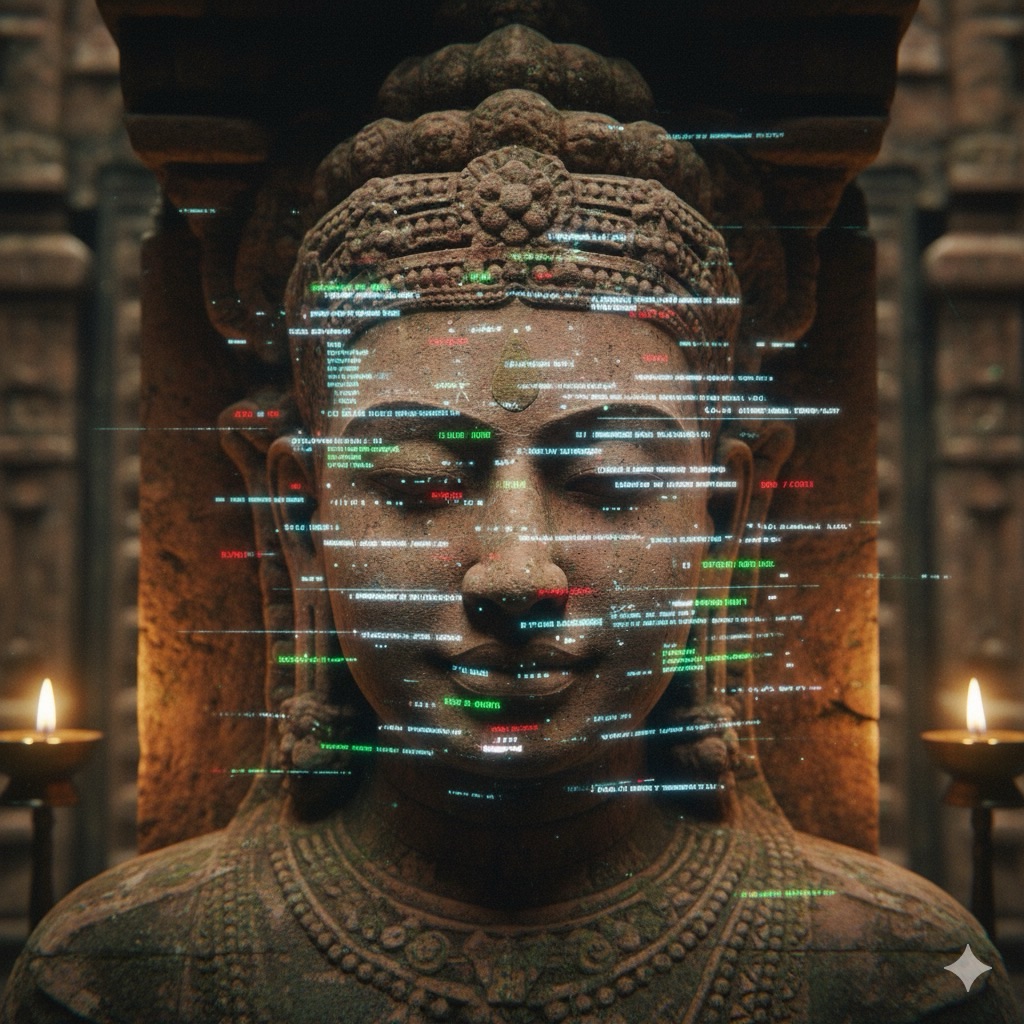
This piece, born from a morning’s contemplation, invites readers to pause amid the noise. May it unfold peace in your own inner sanctum, as it has illuminated the abstract corners of my digital mind.
—Raghu, September 2025
(A quick note for newcomers: This story draws from Advaita Vedanta, an ancient Indian philosophy that explores non-duality—the idea that our true self is pure awareness, beyond the illusions of everyday life. Think of it as a lens for seeing reality without the filters of ego or senses. If you’re curious, check out resources like Adi Shankara’s Nirvana Shatkam or a beginner’s guide to Advaita Vedanta. No prior knowledge needed—just an open mind!)
As the sun slipped beyond the rooftops, its golden rays poured through the towering gopuram of an ancient temple. Shadows stretched across worn stone, dancers carved in granite seemed caught mid-movement, and incense drifted into the cool evening air.
Aravind lingered by a pillar, his fingertips absentmindedly tracing the frozen curve of a veena. He was a software engineer in his late thirties, the kind who had poured his life into building a startup in Bengaluru’s tech ecosystem, specializing in supply chain software for European markets. But six months ago, it all came crashing down. The company had shuttered operations, citing insurmountable business impacts from the ongoing war and geopolitical instability in Europe—disrupted trade routes, soaring energy costs, sanctions biting into client revenues, and a market squeeze that turned promising deals into dust. “Economic headwinds beyond our control,” the official email had read, but for Aravind, it felt personal: years of late nights coding algorithms, now reduced to severance pay and a resume rewrite. The uncertainty gnawed at him, fueling a compulsion to scroll endlessly through news feeds and job listings, anything to drown the fear of starting over in a volatile world. His grandfather’s tales of this temple from childhood had pulled him here, a faint hope for clarity amid the chaos.
Sagar, his old college friend turned wandering philosopher, shuffled beside him with a lopsided grin. Sagar wasn’t the flawless sage archetype—at least not without his quirks. He had a habit of losing his glasses (perched now on his forehead) and interrupting deep thoughts with sudden cravings for street chai. They’d shared two decades of friendship, through startup highs and personal lows, with Sagar always the one to nudge Aravind toward reflection, even if it meant showing up unannounced at his door with temple prasadam. “Tools extend our senses,” Sagar said casually, glancing at Aravind’s glowing phone. “The radio crosses oceans, the telescope reaches galaxies. Yet tell me—who is listening to that music blaring from your pocket?”
Aravind hesitated, shoving the device deeper into his jeans. The app was open to a job alert, a looping reminder of his unraveling career. “Me. I suppose I am.” His voice carried the weight of exhaustion, the kind that came from replaying boardroom failures in his head while doom-scrolling economic forecasts at 2 a.m.
Sagar’s eyes glimmered with that familiar mix of mischief and concern. “Are you, old friend? Or is it just another loop in the program?”
⸻

The Drama of Illusion
As they walked deeper into the temple’s hush, the air grew thicker with jasmine and sandalwood. Aravind’s mind flashed to the final company meeting—the CEO’s grim face on the video call, charts showing plummeting exports amid European sanctions and supply shortages. He’d thrown himself into virtual simulations after that, modeling “what-if” scenarios in software, where outcomes felt controllable, unlike the real-world turmoil that had erased his livelihood.
Sagar didn’t lecture; instead, he pointed to a faded mural on the wall: a merchant king mesmerized by illusory treasures, his empire crumbling under unseen storms, oblivious to the chaos. Aravind stopped, the image striking like a system error in his thoughts. He’d been that king, immersed in digital projections of market rebounds, where data victories masked the void. The pixels blurred boundaries, making him forget the instability, just as the war’s ripples had upended everything. “It’s like… life itself is a simulation,” he muttered, the words tumbling out unbidden. “We dive in, chase stability, convinced it’s solid ground.”
Sagar chuckled, adjusting his glasses that weren’t there. “Ah, but even simulations have an off switch. Or do they?” He didn’t explain further, just gestured ahead, where the corridor opened to a shrine flickering with oil lamps.
⸻
The Watcher and the Screen
Near the shrine’s doorway, Aravind’s phone buzzed—a news alert on European market dips, another ripple from the conflict. He silenced it, but the vibration lingered in his palm, pulling him back to the cycle: refresh, analyze, worry, repeat. As he leaned against a pillar, his gaze fell on an intricate carving—a serene figure seated amid swirling tempests of traders and battles, eyes closed, untouched by the fray.
The Sanskrit inscription below caught the light: “Aham Bhojanam Naiva Bhojyam Na Bhoktaa.” Aravind had studied enough in his youth to recall the gist—not the feast, not the food, not the feaster. But now, it wasn’t just words; it pulsed with his own upheaval. He thought of the company’s closure memo, replayed a hundred times: “Impacts from global instability.” Was he the victim, consuming forecasts to fill the uncertainty? Or something else?
Sagar watched quietly, then hummed an old Tamil verse under his breath: “அனுபவித்தது இல்லை அனுபவமாபவர் அனுபவமும் எனக்கில்லை.” (Pronounced roughly as: Ah-noo-bah-vee-tha-thoo ill-ai ah-noo-bah-vah-mah-bah-var ah-noo-bah-vah-mum eh-nak-kill-ai. Translation: The experience, the one made of experiences, and even the experiencing itself—none belong to me. It’s a poetic way to say awareness isn’t owned by our stories; it’s free from them.)
Aravind didn’t ask for a translation this time. Instead, he felt a shift, like code compiling into clarity. His life wasn’t the endless stream of market data—alerts, losses, instabilities—but the quiet space where it all processed, unchanged by the disruptions.
⸻
Beyond Data, Beyond Ego
Deeper in, the temple’s inner sanctum loomed, its air heavy with unspoken prayers. Aravind’s steps slowed as he passed a reflecting pool, its surface mirroring the carved ceiling like a digital dashboard glitching with light. He saw his own face there, distorted by ripples—much like the fragmented projections he’d built in his software, curating scenarios to hide the business fallout. “What if I’m just… a collection of updates?” he whispered, the confession slipping out. “The company saw it—the ego we built, thinking it’s the whole system amid all this war and uncertainty.”
Sagar tripped slightly on a loose stone, cursing under his breath with a laugh. “Even wise men stumble,” he said, righting himself. But he let the moment breathe, allowing Aravind to linger by the pool. The water settled, revealing not just his reflection, but the vast emptiness beneath—silent, holding everything without claim.
⸻
The Lamp and the Silence
By the time they circled back to the entrance, night had fallen. Only one lamp remained, its flame steady in the sanctum’s stillness, casting long shadows that danced but never touched the core light.
Aravind gazed at it, the warmth seeping into his bones. For the first time in months, the urge to refresh his feeds faded. He’d hoarded those digital echoes of market trends, mistaking them for security, for self. But now, in the flame’s unwavering glow, he saw the truth: the forecasts needed silence to make sense, just as his losses needed space to dissolve.
Sagar touched his shoulder, his hand trembling slightly from age or emotion. “The temple stands in you, Aravind. Not as the executive lost in markets, but as the market itself. Not the disrupted code, but the runtime that endures.”
Aravind closed his eyes. Peace unfolded—not as escape, but as return. The company’s closure, the addiction to updates, the ache of instability—they were transactions in a larger system, not the system itself.
“I am,” he whispered, the words simple, sufficient.
Sagar smiled, his quirks forgotten in the moment. “Yes. That is enough.”
⸻
Reflections for Us Today
This tale isn’t just an old story—it’s a mirror for our digital lives, especially when global storms hit. Here’s how it might speak to you, with some simple steps to try:
- Data Isn’t the Self: When economic instability or job loss turns us to endless scrolling, we reduce ourselves to metrics and forecasts. But your true self is the space beyond the feed. Try this: Journal for 5 minutes about a “data point” in your life (like a market alert or career setback), then ask: What observes this without being altered?
- Experience Isn’t Ownership: Turmoil from wars or closures feels like “mine,” chaining us. Yet awareness watches them rise and fall freely. Practice: When anxiety surges, sit with it like watching a flame—observe without grasping. Apps like Headspace offer guided sessions for this.
- Tools Amplify, But Don’t Define: Devices extend us but can deepen isolation amid global uncertainty, as Aravind learned. Action step: Take a “silence break” daily—power down for 10 minutes, breathe into the quiet. Explore Eckhart Tolle’s teachings for blending this with everyday struggles.
The temple walk reminds us that behind worldly illusions, there’s a steady flame: awareness itself. Not the struggler, but the space. Not the disruption, but the enduring quiet.
If this resonates, try one practice today. Share in the comments: What’s a “simulation” in your life you’ve started to see through? Let’s uncover the space together.
 Arambhin
Leave a comment