

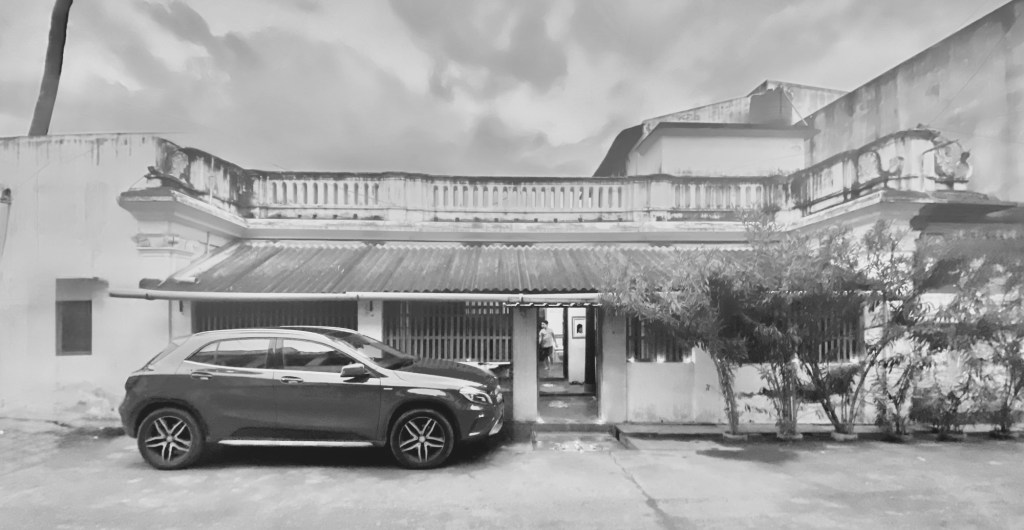
It had been years since I last returned to the old house. A hundred years it had stood, with its sloping tiled roof, carved wooden doors, and the faint smell of tamarind and old notebooks that never seemed to leave its walls. I grew up here—running barefoot across the government school’s vast grounds, slipping into the paddy fields after class, and falling asleep to the rhythm of my grandfather’s typewriting institute, where the clatter of keys was the family’s background music.
My father was the other constant. Always in a spotless white dhoti—never once in a pant. He was a man of astonishing simplicity, yet never careless in quality. If he bought a pen, it would glide for years. If he gave us books, they would be the finest editions he could afford. His life proved that simplicity did not mean lowering one’s standard of living, but rather raising one’s eyes to what mattered most.
He was a voracious reader, and the boxes of books stacked in our house were proof. Bharathi’s verses jostled with Reader’s Digest, Soviet Union magazines with Perry Mason and Jack London. His elder brother, a customs officer, sent books from faraway ports, and between them they built a library that never slept. On summer afternoons, my father would quote Bharathi, explain a story from Readers Digest, or make us debate an editorial from The Express.
Music floated in the house like another language. Mostly Carnatic—Ariyakudi, M.L.Vasanthakumari, or Madurai Somu on the radio.
And laughter too was part of his world. He had a heart for comedy that ran in his blood. Flight 172, Crazy Mohan, and S. Ve. Shekher plays were household names to us. But when he was in the mood, he would pull out his mouth organ and play a Kishore Kumar tune, or hum along with Manna Dey. Cinema songs were rare, but when they came, they felt like festivals.
And then there were the games. Cricket in the backyard with tennis balls, chess matches that stretched past midnight, and carrom battles that went on till early morning during summer holidays. My father played with the same seriousness he reserved for mathematics—no indulgence just because we were children. Victory or defeat, both were to be accepted with dignity.
Now, in 2024, I walked through a town that had changed. The paddy fields were fewer, the roads broader, and the government school no longer looked as vast as it once did in the eyes of a boy. But the old house still carried those echoes—chalk on a blackboard, the strike of a striker on carrom wood, the breathy notes of a mouth organ at dusk.
That morning, I stepped into the medical shop to buy medicines for my mother. The man behind the counter, in his late fifties, handed me my order but kept staring, hesitant. Finally, he asked:
“Are you… sir’s son?”
That was all. No name, no explanation—just sir’s son.
When I nodded, his face brightened. He put aside the money, came out from behind the counter, and began to speak with the eagerness of someone who had stumbled upon a long-lost page. “Yes, yes—you and your brother! I remember both your names. I studied mathematics under your father. What a man! He taught with such patience. He never turned anyone away. He would take fees only if we could pay… but he taught everyone, always.”
For forty-five minutes, the medical shop became a classroom of memories. He spoke of how my father could talk on any subject—history, literature, sports. How, as students, they marveled at the way he moved from Bharathi’s poetry to cricket scores, from algebra to the Soviet Union, as if everything belonged to the same world of learning.
I listened quietly, struck by how vividly strangers carried my father in their minds.
Months earlier, at a wedding, I had met the town’s doctor Dr.Ganesh —another of my father’s old companions. He shook my hand warmly, peered at me, and said, “Ah, your father and I were bus mates for years. Morning and evening, every day to town and back. We would sit together and exchange books. Sometimes I gave him detective novels, sometimes he gave me Ayn Rand, Agatha Cristy or a Readers Digest.”

Then he looked at me slyly: “So… do you also read as much as your father?”
I hesitated, fumbling for an answer. Perhaps he saw the blankness on my face, because he laughed, wagging his finger: “Nowadays you youngsters read everything on your mobile itself, eh? WhatsApp, articles, forwards… and you think that is reading!”
We both laughed, though I carried a quiet guilt. For all the scrolling I did on my phone, I could not claim to have inherited the discipline of filling boxes with books.
As I walked home from the medical shop, the afternoon sun pressed heavy on the street. Yet I felt strangely lighter, carried by the knowledge that my father’s simple, book-filled, music-filled life had stitched itself into the memory of the town.
I wondered: Can I ever create such a memory for my children? Will they walk into a shop one day and hear someone say—“Ah, you are his son”—with the same reverence?
At home, I placed the medicines on the table. My mother, still in prayer, said without looking up, “Good, you brought them.”
Perhaps legacy is exactly that—quiet, unspoken, yet deeply lived. My father never sought recognition, but his life of reading, teaching, and simple joy had become part of the town’s bloodstream.
And perhaps, in the silence of that old house, surrounded by books, music, and the echoes of late-night games, I too had already begun to carry it forward.
 Arambhin
Leave a comment