

Alex slumped on the couch in their cramped apartment, the glow of their phone screen casting a cool, alien light across the room. It was Friday night, and the group chat was buzzing: “Party at Mia’s! Who’s bringing the vibes?” Alex, a 22-year-old graphic design student juggling freelance gigs and endless digital scrolls, felt the familiar, magnetic tug. Their thumb hovered over the delivery app—a bucket of biryani for pre-game fuel? Or maybe skip straight to cocktails? Lately, these impulses had become a ritual, a quick, narcotic escape from the grind of deadlines and digital fatigue.
Inside Alex, the battle raged. Gut, a plucky rebel with a penchant for instant gratification, stirred first. Evolved from hunter-gatherer days to chase the rush of dopamine hits, Gut had grown reckless in this era of endless, effortless options. “Come on, let’s do it,” Gut grumbled, its voice a low rumble echoing through Alex’s midsection. “That biryani’s calling—spicy, saucy, with extra naan. And hey, if we’re heading out, a cocktail or two won’t hurt. Remember last weekend? The buzz made everything funnier.”
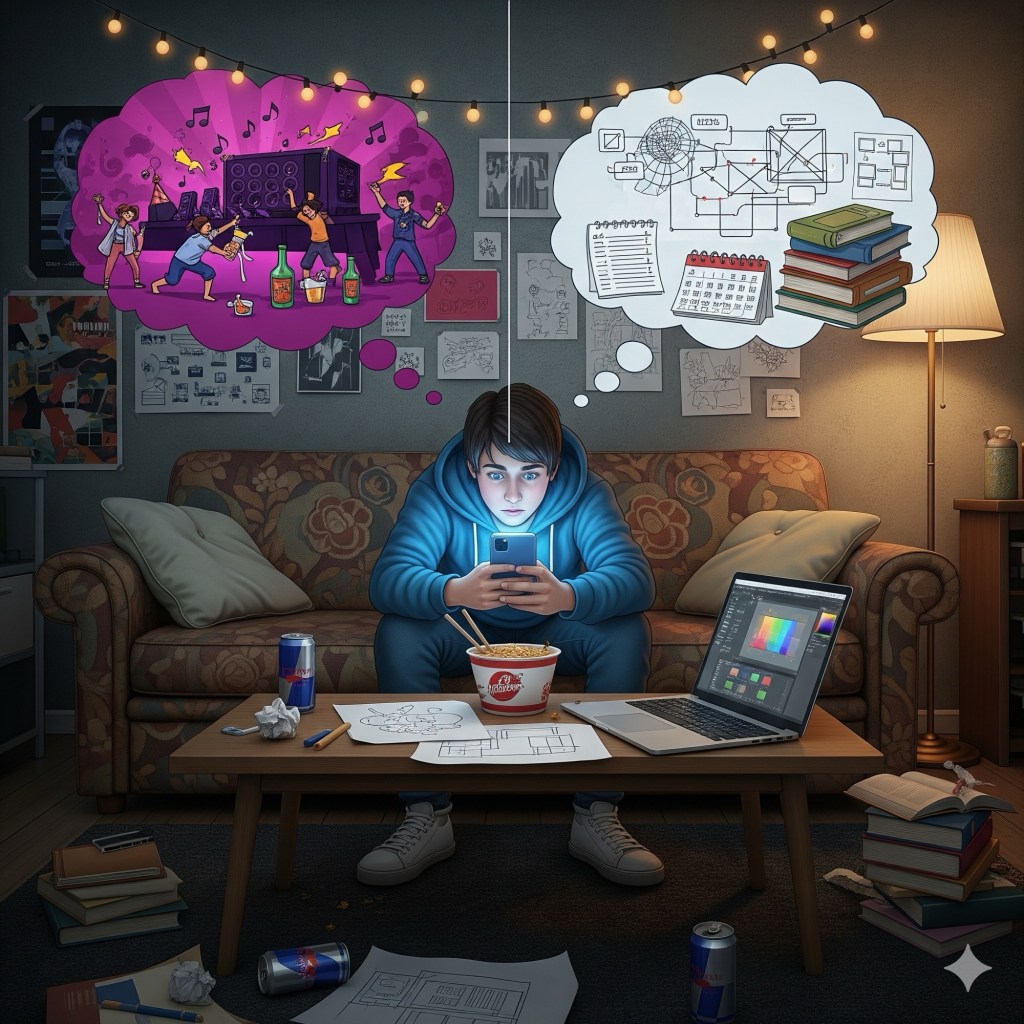
Mind, the sharp overthinker in the cranial command center, sighed. Mind prided itself on logic, on mapping out neural pathways like a flawless algorithm. But it had a persistent flaw: analysis paralysis. It could foresee every consequence but often froze when impulse struck, leaving Alex adrift. “Not again, Gut,” Mind retorted, its tone laced with weariness. “You’re always chasing the high, but you forget the aftermath. Last time, you flooded the system with grease and booze, and I spent the next day untangling the fog. Alex couldn’t focus on that logo—missed the deadline, remember? We’re not built for this constant overload.”
Gut chuckled, a hint of defensiveness in its bravado. Deep down, Gut longed for balance; its microbiome, that bustling community of bacteria, thrived on variety, not chaos. But convenience had turned it into an enabler. “Lighten up, Mind. Life’s short—Alex deserves a break. One click, and boom, dinner’s here. No cooking, no hassle. And at the party? A smoke with friends, a drink to loosen up. It’s social glue!”
As Alex swiped open the app, temptation built. Notifications pinged like digital fireworks: “Flash sale on wings!” “Cocktail kits delivered in 20!” Gut revved up, sending waves of craving that made Alex’s stomach audibly growl. Mind tried to intervene, flashing warnings—images of bloated regret, of hazy, anxious mornings—but it overcomplicated things, spiraling into what-ifs: What if this leads to another all-nighter? What if Alex’s portfolio suffers? What if… Paralyzed, Mind let the impulse win. Alex hit “order,” then grabbed their jacket for Mia’s.
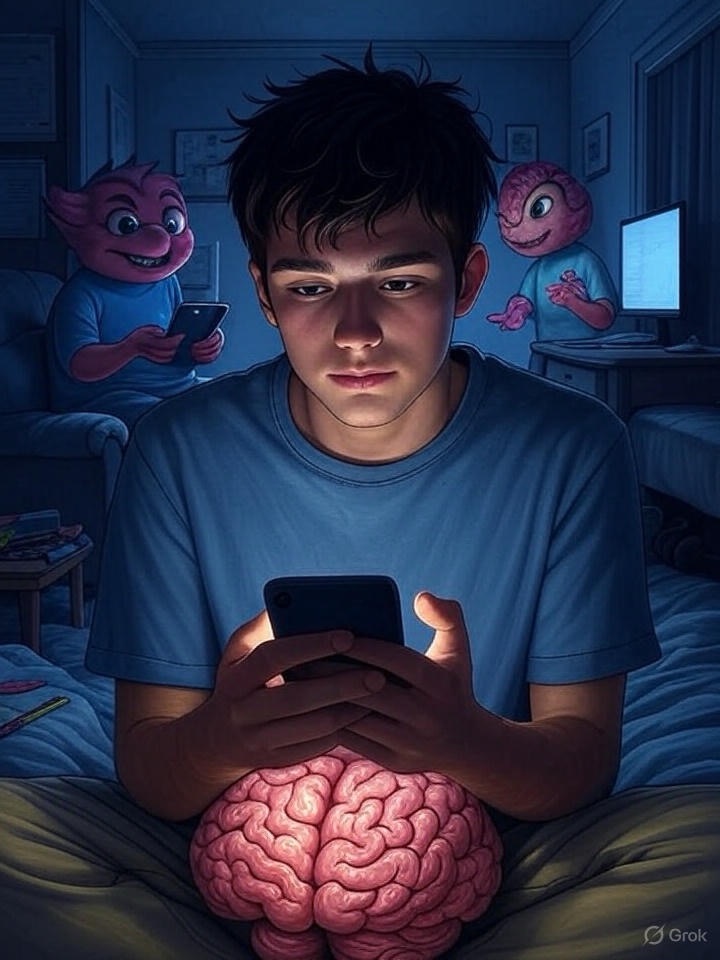
The party was a blur. Laughter echoed, but so did the haze of smoke—amplified by secondhand vibes—and the sharp burn of shots. Gut reveled at first—“Yes! This is living!”—but as the night wore on, the chaos hit. Alcohol scorched Gut’s lining, throwing its microbiome into disarray; bacteria rebelled, sending signals of profound unease. Smoking amplified it, a toxic tag-team that left Gut feeling hollow, its usual pluck completely deflated. “Okay, maybe too much,” Gut admitted weakly, as a wave of nausea crept in.
Mind, meanwhile, grappled with the fallout. The buzz had short-circuited focus, turning thoughts into a jumbled mess. “See? This is what I meant,” Mind snapped, but its voice cracked with fatigue. Mind’s flaw was glaring—it had seen this coming but hadn’t pushed hard enough, too busy analyzing to act. As Alex stumbled home, the crash descended: anxiety spiked, a dense fog settled in, and a quiet voice of self-doubt whispered, Why can’t I just say no?

The next morning, Alex woke to a pounding head and a queasy stomach, the remnants of biryani wrappers scattered like evidence. Staring at their laptop, the unfinished project mocked them. For the first time, Alex paused—not out of habit, but out of a deep, weary necessity. They took a deep breath, then another, questioning the pull: Is this what I need, or just a habit? Instead of scrolling for a hangover cure, Alex opted for a simple yogurt from the fridge—plain, probiotic-rich, a quiet nod toward restoration.
Gut perked up slightly. “Hey, that feels… steady. No flood, just fuel.” It was a small win, but it revealed Gut’s hidden strength: resilience when given a chance to reset.
Mind, sensing the shift, finally broke free from its overthinking loop. “Exactly. We don’t have to chase every ping. Let’s build on this—move a bit, clear the cache.” Alex laced up sneakers for a brisk walk, the movement syncing their systems, easing the fog.
Over the following weeks, the internal duo evolved. Gut learned to temper its impulses, appreciating the calm of balanced inputs—water and veggies amid the occasional treats. Mind shed some perfectionism, acting swiftly with gentle nudges rather than endless debates. Alex, the unwitting pilot, started weaving these instincts into life: pausing before ordering, scanning choices for real nourishment, checking social vibes against true desires. Failures still happened—a slipped cigarette here, a late-night snack there—but each built toward growth.
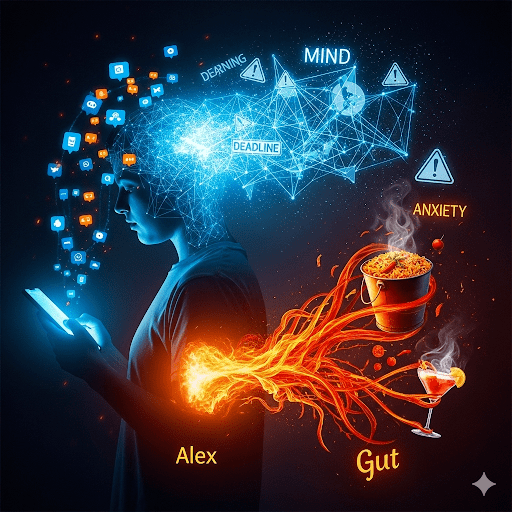
One evening, as Alex declined a party invite for a quiet design session, Gut and Mind shared a rare moment of harmony. “We’re getting better at this,” Gut said, content.
Mind nodded. “Together, we keep the system stable. Alex is thriving—not just surviving.”
In the end, Alex didn’t need alerts or rules; the journey had etched the wisdom—fueled by a diverse microbiome—into their core. The instincts, once mindless, now guided with a quiet purpose.
 Arambhin
Leave a comment