

Once upon a time in the bustling digital haze of 2025, there lived a Gen Z kid named Mahi. At 22, Mahi was the epitome of the scroll generation—his thumbs were practically fused to his phone screen. From dawn till the wee hours, he’d dive into endless feeds: TikToks of outrageous fails, Twitter rants about the world’s injustices, Instagram reels flaunting unattainable lifestyles, and Reddit threads dissecting every conspiracy under the sun. “Just one more video,” he’d mutter, as hours evaporated like morning dew. His mind was a whirlwind of envy, outrage, and FOMO, constantly chasing the next dopamine hit. Opportunities? Nah, all he saw were reasons to be mad—the economy sucking, friends ghosting, climate doom scrolling right into his psyche.
Mahi’s life mirrored his feed: chaotic and unfulfilling. He flunked out of online classes because “who has time to study when the world’s on fire?” His room was a mess of takeout boxes and forgotten dreams, and his part-time gig at a coffee shop felt like a dead end. “Everything’s rigged against us,” he’d gripe to his coworkers, spotting red flags in every interaction like spotting red cars on a highway. Little did he know, he was becoming what he constantly thought about—a perpetual storm cloud, repelling friends and chances alike.
One rainy afternoon, while doom-scrolling in the park (because even outdoors, the phone won), Mahi’s battery died mid-rant. Frustrated, he shoved the device in his pocket and noticed an old bookstore across the street—quaint, dusty, the kind of place algorithms never recommend. Bored and phone-less, he wandered in. Rifling through shelves, he pulled out a tattered book titled Echoes of Eternity: Ancient Wisdom for Modern Minds. It was a compilation of Sanatana Dharma teachings, translated for the TikTok era. Skeptical but intrigued (hey, it had cool illustrations), he flipped to a random page and skimmed a snippet from the Brihadaranyaka Upanishad: something about desires shaping your whole vibe. “Sounds like boomer mindfulness crap,” Mahi thought, but he bought it anyway.
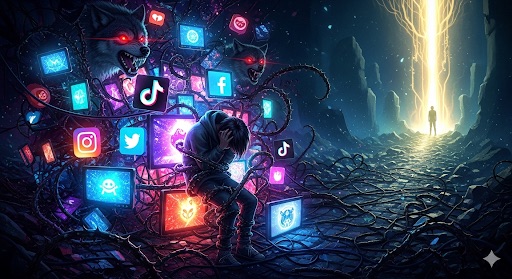
That night, as he charged his phone and skimmed the book, the words lingered like a stubborn notification. He tried a simple exercise: meditate for five minutes, watching his thoughts without judgment. But here’s where the twist hit—Mahi dozed off mid-meditation and plunged into a vivid dream. In this surreal realm, his thoughts manifested as literal avatars: angry rants as snarling wolves chasing him through a crumbling city; envy as green vines strangling his path; endless scrolls as quicksand pits sucking him under. Panicking, he spotted a serene figure—an ancient sage with Jason Statham’s face (dream logic, right?)—pointing at him just like in that viral meme. “The self is desire alone; as it desires, so it becomes,” the sage intoned, echoing the Brihadaranyaka Upanishad’s verse. Then, shifting to full meme-speak: “Bro, your desires are like your search history. Keep googling trash, and guess what your life’s algorithm serves you? Trash. That Upanishad nails it—desire turns to will, will to action, action to straight-up destiny. Switch the input, change the feed, or get devoured by your own vibes.”
Mahi bolted awake, heart pounding, the sage’s words echoing like a remix of ancient philosophy and viral wisdom. Was it just his brain glitching from scroll withdrawal? Or a deeper hack into his reality? Shaken, he decided to test it. No more mindless feeds—he curated his inputs like a pro editor. Apps for learning coding (his forgotten passion), podcasts on opportunities in tech, and even a yoga app rooted in dharma principles. He started journaling thoughts, catching negativity early: “Why focus on reasons to be mad when I can spot red cars—er, chances—everywhere?”
A few days in, still buzzing from the dream, Mahi bumped into his old friend Priya at the coffee shop—a vibrant dancer who’d been grinding through auditions for a fusion Bharatnatyam troupe. They’d lost touch amid his scrolling haze, but now, over lattes, he spilled about the book and the wild dream. “Dude, this Upanishad stuff says your desires basically blueprint your life—think bad vibes, get bad destiny,” Mahi explained, quoting the verse awkwardly. Priya’s eyes lit up; as a dancer steeped in classical traditions, she connected the dots instantly. “That’s straight fire, Mahi! It ties right into the Natya Shastra—Bharata Muni’s ancient dance bible.
There’s this shloka:
‘Yatho Hasta thatho Drishti’—where the hands go, the eyes follow;
‘Yatho Drishti thatho Manah’—where the eyes go, the mind follows;
‘Yatho Manah thatho Bhaava’—where the mind goes, emotions bloom;
‘Yatho Bhaava thatho Rasa’—and from those emotions, you evoke the real mood, the rasa that hits the audience deep.”
She leaned in, gesturing like in a performance. “This is what Kamal Haasan says to a dancer post the fantastic dance scene in the office in the movie Salangai Oli—that her dance is not up to the mark, even though it looked amazing technically, because it lacked that true integration of mind, emotion, and rasa. He even demonstrates different dance forms to show what real art is! In dance, if my hands flail without focus, my eyes wander, my mind drifts, and poof—no authentic emotion, no impact. But align it all with intention? Magic. Same with life—your scrolling hands led your eyes to doom, mind to rage, emotions to chaos, and your whole vibe became this sour rasa. The Upanishad starts from inner desire; Natya Shastra from outer action. But they’re linked: guard your ‘hasta’ (actions), and the chain flows to a better destiny. Try it—next time negativity creeps, think of it as a bad dance move. Redirect, like choreography.”
Mahi nodded, mind blown—the discussion sealed his resolve, blending the philosophies into a practical remix.
The change wasn’t instant vibes; it was gritty. A week in, Mahi slipped—thumb hovering over a rage-bait thread about economic collapse. The wolves from his dream snarled in his mind, and Priya’s words echoed: “Where the hands go…” He paused, whispering the mantra: “Watch your thoughts, bro—desire to destiny.” He swiped away, opting for a coding tutorial instead. Another slip mid-month: envy hit hard seeing a friend’s vacay reel, vines creeping in. But he caught it, journaling: “Switch the input—eyes to mind to rasa.” Small wins stacked—better focus at work, a random chat leading to a freelance gig.
Weeks turned to months; those daily battles forged seismic shifts. Mahi built a side hustle app that gamified eco-friendly habits, born from redirecting his “doom” thoughts to innovative solutions. Investors noticed—boom, funding. Friends returned, drawn to his new energy—Priya even collaborated on a promo video, infusing dance elements to evoke that positive rasa. He traveled to India on a whim, visiting ashrams where he delved deeper into the Brihadaranyaka Upanishad and Natya Shastra, learning how their principles promote living in harmony with eternal dharma, staying watchful to avoid adharma’s traps.
Years later, Mahi—now a successful entrepreneur—looked back at that dream-twisted night and his chat with Priya as the pivot. The snarling wolves? They became a tattoo on his arm, a reminder to guard his mind. The ancient wisdom wasn’t just words; it was a life hack that reprogrammed his reality, from desire to destiny. He didn’t need a feed anymore—the universe was his scroll, and every thought he chose was his algorithm of destiny. Watch yourself, indeed.
The Ultimate Algorithm Isn’t Code. It’s You.
We live in an age of frictionless inputs. Your phone, a polished slab of glass and aluminum, is an oracle delivering an endless stream of information, outrage, and curated perfection. We are all Mahi, chasing a fleeting hit of dopamine, convinced that the answers—and our value—lie just one more scroll away.
But what if the most powerful technology isn’t in your pocket? What if the most complex and elegant algorithm ever designed is the one running inside your own mind?
This story is more than a glimpse into the chaotic landscape of 2025. It’s a powerful debug tool for our collective operating system. Mahi’s journey from a perpetually glitched-out state—a human-sized metaphor for a system with corrupted inputs—to a focused, purpose-driven creator is the ultimate proof of concept.
He didn’t find salvation in a new app or a different social platform. He found it in a manual thousands of years old. The Brihadaranyaka Upanishad and the Natya Shastra aren’t relics; they’re a software update for the human condition. They teach us that our true “feed” is our thought stream, and our “likes” are the desires we let take root.
This is the ultimate hack. The true innovation isn’t building a faster chip or a more immersive metaverse. It’s learning to master your own mind. It’s understanding that your mental inputs—your drishti and your manah—are the source code for your reality.
The final frontier of human progress isn’t outer space. It’s inner space. So, read this story, but don’t just consume it. See it as a prompt. A call to action to audit your own system, delete the bloatware of envy and outrage, and start coding the destiny you want to see. The universe is waiting for you to run the program.
 Arambhin
Leave a comment