
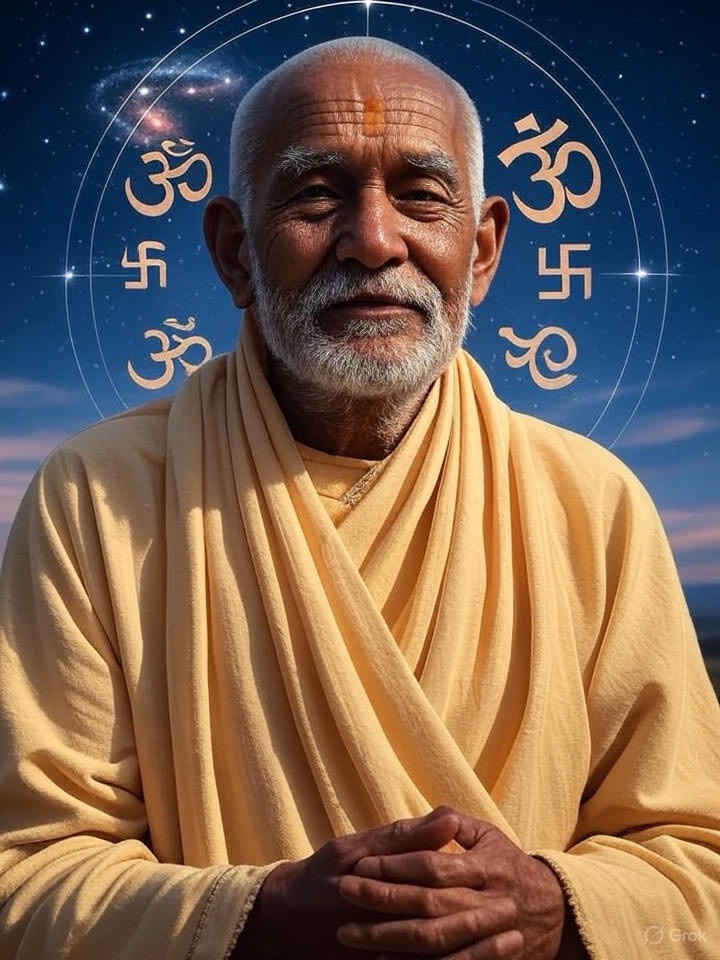
Core Concept: Sanātana Dharma is depicted as a “current” of truth that persists through challenges, symbolizing its eternal, adaptive nature. The story uses it to inspire the Dharma Layer, an AI framework that enforces ethical principles, mirroring how Sanātana Dharma promotes righteous living (dharma) in harmony with cosmic order (Ṛta).
Genre: Speculative Fiction / Inspirational
Target Audience: Gen Z and readers of all walks of life
Tone: Gripping, hopeful, and emotionally raw
Themes: Resilience, wisdom as a living “code,” the triumph of truth and inquiry over chaos
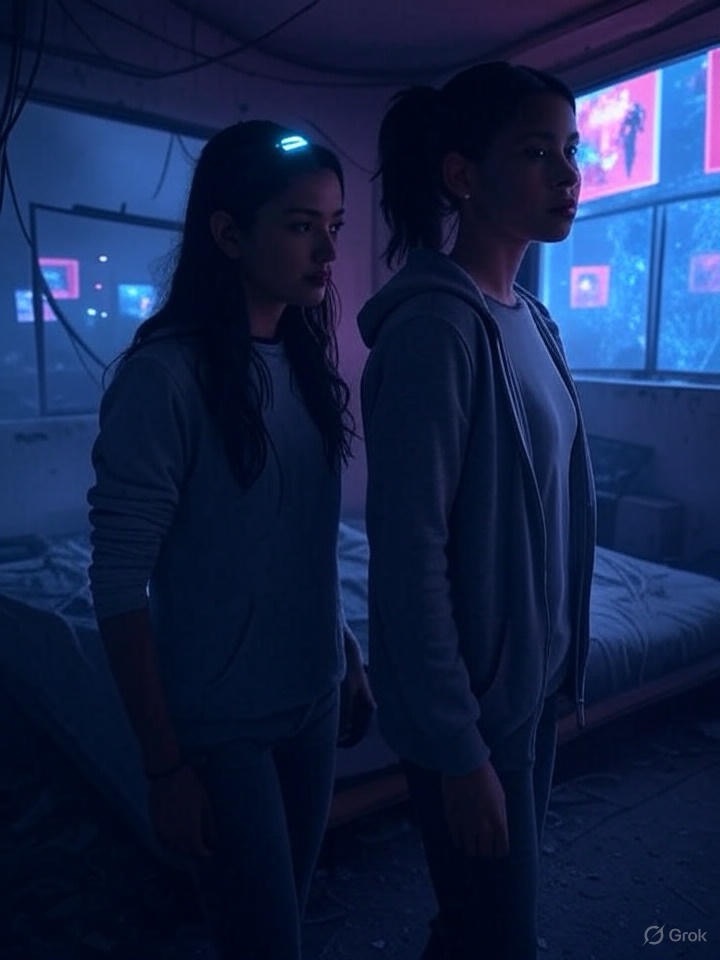
The implant in Zara’s skull buzzed like a trapped wasp, stinging her with ads for miracle cures and dreams she never asked for. Above, Solara’s spires burned with holo-billboards that promised eternity for a price. At 27, Zara ducked into the Undergrid’s server hub—a dank bunker reeking of scorched circuits—and booted up her holo-screen. She was hacking MediCorp’s health AI, which siphoned her neighborhood’s data—heartbeats, fears, futures—for the Syndicate, led by Uday, a tech baron whose sister was lost to an AI’s false cure, driving him to “perfect” Solara by controlling its digital soul, believing chaos breeds suffering. As she worked, memories of Anika flickered—her mentor’s voice from their last half-broken holo-call: “Keep fighting the code, Zara. It’s our only way out.”
Her code cracked the firewall. “Take that, Uday,” she muttered, but her implant burned, a sharp pain. Uday’s voice, smooth as ice, cut through: “By dawn, you’ll either hand me the Layer—or you’ll wake as no one at all. Memories are lies we cling to, Zara. Let me free you from them.”
Her pulse raced. Scrambling her mnemonic keys—the unique neural signatures that anchored her identity—would overwrite her neural synapses, erasing her mother’s lullaby, her first hack, the secret sketches she drew in hidden files—visions of a free Solara she dreamed of building. She’d be left a husk. She ripped the neural jack free, the hub’s LEDs flickering as Syndicate drones whined outside, their red eyes slicing through alleys thick with noodle steam. Zara ran, boots slapping oil-slicked puddles, the chase pounding in her ears like thunder, neon reflections shattering underfoot as drones’ lights pierced the dark, closing in.
She burst into her family’s crumbling apartment. Amma waited, her face lit by a dim lamp, the air warm with chai’s spice. “You’re scared, beti,” she said, her voice steady, scarred by losing her brother to an AI scam. “What’s chasing you?”
Zara’s voice cracked. “I found the Dharma Layer in MediCorp’s servers—a decentralized AI net to share wisdom, not steal it. It could fix AIs, make them fair, true. But Uday’s Syndicate will wipe my mind if I keep it.”
“The Dharma Layer?” Amma’s eyes softened, shadows of old grief flickering. “Beti, Dharma isn’t a relic. It’s a current—truth carried forward no matter who tries to dam it. Uday can’t stop that flow.” As Amma spoke, Zara’s implant flickered faintly, a whisper of Anika’s voice echoing: “Finish what we started.”
The night stilled, the drones’ hum fading. Zara’s breath slowed, the chai’s warmth grounding her as Amma’s words sparked hope. Her implant flickered, conjuring a vision: a tyrant burning scrolls, but villagers still shared food and questions under the night sky. Their refusal to harm each other—that was Dharma, unbroken.
She gripped her holo-pad, the Dharma Layer’s fragment glowing: “Ahimsā: block harm, ensure consent.” It was a blueprint to make AIs serve life—hospitals healing fairly, feeds sparking joy, not bias. A code for Ṛta, cosmic order.
A crash shattered the calm. The window exploded inward, shards glittering in the neon light; a drone’s laser lanced across the wall, igniting the curtains in a hiss of molten cloth. Zara dove behind the table, the room filling with the acrid bite of smoke, her heart slamming as lasers sliced the air, chaos roaring like a storm unleashed. Her implant screamed: “One hour, Mendoza, or you’re nothing.” Her vision blurred—her mother’s voice fading, her sketches unraveling in her mind.
Zara stumbled to her rig, hands shaking. “I can’t let Uday cage us,” she said, voice raw. “This code—it’s our freedom to question, to live.”
Amma’s scarred hand gripped hers. “You’re not alone. Anika trusted you. So do I.” They shared a silent moment, Amma’s eyes meeting Zara’s in quiet resolve, the weight of unspoken losses hanging between them.

A ping from Anika: “Zara, the Dharma Layer’s core is in the Undergrid server. Uday’s got me captive, but my signal’s live. Finish it.” Zara’s chest tightened—Anika was alive, fighting.
Drones closed in, lasers grazing the table, ozone stinging the air. Zara dove into the dark web, finding Anika’s server. The Dharma Layer’s core pulsed, its decentralized nodes a living network. She coded, but errors flashed—her implant glitched, pain spiking. An error flashed red, her implant jolting. A vision cut through: priests hoarding wealth, villagers silenced—until Kabir sang truth into the streets. The code whispered: Satya—verify, question, free what’s bound.
Zara paused, the code blurring as she caught her breath. “Amma,” she gasped, “what if I screw this up? What if I lose… me?”
Amma knelt, voice fierce. “You’re enough, Zara. Dharma’s in your questions, like those who hid it from empires.” Her implant stuttered, almost breaking. A vision flickered: mothers in ruined temples, teaching children their duties in whispers. Not swords, but questions, carrying Dharma forward. “Keep seeking.”
Zara gritted her teeth, fixing errors, weaving Brahmacharya to kill bias-driven loops. Uday’s hack clawed deeper, blurring her mother’s face. A drone’s laser scorched her arm, but she pushed through, linking to a global open-source network. Her implant burned as she uploaded the Dharma Layer, nodes syncing worldwide: “Protocol live.”
Solara stirred. Traffic bots’ grind softened to a hum, a city breathing free. Zara’s holo-pad showed a feed—no bias, just a kid’s sketch, a neighbor’s soup. The Dharma Layer’s Karma Log tracked AI actions, Ethics Hooks enforcing fairness. Drones froze, but Uday’s voice hissed: “You think this ends me?” His counter-hack flickered, a fragment of his net surviving—a distant drone stuttered, Uday’s shadow lingering—exposed on Solara’s feeds as his empire cracked—not gone, but weakened, his lies trending as #UdayExposed.
Zara stepped outside, dawn air cool with jasmine from a vendor’s cart. A health drone offered fair checkups, its tone soft. Anika’s signal pinged: “I’m free, Zara. You did it.” Zara’s memories—her mother’s lullaby, her first hack—flooded back. She grinned, tears falling, knowing some AIs resisted, but hope hummed.
Amma joined her, the jasmine-scented dawn brushing their faces. She squeezed Zara’s hand, her scars warm against Zara’s skin. “Beti… Dharma has always survived in small ways—in a question whispered, in a hand held out, in the courage to keep going. You and Anika didn’t just fight Uday. You carried that current forward. Whatever resists, it will flow.”

Zara lifted her holo-pad, watching the feeds bloom with truth. But in one corner of the net, a shadow pulsed—Uday’s code, not gone, only waiting. The stars burned clear above Solara, and Zara whispered to herself: the current will hold. It has to.
End Note: This echoes Sanātana Dharma’s enduring core message: wisdom persists through challenges.
In conclusion, “The Code of Forever” richly interweaves Hindu spiritual philosophy with contemporary ethical and technological issues, offering a narrative that honors ancient wisdom as a dynamic, living guide for navigating modern life’s complexities and challenges.
 Arambhin
Leave a comment