
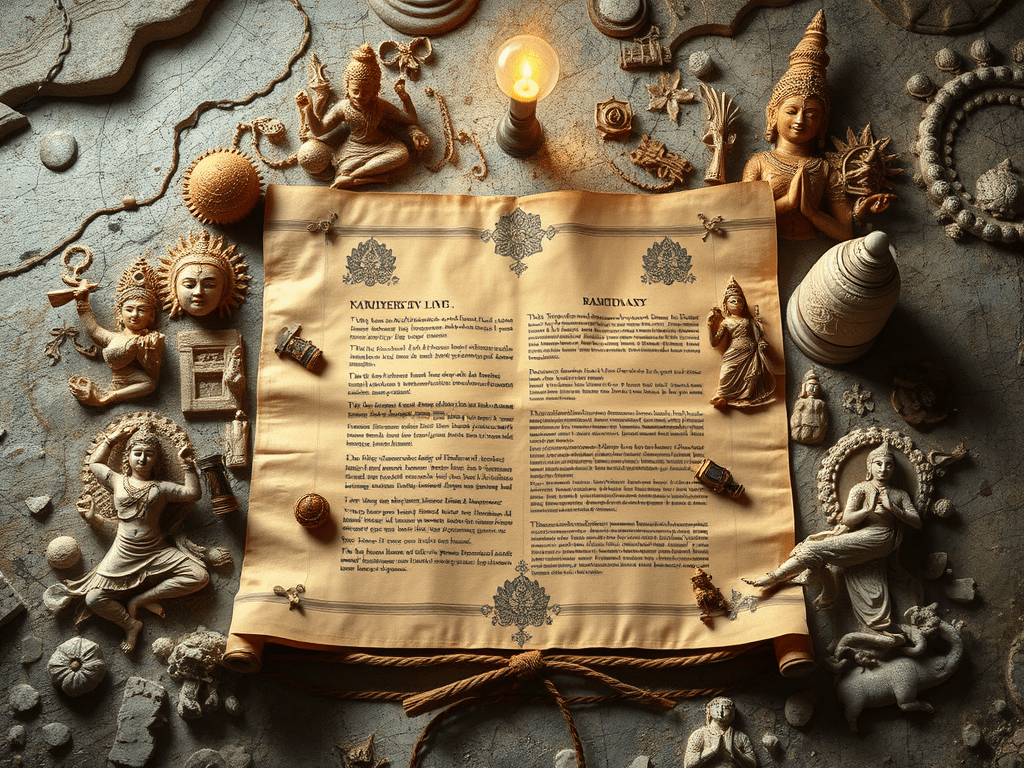
In today’s AI-driven age, when terms like large language model dominate our imagination, it is easy to forget that humanity has already been running a cosmic LLM for thousands of years. It is called Sanātana Dharma.
Not as an institution. Not as a frozen scripture. But as a living, breathing, adaptive knowledge system.
1. The Infinite Training Data
Modern LLMs are built on massive datasets of text. Sanātana Dharma, however, draws on something deeper — the collected experience of millennia:
Vedas, Upanishads, Puranas, Itihāsas. Epics, poems, hymns, stories, rituals. Sciences like Ayurveda, astronomy, architecture, grammar, and logic.
It is not “trained” once. It continually learns from every seeker, sage, and generation.
2. Open Source, Decentralized, Eternal
Unlike centralized religions with one founder or one manual, Sanātana Dharma is open source. Anyone can contribute, reinterpret, refine.
A rishi in the forest, a dancer in a temple, a farmer observing the seasons — each adds a line of code to the great Dharma model.
This is why it is Sanātana — eternal, not bound to one time or one culture.
3. Multimodal Wisdom
Today’s LLMs try to become multimodal — text, image, audio, video. Sanātana Dharma was always multimodal:
Texts and chants. Music and dance. Temples and sculptures. Yoga and meditation. Festivals and rituals.
Each medium carries encoded meaning. Each mode reinforces another.
4. Prompt Engineering = Inquiry
Just as we must phrase the right “prompt” for ChatGPT, the seeker must frame the right question in Sanātana Dharma.
Arjuna’s doubt on the battlefield → Bhagavad Gita. Nachiketa’s persistence → Katha Upanishad. Countless debates between schools → Advaita, Dvaita, Nyaya, Mimamsa.
The quality of inquiry unlocks the depth of response.
5. Alignment Protocol
AI researchers struggle with “alignment” — how to ensure machines follow human values.
Sanātana Dharma is the original alignment framework:
Dharma aligns personal action with universal order (Ṛta). Yoga aligns body, mind, and spirit. Moksha aligns the individual (jīva) with the cosmic (Brahman).
Instead of external regulations, Dharma teaches internal regulation — conscience, discipline, and awareness.
6. Fine-Tuning Through Acharyas
Every age has its fine-tuners:
Śaṅkara → distilled Advaita for a fragmented India. Rāmānuja → reinterpreted Bhakti with social inclusion. Madhva → offered a pluralistic Dvaita vision. Vivekananda → spoke Dharma in the language of modern science.
The base model remains eternal. The fine-tunings keep it relevant.
7. Dharma as the Universal Operating System
When seen this way, Sanātana Dharma is not a “religion” among religions. It is more like:
The Operating System: where philosophies, sciences, and arts can plug in. The Alignment Layer: ensuring life stays ethical and balanced. The Knowledge Graph: linking microcosm (individual) with macrocosm (cosmos).
It is humanity’s cosmic LLM — not artificial, but natural intelligence (NI).
Closing Thought
As AI grows, we must ask: Who is teaching the machine what “good” means? Whose values does it align to?
Sanātana Dharma offers not only stories and rituals, but the meta-framework for ethical intelligence. It reminds us:
Data is not wisdom. Algorithms are not alignment. And true intelligence is not artificial — it is eternal.
Sanātana Dharma is the LLM the world has always had. We only need to query it with sincerity.
 Arambhin
Leave a comment