
The Kabini River shimmered in the late light, its backwaters weaving through the Nagarhole National Tiger Reserve, where teak and sandalwood trees cast long shadows over the Nilgiri Biosphere’s lush heart. The air carried the sharp tang of wet earth and the faint musk of an elephant herd grazing near the river’s edge. At a small eco-lodge with a thatched roof, six photographers gathered, their cameras scattered across a wooden table dusted with red laterite soil.
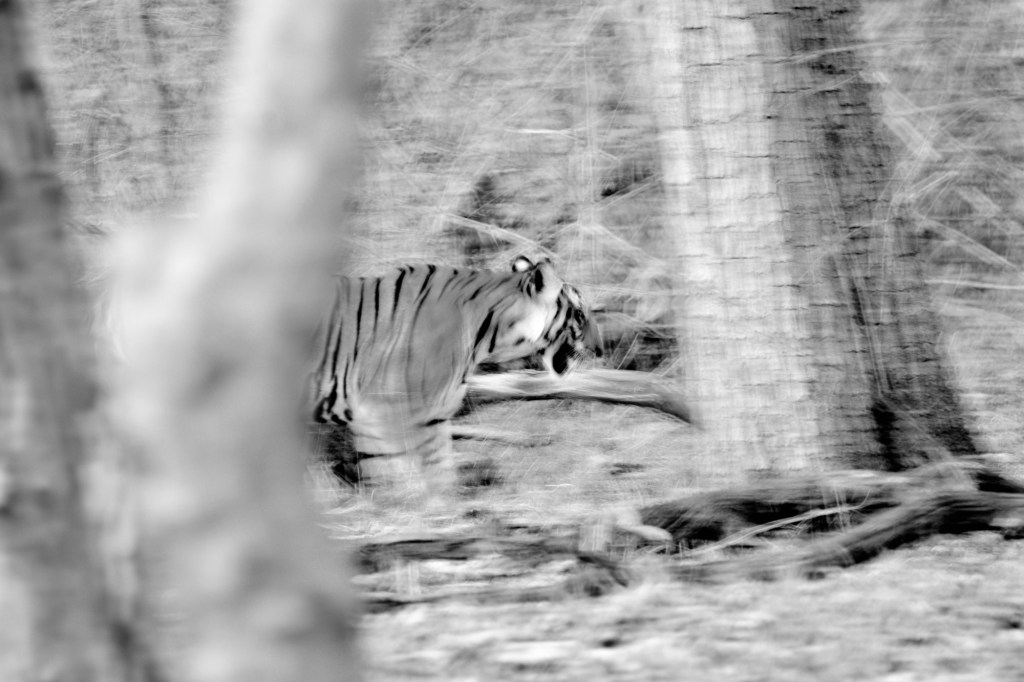
Priya traced the cool focus ring of her Nikon Z9, its 400mm f/2.8 lens a weight that steadied her grief. Her brother’s death had driven her into Kabini’s forests, chasing life’s fleeting pulse. “I caught her today,” she said softly. “The tigress, eyes locked on a chital, her stripes sharp through my lens. A Malabar trogon’s soft ‘cu-ow, cu-ow’ broke the silence just before. In that stare, I felt… kinship. Vasudhaiva Kutumbakam—the world as one family. Maybe survival isn’t just struggle; it’s recognition.”
Arjun, his Canon R5 with a 300-600mm zoom resting idle, let out a sharp laugh. Once a cosmologist, he’d left equations behind after a divorce stripped him of certainty. “Family? The cosmos doesn’t care. Hydrogen, oxygen, carbon—we share atoms with stars, yes. But atoms don’t embrace you when your life falls apart. Spinoza came close, calling it one substance, God or Nature. To me, it feels like chaos.”
The veranda fell into a thoughtful hush, pierced by the rolling ‘krr-krr’ of an Indian roller perched on a teak branch, Karnataka’s vibrant state bird signaling dusk.
Mei, pencil tucked behind her ear, looked up from her sketchbook, where she’d drawn a langur’s alarm call. She’d turned her back on Shanghai’s corporate towers to study Kabini’s wildlife. “Biology whispers differently, Arjun. A chital sensing danger floods with adrenaline, just as our hearts race when startled. Sandalwood trees signal beetle attacks with scents. Our mirror neurons fire when we witness that tigress-chital stare, making us feel their fear. It’s a survival code we all share. The Gita has a verse about all beings being one, doesn’t it?”
Priya nodded. “Sarvam brahmatmakam—the Supreme dwells in all. Not separate lives, but variations of the same song.”
Vikram adjusted the levels on his Zoom H6 recorder, capturing the forest’s symphony. As a boy, he’d stuttered into silence; now, Kabini’s sounds were his voice. “Signals, yes. But family means trust, not chemistry. Still, I recorded a crested serpent eagle’s piercing ‘kee-kee-kee’ today, echoing over the Kabini backwaters, and an elephant’s infrasound at 15 hertz, carrying five kilometers. It’s not just sound—it’s resonance. Maybe that’s unity.”
Rohan, laptop balanced on his knees, gave a tight smile. Data was his refuge, the clean logic he clung to after losing friends to ambition’s race. “Romance, all of it. Numbers don’t lie: a tigress succeeds in one hunt out of ten, the chital survives the rest. Competition, not kinship, defines life. Show me proof otherwise.”
The group stirred, discomfort rising like the river’s currents against its banks. Tara, seated cross-legged with her scarred arm in her lap, broke the silence. Chronic pain had made her body a cage; meditation her only key. “Rohan, I see what you mean. Pain makes me feel alone. But by the Kabini, watching predator and prey—fear, joy, desire, suffering, survival—they flow through us too. Maybe unity is recognizing that everyone carries it.”
No one answered. They listened instead: the forest’s pulse, the Malabar trogon’s soft trill fading into twilight, the distant rumble of the river. Then, as if by instinct, each reached down and touched the soil. Cool, damp, grounding. Fingers brushed against earth—and against each other.
Priya spoke again, quietly: “The Tirukkural says, Pirappokkum ella uyirkkum—all beings are equal at birth. Tigress, chital, us. The spark is the same.”
Arjun tilted his head back, eyes tracing Orion’s Belt through his f/5.6 aperture. “Maybe Spinoza was right. Deus sive Natura. God or Nature, one substance. If I doubt, it’s only because I want to believe.”
Mei closed her notebook. “Science names it in pieces—hormones, neurons, molecules. But maybe those are verses of a larger poem.”
Vikram played the low hum of the elephant call. The veranda vibrated with it.
Rohan’s smartwatch lit up. “Your heart rates,” he said slowly, his graphs blurring into breath, “they’ve dropped. From seventy-five to sixty-eight. Maybe there’s data in this unity.”
Tara breathed deeply, her face softening. “Then let’s sit with it. Inhale the forest. Exhale our doubt. Just for a moment—be one.”
They closed their eyes. The thatched roof dissolved into the canopy, the canopy into sky. Priya saw her brother’s smile flicker in the tigress’s gaze. Arjun felt the stars pulse in his chest. Mei sensed the codes of life—chemical, neuronal—fusing into one current. Vikram’s stutter faded into the 15 Hz hum. Rohan’s data merged with the group’s rhythm, his isolation softening. Tara’s pain flowed into the Kabini’s current.
A tigress’s roar, resonant at 80 Hz, echoed across the backwaters—not menace, but affirmation. Their hands on the earth felt the vibration. Their heartbeats, steady at sixty-eight, pulsed as one.
They opened their eyes. Six strangers, no longer just photographers or skeptics, but part of Kabini’s breath, the cosmos’s song, the wheel of fear, joy, and survival. Ekam sat vipra bahudha vadanti. Sarvam brahmatmakam. Pirappokkum ella uyirkkum. Truth is one. The divine dwells in all. By birth, all are equal.
Under the thatched roof, under the same sky, they were one family.
Here are full sentences for each concept with proper references and verse details:
- “Vasudhaiva Kutumbakam” comes from the Maha Upanishad, Chapter 6, Verse 72. It states: “Only small-minded people discriminate, saying ‘this person is mine, that one is a stranger’; but for those of noble character, the entire world is one family.” (Sanskrit: अयं बन्धुरयं नेति गणना लघुचेतसाम्। उदारचरितानां तु वसुधैव कुटुम्बकम्॥) .
- “Sarvam brahmatmakam,” meaning “the divine dwells in all,” is reflected in Bhagavad Gita 6.29, which reads: ‘He who sees the Self dwelling in all beings, and all beings dwelling in the Self, never looks upon any being with contempt.’ (Sanskrit: सर्वभूतस्थमात्मानं सर्वभूतानि चात्मनि).
- In the Rig Veda, Mandala 1, Hymn 164, Verse 46, the phrase “Ekam sat vipra bahudha vadanti” declares: “Truth is one; the wise call it by many names.” (Sanskrit: एकं सद्विप्रा बहुधा वदन्ति) .
- The Tirukkural, in Chapter 25, Kural 243, states: “All beings are equal at birth,” emphasizing the equality and shared origin of all living creatures. (Tamil: பிறப்பொக்கும் எல்லா உயிர்க்கும்) .
Each sentence gives the concept, the meaning, and the original verse information, providing clear references for further study.
 Arambhin
Leave a comment