
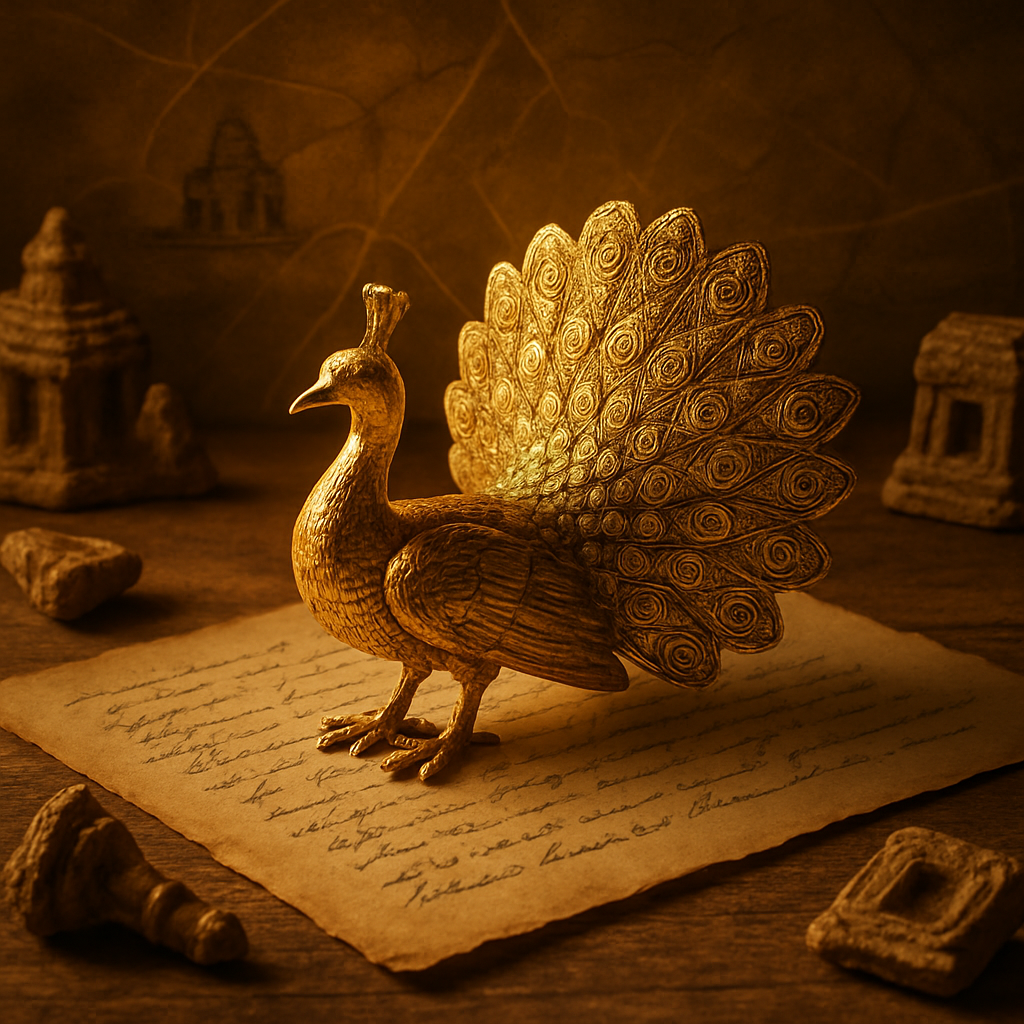
In the bustling tech hub of Silicon Valley, lived Elias Thorne, a brilliant inventor with a penchant for whimsy. Elias had grown weary of the digital world’s ephemerality—social media likes that faded in seconds, apps that promised connection but delivered isolation. He yearned to create something tangible, something that could spark real human interaction, yet with a built-in impermanence to remind people of life’s fleeting nature. Deep down, Elias carried a quiet loneliness from years of burying himself in code and circuits, rarely sharing his creations beyond prototypes. This peacock would be different—a bridge to the world he often observed from afar. Unbeknownst to him at the start, his inspiration drew from a real-world mystery: the legendary missing peacock idol from the ancient Kapaleeshwarar Temple in Mylapore, Chennai—a place whose very name means “land of peacocks,” tied to myths of divine birds. Elias had read about the idol’s disappearance years ago, a story of alleged theft or replacement that sparked global intrigue about cultural heritage vanishing into the shadows.
One rainy evening in his cluttered workshop, Elias crafted his masterpiece: a miniature golden peacock statue, no larger than a fist. Its feathers were intricately etched with iridescent alloys that shimmered under light, as if the bird were about to unfurl its tail in a dazzling display. But this was no ordinary trinket. Embedded within its base was a self-destruct mechanism—a tiny vial of acid that would activate after 90 days if not reset by passing it on. Accompanying the statue was a handwritten note: Cherish this gift, but share it with another soul within 90 days. If you hold on too long, it will vanish forever, a reminder that beauty is meant to be passed, not possessed.
To track its journey, Elias installed a discreet GPS chip, powered by a long-life battery and linked to a custom app on his phone. He imagined it like the Amur falcons he admired—migratory birds tagged by ornithologists, their paths tracing invisible threads across continents. With a mix of excitement and trepidation, Elias gifted the peacock to his old college friend, Mia, a barista in San Francisco. “Start the chain,” he told her, his voice steady but his heart pounding at the thought of releasing his creation into the unknown.
At first, the statue’s movements were predictable. Mia, enchanted by its glow, kept it on her windowsill for a week before passing it to her coworker, a musician named Jax. Jax reset the timer by scanning a hidden QR code and gave it to a street artist in Los Angeles. Elias watched the dots on his map app light up like fireflies—San Francisco to LA, then hopping to a tech conference in Austin. A smile crept across his face; pride swelled in his chest as he saw his invention weaving through familiar circles. “It’s working,” he whispered to himself, sipping coffee alone in his dim apartment.
But soon, the path veered into the unknown, weaving in intimate transformations along the way. Take Raj, the reclusive antique dealer in Mumbai. Once a vibrant trader who traveled the world with his wife, Priya, collecting artifacts that symbolized their shared adventures, Raj had withdrawn into solitude after her sudden death from illness five years prior. His shop became a mausoleum of memories, each dusty relic a barrier against grief. When the peacock arrived from a Parisian student during a chaotic market exchange, Raj nearly dismissed it as another curiosity. But the note’s imperative—”share or vanish”—resonated like a whisper from Priya, who had always urged him to give freely. For weeks, he carried it in his pocket, its warmth a companion during lonely evenings. Memories flooded: Diwali nights where they’d release lanterns, symbolizing release. On the 89th day, as the base hummed with warning heat, Raj felt a shift. He reset the timer and sought out Aarav, a young historian from Chennai browsing his shop. Handing it over, Raj said, “This bird freed me from my cage.” In the months that followed, Raj transformed: he donated half his collection to museums, reconnected with estranged family, and even started a community workshop on heritage preservation. “The peacock didn’t just pass through,” he reflected in a later X post that went viral, “it shattered my walls, teaching me that holding on poisons the soul.”
Further along, in a quiet café in Paris, the peacock landed with Elise, an estranged single mother whose life had unraveled like a frayed tapestry. Abandoned by her partner when their daughter, Sophie, was young, Elise juggled two grueling jobs as a waitress and cleaner, her days a blur of exhaustion and resentment. Sophie, now a rebellious teen, lived with grandparents, their bond fractured by years of missed birthdays and unspoken hurts. The student from Tokyo slipped the statue into Elise’s tip jar with a wink: “Pass it on, or poof!” Skeptical, Elise placed it on her cramped apartment’s nightstand, its shimmer a rare light in her dim routine. As the days ticked by, the 90-day urgency mirrored her regrets—clinging to anger, hoarding pain instead of sharing love. One stormy night, with the timer nearing zero and the base warming like a fever, Elise broke. She called Sophie, statue in hand, and they met at a park bench. “This little bird reminded me,” Elise confessed through tears, “that beauty fades if you don’t let it fly.” They talked until dawn, rebuilding bridges. In the long term, Elise quit her second job, enrolled in counseling with Sophie, and pursued her dream of opening a small bakery. The ripple? Sophie, inspired, started a youth group for fractured families. Elise’s viral thread chronicled it: “From a stranger’s gift to a mended heart—the peacock’s magic is real, and it lasts.”
The GPS trail zigzagged—Europe, Asia, Africa. In Cape Town, a journalist wrote an article about it, dubbing it “The Peacock That Refuses to Roost.” Reactions varied wildly. Some hoarded it briefly, testing the 90-day limit, only to panic and pass it on when the base began to warm ominously. Others embraced the philosophy, writing heartfelt notes of their own: “This taught me to let go,” one said.
Word spread organically on X, exploding into virality. Hashtags like #WanderingPeacock and #90DayGift trended. Influencers speculated: Was it a social experiment? A cursed artifact? A viral marketing stunt? Skeptics debunked the self-destruct claim as hype, while romantics hailed it as a beacon of generosity in a selfish world. Elias refreshed his feed obsessively, his emotions a whirlwind. Surprise at the global reach gave way to pride, but anxiety gnawed too—late nights, he’d pace, wondering if someone might ignore the timer, letting his creation dissolve into nothing.
Yet, as the peacock neared Chennai—the very cradle of its mythical inspiration—a micro-revelation unfolded with Aarav, the historian. Aarav had dedicated his life to uncovering lost artifacts, driven by a childhood tragedy: his family’s ancestral temple vandalized during riots, erasing heirlooms that defined his identity. Now in his thirties, he lectured at a local university, but his true passion was advocacy, filing petitions against heritage theft. Receiving the peacock from Raj, Aarav froze—its design echoed the temple’s lost idol, missing since around 2004 amid allegations of replacement and theft. He posted on X: “This wandering bird mirrors our vanished peacock—buried in myth or stolen? If we don’t act, more idols will disappear.” The post ignited debates, drawing Elias’s attention. For Aarav, the statue became a catalyst: he reset the timer, passed it to a colleague heading abroad, but kept replicas for study. Long-term, it propelled him into activism—he collaborated on documentaries, lobbied for stricter laws, and found personal healing, marrying a fellow researcher and starting a foundation for lost artifacts. “The peacock didn’t just visit,” Aarav later wrote, “it awakened my purpose.”
Elias, seeing the connection for the first time in the viral discourse, felt a chill. His story wasn’t just whimsy; it was a wake-up call. Urgency gripped him—we must find and fix this, he thought, before more tales of loss multiply. Spurred by Aarav’s post, Elias embarked on a parallel quest, mirroring the peacock’s nomadic path. He dove into research, uncovering court records: a 2018 PIL claiming the idol was replaced with a fake, a 2022 Madras High Court order for a probe by the Idol Wing CID. Searches in the temple tank using divers yielded nothing, despite tips of burial. Elias booked a flight to Chennai, contacting Aarav via X. Together, they met temple officials, sifted through archives, and even joined a volunteer dig around the sannidhi—echoing the 2022 efforts that found no trace. Elias’s tech savvy shone: he developed a drone with ground-penetrating radar, scanning the premises for anomalies. Pride swelled as clues emerged—a faded ledger hinting at a 2004 “restoration” by a shadowy contractor.
But opposition arose in Victor Hale, a ruthless black-market art collector from London, embodying possession’s dark side. Victor, a former archaeologist turned profiteer, had hoarded stolen relics in his fortified estate, viewing artifacts as conquests to control. Rumors linked him to the original theft, perhaps commissioning the fake replacement for profit. When the wandering peacock went viral, Victor saw opportunity: its resemblance to the temple idol could fetch millions, or serve as leverage to silence probes. He dispatched agents to intercept it—bribing a recipient in Africa to hoard it, nearly triggering the self-destruct before they panicked and passed it on. Victor then targeted Elias’s quest, sending anonymous threats: “Cease digging, or your bird’s journey ends.” In Chennai, Victor’s henchmen shadowed Elias and Aarav, sabotaging a search by tampering with equipment. Elias felt anxiety peak—his loneliness now compounded by fear—but it fueled resolve. “This is about more than my creation,” he told Aarav. “It’s about reclaiming what’s lost.”
The buzz reached corridors of power. At a White House press briefing, a reporter asked about the “global phenomenon,” joking if it symbolized fleeting diplomacy. The President chuckled, “If only world peace came with a 90-day timer!” World leaders chimed in on X. The Prime Minister of India retweeted a photo from Mumbai, calling it “a symbol of shared heritage.” In Davos, during a panel on innovation, a CEO referenced it: “This peacock shows how tech can humanize us—trackable, yet free.” Elias felt a surge of validation, but also vulnerability—his private whim had become public spectacle, now entangled with Victor’s shadows. “What have I unleashed?” he confided to his journal, his hand trembling slightly.
Months turned into a year. The peacock’s odyssey continued: From a nomad in the Sahara—evading Victor’s grasp—to a diver in Australia, then to a scientist in Antarctica. Elias’s map resembled a bird’s migration route, vast and unpredictable. Viral videos captured unboxings, pass-ons, even a flash mob in New York where strangers vied to be next. As the statue ventured farther, Elias’s pride deepened, but so did his anxiety, especially after the Chennai link surfaced. He read about space missions in the news, pondering the fragility of exploration—how solar flares could disrupt even the most advanced tech, turning triumph to tragedy in an instant. It reminded him of his peacock: beautiful, but perilously transient—and now, tied to a real-world plea for preservation.
Then came the pinnacle. In Houston, the statue reached Dr. Lena Voss, a NASA astronaut preparing for the Artemis IV mission—a bold lunar orbit with plans for Mars scouting, fraught with risks like unpredictable solar activity that could scramble systems or veer crafts off course. Lena, moved by the note during a stressful training week amid warnings of heightened solar flares that season, saw it as a talisman of exploration. She reset the timer one last time and tucked it into her personal effects, cleared for the flight. “This peacock’s journey ends in the stars,” she tweeted, with a photo that garnered millions of likes. Elias’s app pinged: Houston to Cape Canaveral, then… liftoff. His heart raced with awe and fear—pride that his creation had soared so high, anxiety over the mission’s inherent dangers, and a newfound resolve to address the temple’s mystery back on Earth, even as Victor’s threats loomed.
The world watched the launch, the rocket piercing the sky like a fiery arrow. Elias tracked the signal as it ascended, the GPS relaying coordinates from low Earth orbit. But tragedy struck, as many had quietly feared amid the solar warnings. A massive solar flare disrupted communications, the spacecraft veering off course, its thrusters failing. Rescue attempts faltered; Dr. Voss and her crew were lost, the vessel drifting into the void beyond the moon.
Elias stared at his app, the final dot frozen in the infinite black, tears blurring his vision. The peacock, once an earthly wanderer inspired by a temple’s loss, now floated eternally in space—untouched, unvanished, its 90-day clock irrelevant in the timeless expanse. Somewhere among the stars, the golden bird sailed on, a silent testament to human curiosity, connection, and the ultimate letting go. For Elias, it was a bittersweet closure: his loneliness bridged by a world’s embrace, yet forever marked by the ache of what was lost. Back in Chennai, his quest persisted—Aarav’s foundation grew, Victor was exposed in a sting operation using Elias’s tech evidence, leading to arrests and recovered artifacts. Though the original idol remained elusive, their efforts sparked reforms, preventing future vanishings. In the end, Elias found not just a relic, but purpose: beauty, once shared, echoes eternally.
 Arambhin
Leave a comment