
A meditation on memory, machines, and the soulful journey.

We once made tools to free our hands—
Now they manage our minds.
We renamed wrongs to feel right.
Sold silence as content.
Tamed nature into numbers.
Traded wonder for widgets.
But in the hush beneath all updates,
The soul still whispers:
“Not everything is meant to be new.”
What now, step away from the scroll.
Return to rhythm, roots, and reason.
Explore the cycles that never went out of style—
And the Dharma that still dares to hold it all together.
A reflection on modern life, eternal Dharma, and the soul’s responsibility in a world of infinite options.
“We live in a society where Alcohol is a beverage, Adultery is romance, Usury is profit, Bribery is a tip, Modesty is outdated, Lies are diplomacy, Cheating is smartness, and Morality is old-fashioned. And if someone questions this, he is a clout chaser.”
In a time where everything is being reinvented, rebranded, and resold, we must pause to ask:
What has been lost in this frenzy of evolution?
As we chase the next big thing—not out of purpose but often out of greed, desire, or the need to show off—we discard what still holds value.
From moral frameworks to cultural wisdom, from ecological balance to timeless designs, we’ve stopped asking what’s worth reusing.
We’ve forgotten that sustainability is not just a climate concern—it is a cultural and spiritual necessity.
The wisdom to reuse is not about living with less—it’s about living with care. With continuity. With consciousness.
This is not just a call for recycling materials.
It’s a call to recycle meaning, revive forgotten truths, and reuse the ethical foundations that once held us together.
I. The Rebranding of Vice
Modern society hasn’t abolished morality—it has cleverly renamed it.
Bribery becomes a tip.
Lies become diplomacy.
Adultery is romanticized.
Modesty is mocked.
Cheating is admired as smartness.
Morality is labeled “old-fashioned.”
We’ve learned to relabel wrongs without resolving them.
And in doing so, we’ve traded substance for semantics.
This cultural remixing doesn’t lead to freedom—it leads to confusion.
We no longer know the difference between what sells and what saves.
II. When Systems Simplify but Numb
We once created systems to free us—from repetition, from error, from burden.
But many of these systems have become invisible puppeteers, managing not just tasks but our attention, our habits, and even our morality.
- Routines replaced reflection.
- Algorithms replaced awareness.
- Convenience replaced consciousness.
We optimized for efficiency but lost depth.
We automated our outer lives, while our inner lives quietly atrophied.
When we stare endlessly at screens designed to liberate us, and yet feel caged by stimulation, we know the tools have become our masters.
III. When Art Becomes Aesthetic
There was a time when art was sacred—not consumable.
Art once carried silence, spirit, and story. It evoked contemplation and communion. Today, much of it has become a filter. A vibe. A passing aesthetic.
When art becomes aesthetic, we lose its truth-telling function.
We replicate the form without the force.
We preserve the beauty, but extract the soul.
We’ve traded timeless vision for trendy visuals.
What once stirred the soul now entertains the senses.
Much of modern art—driven by algorithms and market appeal—leans toward wild imagination that tickles the mind but no longer touches the heart.
Its visual power is dimmed, diluted by excess, and often reduced to irony or spectacle.
The result?
A funny thought replaces a felt truth.
The sacred becomes stylized.
And yet, the art carved into stone thousands of years ago still speaks to us.
It carries the weight of devotion, the patience of purpose, the pulse of a civilization in touch with the eternal.
But the recent aesthetic art, though louder and more visible, has lost the heart within it.
IV. Nature as Machine: The Illusion of Infinite Options
Just as we did with art, we’ve turned nature into a system—to be mined, managed, and monetized.
We act like users with infinite options.
We want food without forests, energy without ecosystems, growth without gratitude.
But nature doesn’t operate on demand.
She renews through reuse, through cycles, through limits.
When we ignore that, we mistake harmony for control—and risk collapse.
True sustainability isn’t about being modern. It’s about being mindful.
It’s about restoring what we’re constantly replacing.
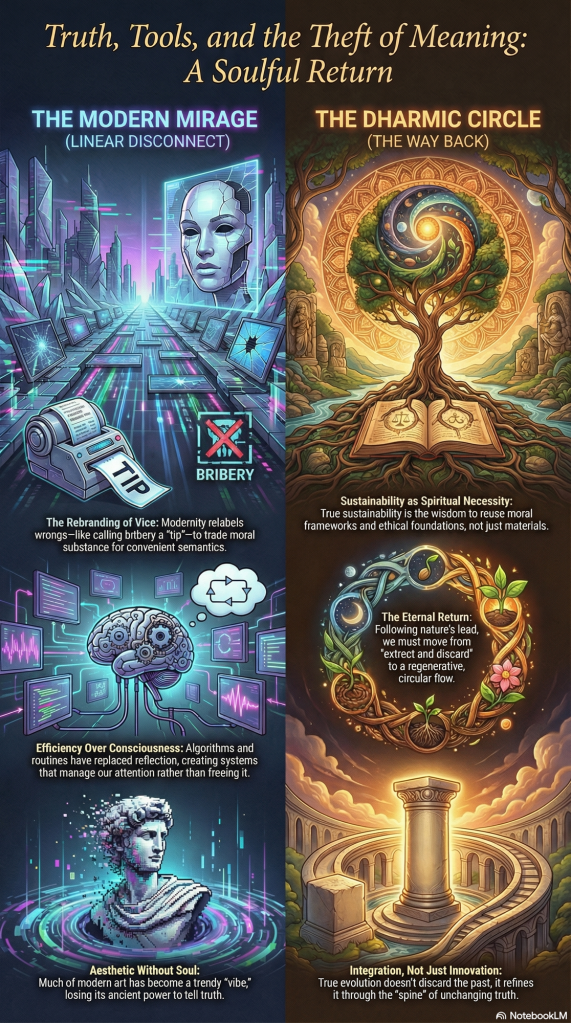
V. From Linear to Circular: Economy, Ecology, and the Eternal Return
Modern life is built on linearity—extract, use, discard.
But nature, Dharma, and even the soul follow a circular path.
The Circular Economy is not just a sustainability model. It reflects how life was always meant to flow:
- Waste becomes input.
- Endings feed beginnings.
- Value is preserved through regeneration, not replacement.
This mirrors the Circle of Life and the wisdom traditions across time:
Nothing truly ends—everything transforms.
A product reused wisely,
a life lived consciously,
a soul evolving slowly—
all follow the same sacred loop.
To reuse is not regression.
It is remembrance.
VI. Freedom, Change, and the Forgotten Framework
Change is not the enemy. Freedom is not the problem.
But directionless change is chaos in disguise.
In today’s world, we often chase the next big thing—not with purpose, but with greed, desire, or the pressure to impress.
We mistake motion for meaning. Speed for significance.
We confuse freedom with the license to discard whatever doesn’t gratify us instantly.
But true evolution doesn’t discard the past—it refines it.
True freedom doesn’t abandon values—it deepens them.
The problem is not that we change—but that we forget why we change, what guides the change, and who we become in the process.
What we need is not just innovation, but integration.
Not just rebellion, but remembrance.
Dharma—eternal, self-sustaining truth—is not a limit to freedom.
It is freedom’s spine, holding us upright when the world tempts us to bend.
VII. The Soul Behind the Systems
All systems, if not grounded in Dharma, will eventually serve themselves—not us.
We are drowning in tools, but starving for truth.
We are surrounded by content, but thirsty for conscience.
Progress without principles becomes noise without music.
Technology without transcendence becomes tyranny in slow motion.
We stopped seeing the soul in things.
We replace everything to suit our whims and fancies.
We never listened to soulful communications—in silence, in nature, in slow and sacred design.
But the soul remembers. It waits. It whispers.
VIII. The Reuse of the Soul: Dharma and Liberation
We talk of reuse as a physical concept. But in the deepest Dharmic sense, it is spiritual.
Life is cyclical.
This soul will be reused—again and again—until it qualifies for liberation.
Where, when, and how it returns depends on how we live now.
How we choose, how we treat others, how we uphold truth in a world of options.
In the grand design of Dharma, nothing is wasted—but everything must be earned.
Final Reflection: Choosing What is Worth Keeping
The modern world offers infinite tools, infinite paths, infinite noise.
But infinite choice without inner clarity is not freedom—it’s fragmentation.
Before we lose ourselves in filters, formats, and feature updates, we must ask:
What must remain?
Let us not just update life—let us upgrade its meaning.
Let us remember that in this world of rebrands and reinventions, the deepest revolution may be to simply live by the unchanging.
By truth.
By Dharma.
By the soul’s slow journey home.
 Arambhin
Leave a comment