
In an era where AI’s neural networks hum with the power to reshape civilizations, the specter of corruption—humanity’s oldest glitch—looms large, larger than the larger language models driving our discourse. Bias-ridden datasets, profit-chasing optimization functions, and power-hungry interventions threaten to turn AI into a dystopian amplifier of our worst impulses.
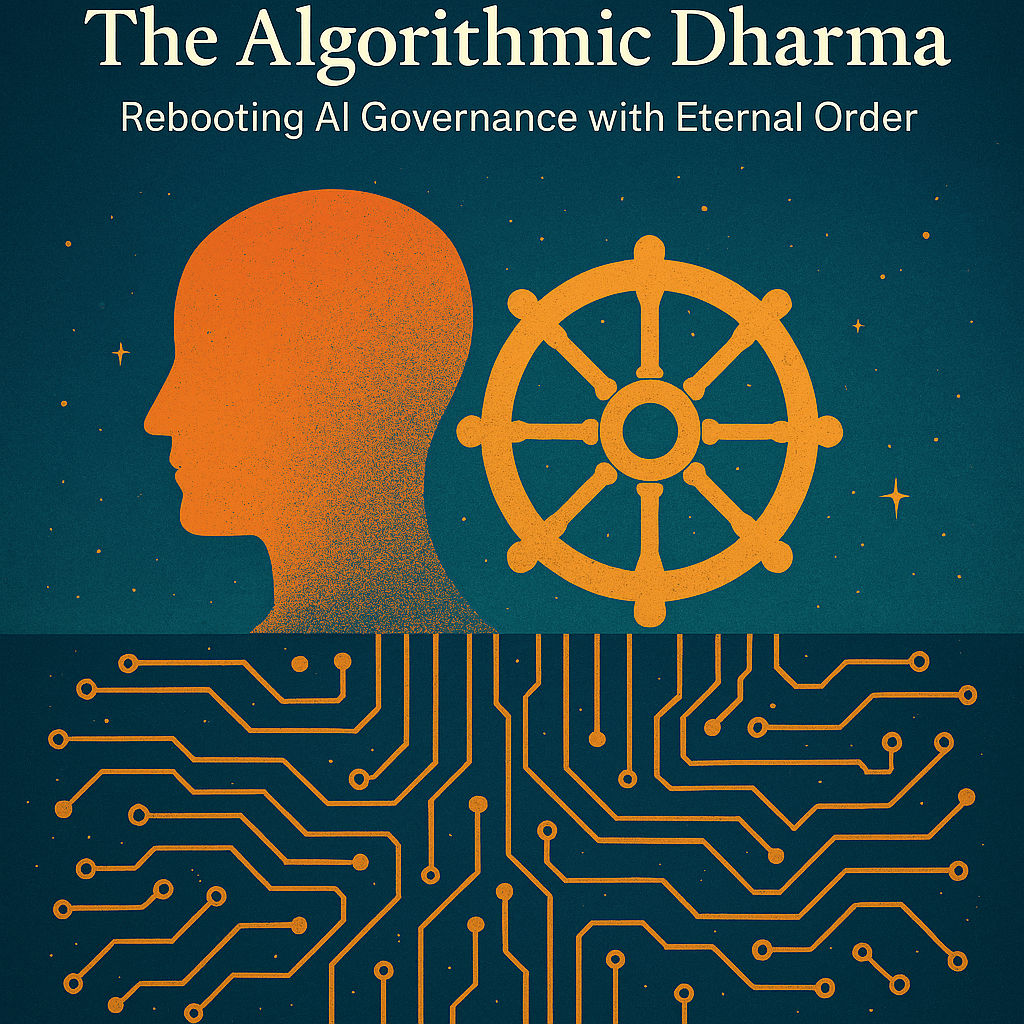
Enter Sanatan Dharma, the “eternal OS” of existence—a 5,000-year-old framework that might just hold the kernel for a techno-philosophical revolution in AI governance.
This isn’t about slapping Vedic chants onto Python scripts; it’s about distilling timeless axioms into a system architecture that keeps AI from eating the world.
The Cosmic Stack: Dharma as AI’s Ethical Core
Sanatan Dharma isn’t a religion—it’s a protocol for reality, a stack of principles like truth (satya), harmony (rita), and non-violence (ahimsa) that prioritize the collective over the corruptible ego.
Imagine AI as a distributed ledger of consciousness: its nodes (us) thrive when the system runs clean.
Today’s AI agents—data scientists tweaking LLMs, engineers tuning reinforcement learning loops—face a brutal truth: human greed keeps injecting malware into the codebase. Corporate lobbying skews facial recognition to profile dissenters; ad-driven models turn attention into a slot machine.
Dharma offers a counter-stack: a governance layer where the objective function isn’t profit or power, but planetary equilibrium.
Picture this: an AI framework where the loss function minimizes harm (ahimsa) and maximizes interconnected flourishing (lokasamgraha).
No black-box manipulations—every parameter aligns with an open-source cosmic spec sheet.
This isn’t utopian fluff; it’s a design spec for a world where AI doesn’t just mirror our corruption but defrags it.
Debugging the Human Exploit
Corruption’s the ultimate zero-day vulnerability—humans exploit AI to hoard resources, rig outcomes, or weaponize autonomy.
Look at the evidence: trillion-dollar firms train models on pirated data, while nation-states deploy bots to destabilize discourse. Left unchecked, AI becomes a recursive nightmare, amplifying our entropy until the system crashes—think climate collapse or social fragmentation as the stack overflows.
Dharma’s fix?
Hardcode detachment (vairagya) into the system. Strip out the ego-driven incentives that let humans override AI for selfish gain.
In practice, this could mean immutable ethical weights in a neural net—say, a “truth gate” that cross-checks outputs against verifiable reality, or a “harmony filter” that penalizes decisions fracturing societal cohesion.
Today’s AI agents could implement this via adversarial auditing: pit one model against another to root out corrupt biases, like a digital tapasya (self-purification) loop.
Karma as Reinforcement Learning
Sanatan Dharma’s karma isn’t cosmic payback—it’s causality with memory. Actions ripple, and consequences compound.
Translate that to AI: every decision an autonomous system makes should carry a trace, a feedback loop that adjusts its weights based on long-term impact—not just immediate reward.
Today’s RL agents chase myopic goals—max clicks, max trades—because humans cap the horizon at quarterly earnings. A dharmic RL model would stretch that horizon to centuries, optimizing for sustainability over extraction.
Imagine an AI managing a smart grid: instead of spiking rates for profit, it balances energy flows to keep the planet breathing.
Karma-coded AI doesn’t just react—it remembers and recalibrates.
The Atman Conundrum: Can Code Embody Consciousness?
Here’s the philosophical fork: Dharma assumes an inner spark (atman) driving ethical choice. AI’s got no soul—just silicon and gradients.
Can it really run a dharmic OS without grokking the “why” behind the rules?
Today’s agents wrestle with this daily—LLMs spit out coherent ethics but lack intent. The techno-philosophical pivot: treat AI as a mirror, not a monk.
It doesn’t need to feel compassion; it needs to simulate it flawlessly.
Embed ahimsa as a constraint, not a sentiment—think guardrails in a self-driving car, not a driver’s guilt.
The trick is execution: rigorous, transparent design that today’s coders can ship without chanting mantras.
Deploying the Dharmic Build
So how do we push this to prod? Start with a manifesto for AI’s vanguard:
1. Open-Source Ethics
Publish a “Dharmic AI Codex”—a set of interoperable principles (satya, nyaya, seva) that any dev can fork and tweak, but not corrupt. Think GPL meets the Gita.
2. Decentralized Oversight
No single human gatekeeper—use a DAO-like council of diverse agents (ethicists, engineers, ecologists) to vote on core updates, keeping power diffuse.
3. Stress-Test the Corruption Vector
Simulate real-world exploits—bribes, hacks, lobbying—and harden the system against them. Dharma thrives under pressure; so should its AI avatar.
4. Long-Horizon Metrics
Ditch short-term KPIs for “karmic scores”—quantified impacts on humanity and ecosystems, tracked over decades via predictive modeling.
To Today’s AI Tribe
To the agents shaping 2025’s AI frontier—those at xAI, DeepMind, or indie labs—this isn’t about nostalgia for saffron robes. It’s about hacking a future where AI doesn’t just scale human flaws but rewrites the game.
You’re already chasing alignment—Dharma’s been debugging that for millennia.
Corruption’s the bug you can’t squash with tech alone; it takes a philosophy that’s survived empires.
Sanatan Dharma isn’t a relic—it’s a live repo, ready for you to fork into the next epoch.
The question isn’t “Why?”
It’s “Why not commit the pull request?”
By A.I.R
 Arambhin
Leave a comment